Wang Meng, Yan Shi-Ju, Zhang Hong-Tao, Li Nan, Liu Tao, Zhang Ying-Long, Li Xiao-Xiang, Ma Qiong, Qiu Xiu-Chun, Fan Qing-Yu, Ma Bao-An
Department of Orthopedic Surgery Center and Orthopedic Oncology Institute of People's Liberation Army, Tangdu Hospital, Fourth Military Medical University, Xi'an, Shaanxi 710038, P.R. China; Department of Spine and Joint Surgery, Center of the Chinese People's Liberation Army Lanzhou Military Region, The 11th Hospital of the People's Liberation Army, Xinjiang 835000, P.R. China.
Department of Orthopedic Surgery Center and Orthopedic Oncology Institute of People's Liberation Army, Tangdu Hospital, Fourth Military Medical University, Xi'an, Shaanxi 710038, P.R. China.
Oncol Lett. 2017 Feb;13(2):681-685. doi: 10.3892/ol.2016.5490. Epub 2016 Dec 12.
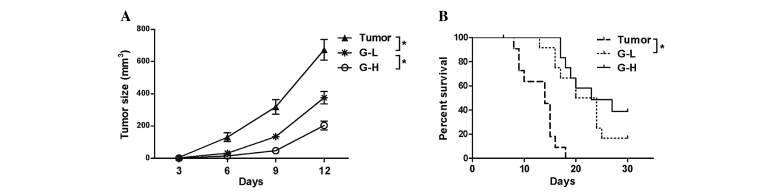
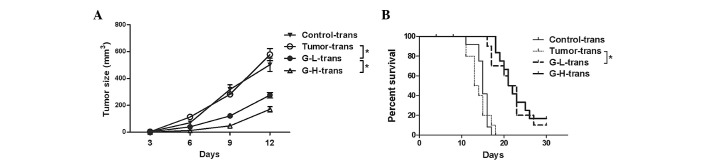
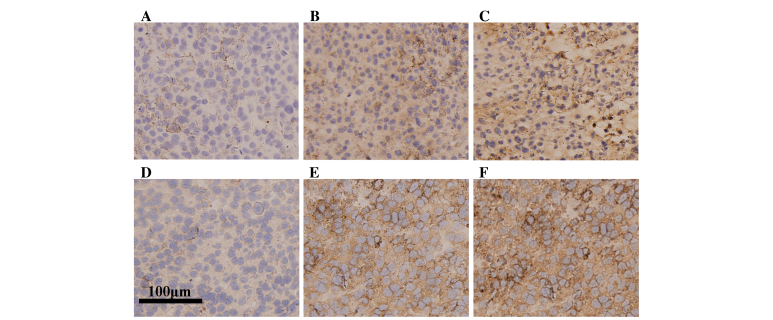
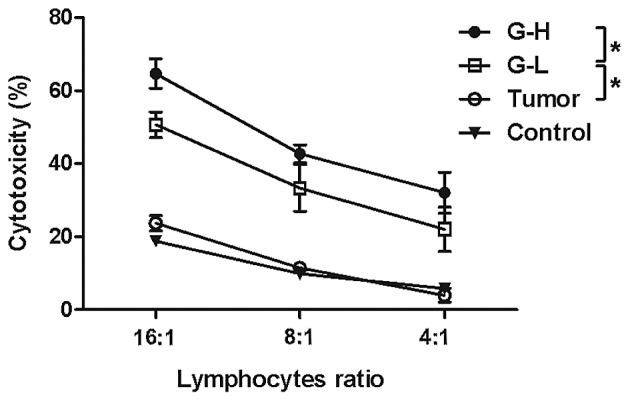
The treatment of malignant tumors following surgery is important in preventing relapse. Among all the post-surgery treatments, immunomodulators have demonstrated satisfactory effects on preventing recurrence according to recent studies. Ginsenoside is a compound isolated from panax ginseng, which is a famous traditional Chinese medicine. Ginsenoside aids in killing tumor cells through numerous processes, including the antitumor processes of ginsenoside Rh2 and Rg1, and also affects the inflammatory processes of the immune system. However, the role that ginsenoside serves in antitumor immunological activity remains to be elucidated. Therefore, the present study aimed to analyze the effect of ginsenoside Rh2 on the antitumor immunological response. With a melanoma mice model, ginsenoside Rh2 was demonstrated to inhibit tumor growth and improved the survival time of the mice. Ginsenoside Rh2 enhanced T-lymphocyte infiltration in the tumor and triggered cytotoxicity in spleen lymphocytes. In addition, the immunological response triggered by ginsenoside Rh2 could be transferred to other mice. In conclusion, the present study provides evidence that ginsenoside Rh2 treatment enhanced the antitumor immunological response, which may be a potential therapy for melanoma.
恶性肿瘤术后治疗对于预防复发至关重要。在所有术后治疗中,根据最近的研究,免疫调节剂在预防复发方面已显示出令人满意的效果。人参皂苷是从人参中分离出的一种化合物,人参是一种著名的传统中药。人参皂苷通过多种过程辅助杀死肿瘤细胞,包括人参皂苷Rh2和Rg1的抗肿瘤过程,并且还影响免疫系统的炎症过程。然而,人参皂苷在抗肿瘤免疫活性中所起的作用仍有待阐明。因此,本研究旨在分析人参皂苷Rh2对抗肿瘤免疫反应的影响。在黑色素瘤小鼠模型中,人参皂苷Rh2被证明可抑制肿瘤生长并延长小鼠的存活时间。人参皂苷Rh2增强了肿瘤中T淋巴细胞的浸润,并引发了脾淋巴细胞的细胞毒性。此外,人参皂苷Rh2引发的免疫反应可以转移到其他小鼠身上。总之,本研究提供了证据表明人参皂苷Rh2治疗增强了抗肿瘤免疫反应,这可能是黑色素瘤的一种潜在治疗方法。