
随着时序衰老,静止和非静止细胞中出现分化的细胞质颗粒形成。
Differentiated cytoplasmic granule formation in quiescent and non-quiescent cells upon chronological aging.
作者信息
Lee Hsin-Yi, Cheng Kuo-Yu, Chao Jung-Chi, Leu Jun-Yi
机构信息
Molecular and Cell Biology, Taiwan International Graduate Program, Graduate Institute of Life Sciences, National Defense Medical Center and Academia Sinica, Taipei, Taiwan. ; Institute of Molecular Biology, Academia Sinica, Taipei, Taiwan.
Department of Life Sciences and Institute of Genome Sciences, National Yang-Ming University, Taipei, Taiwan. ; Institute of Molecular Biology, Academia Sinica, Taipei, Taiwan.
出版信息
Microb Cell. 2016 Mar 3;3(3):109-119. doi: 10.15698/mic2016.03.484.
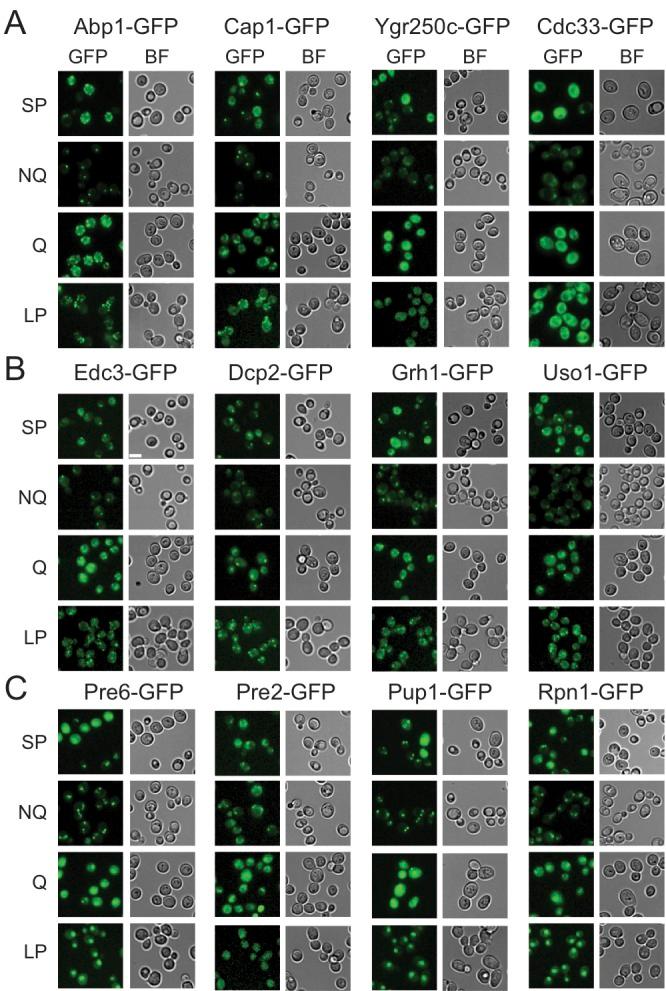
Stationary phase cultures represent a complicated cell population comprising at least two different cell types, quiescent (Q) and non-quiescent (NQ) cells. Q and NQ cells have different lifespans and cell physiologies. However, less is known about the organization of cytosolic protein structures in these two cell types. In this study, we examined Q and NQ cells for the formation of several stationary phase-prevalent granule structures including actin bodies, proteasome storage granules, stress granules, P-bodies, the compartment for unconventional protein secretion (CUPS), and Hsp42-associated stationary phase granules (Hsp42-SPGs). Most of these structures preferentially form in NQ cells, except for Hsp42-SPGs, which are enriched in Q cells. When nutrients are provided, NQ cells enter mitosis less efficiently than Q cells, likely due to the time requirement for reorganizing some granule structures. We observed that heat shock-induced misfolded proteins often colocalize to Hsp42-SPGs, and Q cells clear these protein aggregates more efficiently, suggesting that Hsp42-SPGs may play an important role in the stress resistance of Q cells. Finally, we show that the cell fate of NQ cells is largely irreversible even if they are allowed to reenter mitosis. Our results reveal that the formation of different granule structures may represent the early stage of cell type differentiation in yeast stationary phase cultures.
稳定期培养物代表一个复杂的细胞群体,至少包含两种不同的细胞类型,即静止(Q)细胞和非静止(NQ)细胞。Q细胞和NQ细胞具有不同的寿命和细胞生理学特性。然而,关于这两种细胞类型中胞质蛋白结构的组织情况,我们了解得较少。在本研究中,我们检测了Q细胞和NQ细胞中几种稳定期普遍存在的颗粒结构的形成,包括肌动蛋白体、蛋白酶体储存颗粒、应激颗粒、P小体、非常规蛋白质分泌区室(CUPS)以及与热休克蛋白42相关的稳定期颗粒(Hsp42-SPGs)。除了在Q细胞中富集的Hsp42-SPGs外,这些结构大多优先在NQ细胞中形成。当提供营养物质时,NQ细胞进入有丝分裂的效率低于Q细胞,这可能是由于重新组织某些颗粒结构需要时间。我们观察到热休克诱导的错误折叠蛋白常常与Hsp42-SPGs共定位,并且Q细胞能更有效地清除这些蛋白质聚集体,这表明Hsp42-SPGs可能在Q细胞的应激抗性中发挥重要作用。最后,我们表明即使允许NQ细胞重新进入有丝分裂,其细胞命运在很大程度上也是不可逆的。我们的结果揭示,不同颗粒结构的形成可能代表酵母稳定期培养物中细胞类型分化的早期阶段。



 Zotero 插件