Parhizgar Arezoo Rafiee, Tahghighi Azar
Malaria and Vector Research Group (MVRG), Biotechnology Research Center (BRC), Pasteur Institute of Iran, Tehran, Iran; Department of Medicinal Chemistry, Pharmaceutical Sciences Branch, Islamic Azad University, Tehran, Iran.
Malaria and Vector Research Group (MVRG), Biotechnology Research Center (BRC), Pasteur Institute of Iran, Tehran, Iran.
Iran J Med Sci. 2017 Mar;42(2):115-128.
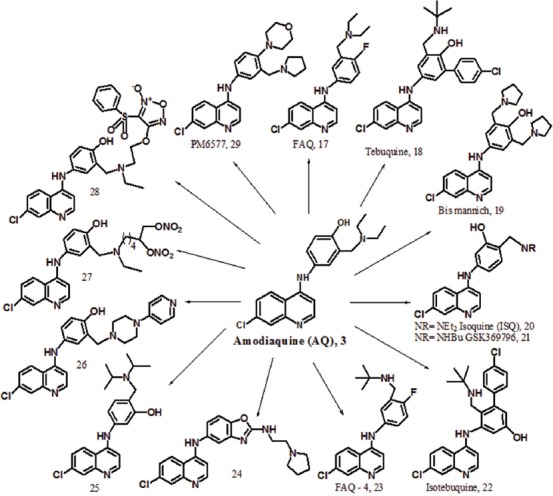
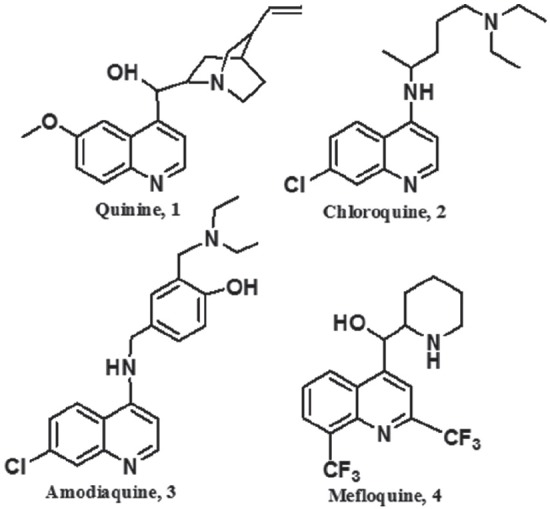
Antimalarial drugs with the 4-aminoquinoline scaffold such as the important drugs, chloroquine (CQ) and amodiaquine (AQ), have been used to prevent and treat malaria for many years. The importance of these drugs is related to their simple usage, high efficacy, affordability, and cost-effectiveness of their synthesis. In recent years, with the spread of parasite resistance to CQ and cross-resistance to its other analogues have decreased their consumption in many geographical areas. On the other hand, AQ is an effective antimalarial drug which its usage has been restricted due to hepatic and hematological toxicities. The significance of the quinoline ring at quinoline-based antimalarial drugs has prompted research centers and pharmaceutical companies to focus on the design and synthesis of new analogues of these drugs, especially CQ and AQ analogues. Accordingly, various derivatives have been synthesized and evaluated and against the resistant strains of the malaria parasite to solve the problem of drug resistance. Also, the pharmacokinetic properties of these compounds have been evaluated to augment their efficacy and diminish their toxicity. Some of these analogues are currently in clinical and preclinical development. Consequently, the recent researches showed yet 4-aminoquinoline scaffold is active moiety in new compounds with antiplasmodial activity. Hence, the aim of this review article is to introduce of the novel synthetic analogues of CQ and AQ, which may constitute the next generation of antimalarial drugs with the 4-aminoquinoline scaffold.
具有4-氨基喹啉骨架的抗疟药物,如重要药物氯喹(CQ)和阿莫地喹(AQ),多年来一直用于预防和治疗疟疾。这些药物的重要性与其使用简便、疗效高、价格可承受以及合成的成本效益有关。近年来,随着疟原虫对CQ的耐药性传播以及对其他类似物的交叉耐药性,它们在许多地理区域的消费量有所下降。另一方面,AQ是一种有效的抗疟药物,但其使用因肝毒性和血液学毒性而受到限制。喹啉类抗疟药物中喹啉环的重要性促使研究中心和制药公司专注于这些药物新类似物的设计和合成,尤其是CQ和AQ类似物。因此,已经合成并评估了各种衍生物,以对抗疟原虫的耐药菌株,解决耐药性问题。此外,还评估了这些化合物的药代动力学性质,以提高其疗效并降低其毒性。其中一些类似物目前正处于临床和临床前开发阶段。因此,最近的研究表明,4-氨基喹啉骨架仍然是具有抗疟活性的新化合物中的活性部分。因此,这篇综述文章的目的是介绍CQ和AQ的新型合成类似物,它们可能构成下一代具有4-氨基喹啉骨架的抗疟药物。