Wang Tao, Hu Peng, Li Bo, Zhang Jun-Peng, Cheng Yu-Feng, Liang Ye-Min
Department of Radiotherapy, Qilu Hospital of Shandong University, Jinan, People's Republic of China.
Onco Targets Ther. 2017 Mar 23;10:1809-1819. doi: 10.2147/OTT.S122803. eCollection 2017.
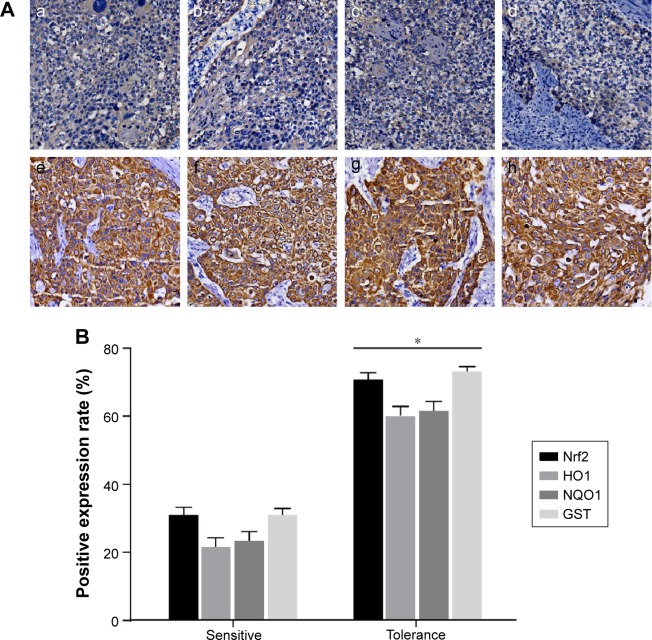
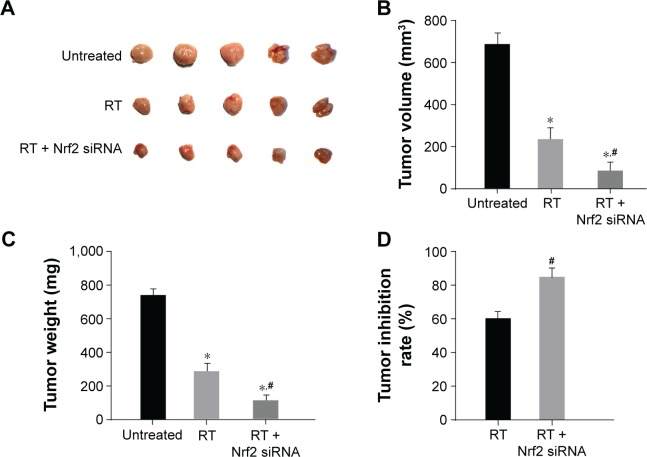
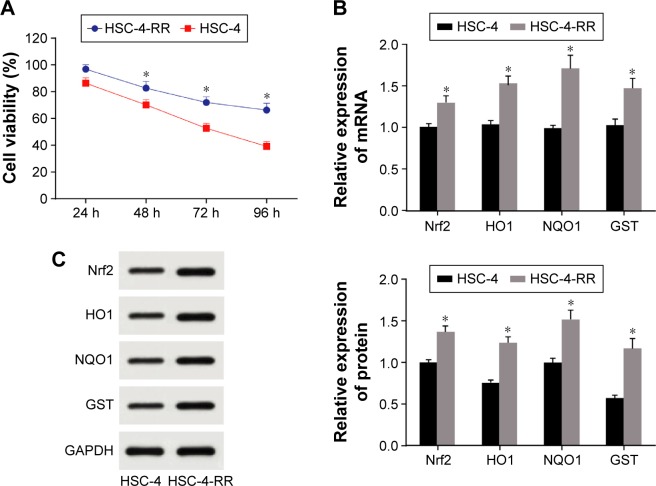
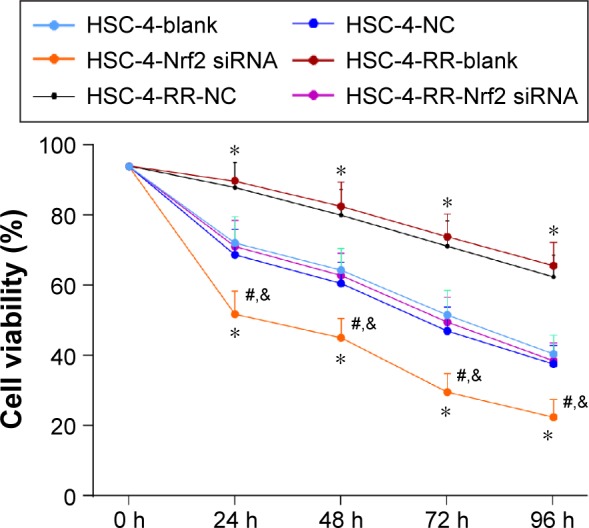
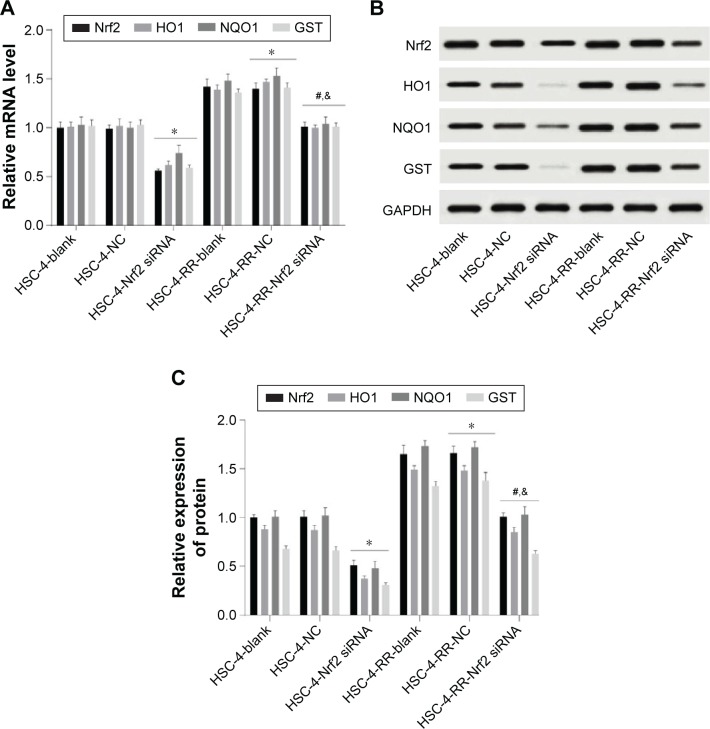
We aimed to investigate the relationship between the nuclear factor erythroid 2-related factor 2 (Nrf2) signaling pathway and the radiation tolerance of patients with head and neck squamous cell carcinoma (HNSCC). From January 2015 to January 2016, 117 patients with HNSCC were enrolled in our study and assigned into the sensitive and tolerance groups based on curative effect. Immunohistochemistry (IHC) was conducted to measure protein expressions of Nrf2, heme oxygenase-1 (HO1), NADPH quinine oxidoreductase 1 (NQO1) and glutathione -transferase (GST). Human squamous cell carcinoma cell line, HSC-4, was induced by radiation to construct the HSC-4-radiation resistance (RR) cell line. HSC-4 and HSC-4-RR were also assigned into the blank, negative control (NC) and siRNA groups. Cell Counting Kit-8 (CCK-8), quantitative real-time polymerase chain reaction (qRT-PCR) and Western blotting were employed to detect cell viability, mRNA expression and protein expression, respectively, of Nrf2, HO1, NQO1 and GST. A total of 40 nude mice were equally assigned into the untreated, siRNA, radiation therapy (RT) and RT + siRNA groups. Compared with the sensitive group, patients in the tolerance group had upregulated Nrf2, HO1, NQO1 and GST expressions. HSC-4-RR cell line had improved cell viability and higher protein and mRNA expressions of Nrf2, HO1, NQO1 and GST compared with HSC-4 cell line. Compared with the HSC-4-NC and HSC-4-blank groups, the HSC-4- siRNA group had downregulated cell viability. Compared with the HSC-4-RR-NC and HSC-4-RR-blank groups, the HSC-4-RR- siRNA group had lower cell viability. However, the HSC-4-RR- siRNA group had elevated cell viability than the HSC-4- siRNA group. Tumor volume and tumor weight in the RT and RT + siRNA groups decreased evidently. The RT + siRNA group exhibited decreased tumor volume and tumor weight in comparison with the RT group. Our data demonstrated that downregulation of HO1, NQO1 and GST via inhibiting Nrf2 signaling pathway reduces the radiation tolerance of patients with HNSCC.
我们旨在研究核因子红细胞2相关因子2(Nrf2)信号通路与头颈部鳞状细胞癌(HNSCC)患者放射耐受性之间的关系。2015年1月至2016年1月,117例HNSCC患者纳入本研究,并根据疗效分为敏感组和耐受组。采用免疫组织化学(IHC)检测Nrf2、血红素加氧酶-1(HO1)、NADPH醌氧化还原酶1(NQO1)和谷胱甘肽-S-转移酶(GST)的蛋白表达。用辐射诱导人鳞状细胞癌细胞系HSC-4构建HSC-4辐射抗性(RR)细胞系。HSC-4和HSC-4-RR也分为空白组、阴性对照组(NC)和小干扰RNA(siRNA)组。分别采用细胞计数试剂盒-8(CCK-8)、定量实时聚合酶链反应(qRT-PCR)和蛋白质印迹法检测Nrf2、HO1、NQO1和GST的细胞活力、mRNA表达和蛋白表达。40只裸鼠平均分为未治疗组、siRNA组、放射治疗(RT)组和RT + siRNA组。与敏感组相比,耐受组患者的Nrf2、HO1、NQO1和GST表达上调。与HSC-4细胞系相比,HSC-4-RR细胞系的细胞活力提高,Nrf2、HO1、NQO1和GST的蛋白和mRNA表达更高。与HSC-4-NC组和HSC-4-空白组相比,HSC-4-siRNA组细胞活力下调。与HSC-4-RR-NC组和HSC-4-RR-空白组相比,HSC-4-RR-siRNA组细胞活力更低。然而,HSC-4-RR-siRNA组的细胞活力高于HSC-4-siRNA组。RT组和RT + siRNA组的肿瘤体积和肿瘤重量明显减小。与RT组相比,RT + siRNA组的肿瘤体积和肿瘤重量减小。我们的数据表明,通过抑制Nrf2信号通路下调HO1、NQO1和GST可降低HNSCC患者的放射耐受性。