Wang Jiaojiao, Ma Jian James, Liu Jiaqi, Zeng Daniel Dajun, Song Cynthia, Cao Zhidong
The State Key Laboratory of Management and Control for Complex Systems, Institute of Automation, Chinese Academy of Sciences, Beijing, China.
College of Business, University of Colorado, Colorado Springs, CO, USA.
Int J Med Sci. 2017 Feb 23;14(3):201-212. doi: 10.7150/ijms.16974. eCollection 2017.
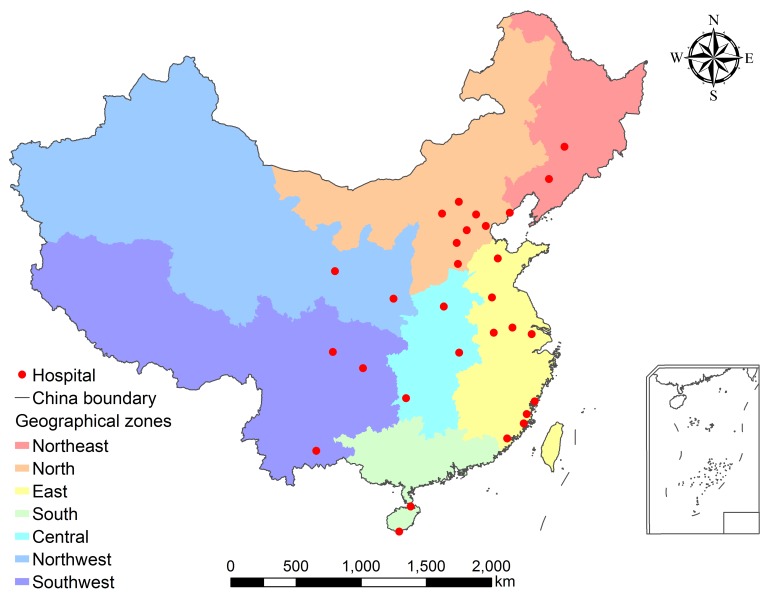
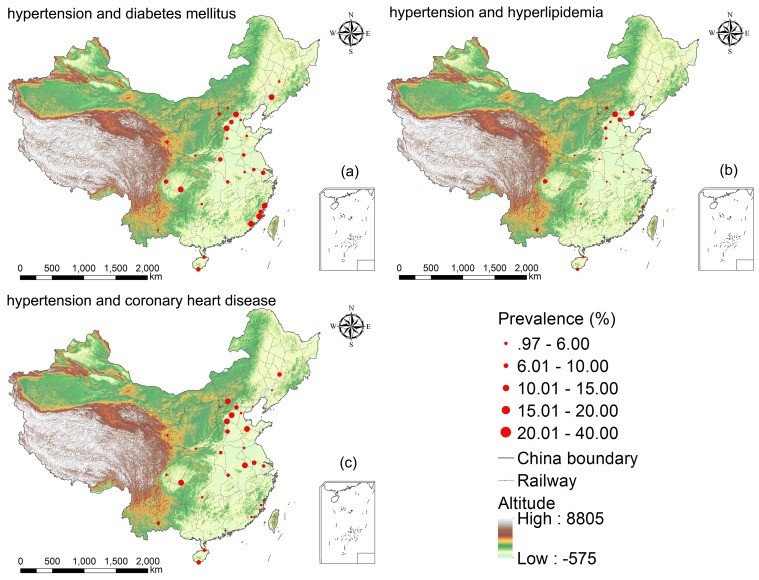
Hypertension is a severe threat to human being's health due to its association with many comorbidities. Many research works have explored hypertension's prevalence and treatment. However, few considered impact of patient's socioeconomic status and geographical disparities. We intended to fulfill that research gap by analyzing the association of the prevalence of hypertension and three important comorbidities with various socioeconomic and geographical factors. We also investigated the prevalence of those comorbidities if the patient has been diagnosed with hypertension. We obtained a large collection of medical records from 29 hospitals across China. We utilized Bayes' Theorem, Pearson's chi-squared test, univariate and multivariate regression methods and geographical detector methods to analyze the association between disease prevalence and risk factors. We first attempted to quantified and analyzed the spatial stratified heterogeneity of the prevalence of hypertension comorbidities by q-statistic using geographical detector methods. We found that the demographic and socioeconomic factors, and hospital class and geographical factors would have an enhanced interactive influence on the prevalence of hypertension comorbidities. Our findings can be leveraged by public health policy makers to allocate medical resources more effectively. Healthcare practitioners can also be benefited by our analysis to offer customized disease prevention for populations with different socioeconomic status.
高血压因其与许多合并症相关联,对人类健康构成严重威胁。许多研究工作都探讨了高血压的患病率及治疗方法。然而,很少有研究考虑患者社会经济地位和地域差异的影响。我们旨在通过分析高血压患病率及三种重要合并症与各种社会经济和地理因素之间的关联来填补这一研究空白。我们还调查了已被诊断患有高血压的患者中这些合并症的患病率。我们从中国各地的29家医院收集了大量病历。我们运用贝叶斯定理、皮尔逊卡方检验、单变量和多变量回归方法以及地理探测器方法来分析疾病患病率与风险因素之间的关联。我们首先尝试使用地理探测器方法通过q统计量对高血压合并症患病率的空间分层异质性进行量化和分析。我们发现人口统计学和社会经济因素、医院等级和地理因素对高血压合并症患病率会产生增强的交互影响。我们的研究结果可供公共卫生政策制定者更有效地分配医疗资源。医疗从业者也可从我们的分析中受益,为不同社会经济地位的人群提供定制化的疾病预防措施。