Chen Limin, Liu Shuyuan, Xu Fen, Kong Yunyuan, Wan Lagen, Zhang Yonglu, Zhang Zhanglin
Department of Clinical laboratory, The First Affiliated Hospital of Nanchang University, Nanchang, Jiangxi 330006, China;; Center for Experimental Medicine, The First Affiliated Hospital of Nanchang University, Nanchang, Jiangxi 330006, China.
Department of Clinical laboratory, The First Affiliated Hospital of Nanchang University, Nanchang, Jiangxi 330006, China.
Int J Biol Sci. 2017 Feb 25;13(3):383-390. doi: 10.7150/ijbs.17236. eCollection 2017.
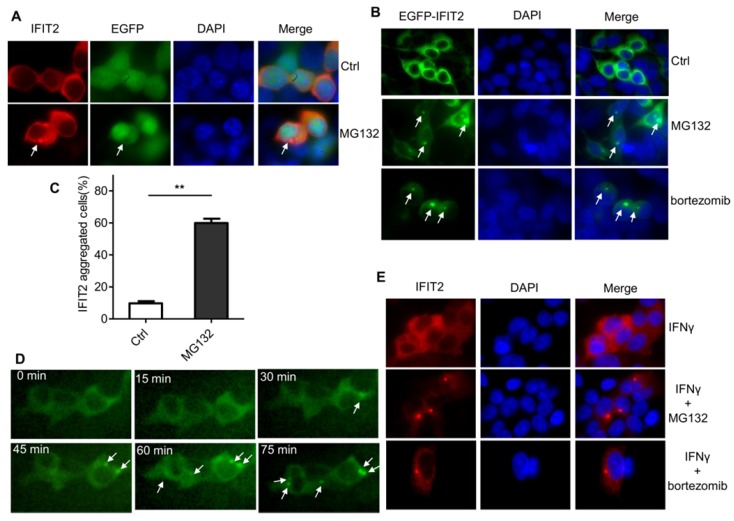
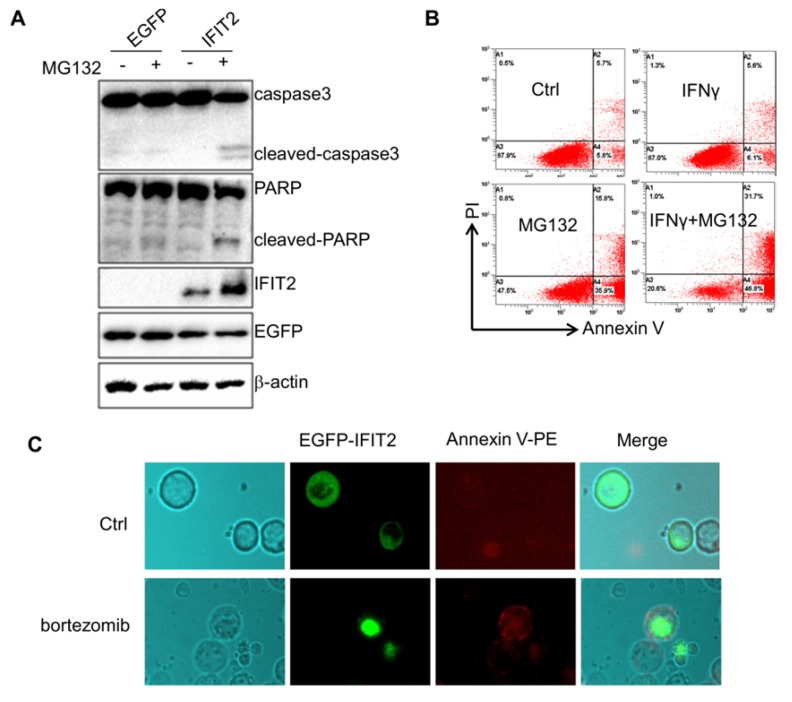
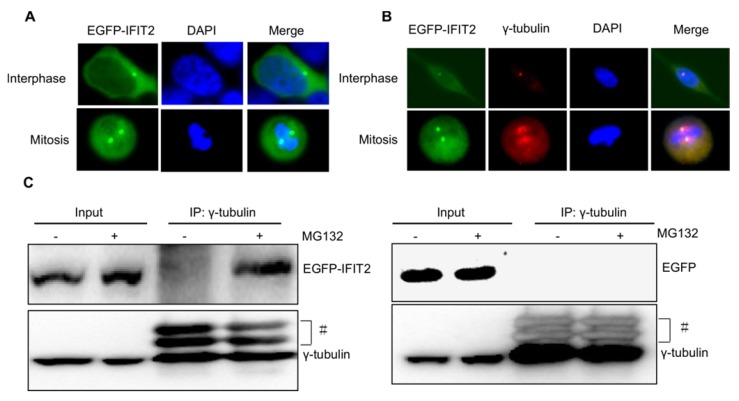
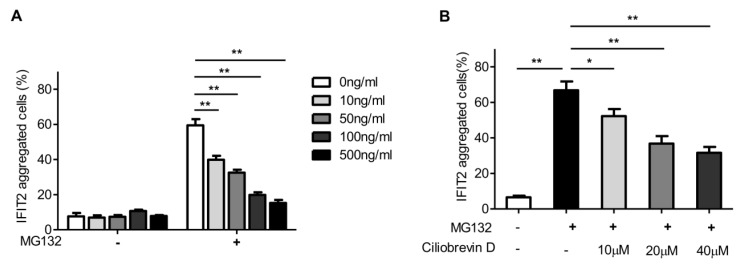
IFN-induced protein with tetratricopeptide repeats 2 (), one of the most highly responsive interferon-stimulated genes, inhibits the proliferation and migration of cancer cells and regulates viral replication. IFIT2 has been demonstrated to be a cytoskeleton-associated protein that becomes enriched in the mitotic spindle of cells. However, the molecular mechanisms by which IFIT2 executes biological functions are largely unclear. The findings of this study showed that inhibiting the activation of proteasome led to the enrichment of IFIT2 and induced the aggregation of IFIT2 protein in the centrosome. Microtubule inhibitor colchicine and dynein inhibitor ciliobrevin inhibited the proteasome inhibitor-induced aggregation of IFIT2 protein in the centrosome. Intriguingly, IFIT2 and proteasome inhibitor worked together to induce the apoptosis of cancer cells. The results of the present study revealed that the inhibition of proteasome activity blocked the degradation of IFIT2 and promoted the aggregation of IFIT2 in the centrosome, which in turn induced cell apoptosis. In short, IFIT2 may be a potential target for cancer therapeutics.
含四肽重复序列的干扰素诱导蛋白2(IFIT2)是对干扰素刺激反应最为强烈的基因之一,可抑制癌细胞的增殖和迁移,并调节病毒复制。IFIT2已被证明是一种与细胞骨架相关的蛋白,在细胞的有丝分裂纺锤体中富集。然而,IFIT2执行生物学功能的分子机制在很大程度上尚不清楚。本研究结果表明,抑制蛋白酶体的激活会导致IFIT2富集,并诱导IFIT2蛋白在中心体聚集。微管抑制剂秋水仙碱和动力蛋白抑制剂西利布林可抑制蛋白酶体抑制剂诱导的IFIT2蛋白在中心体的聚集。有趣的是,IFIT2和蛋白酶体抑制剂共同作用可诱导癌细胞凋亡。本研究结果显示,蛋白酶体活性的抑制会阻断IFIT2的降解,并促进IFIT2在中心体聚集,进而诱导细胞凋亡。简而言之,IFIT2可能是癌症治疗的一个潜在靶点。