Department of Veterinary Clinical Sciences, Jockey Club College of Veterinary Medicine and Life Sciences, City University of Hong Kong, Kowloon, Hong Kong, China.
Centre for Animal Health and Welfare, Jockey Club College of Veterinary Medicine and Life Sciences, City University of Hong Kong, Kowloon, Hong Kong, China.
PeerJ. 2023 Aug 8;11:e15747. doi: 10.7717/peerj.15747. eCollection 2023.
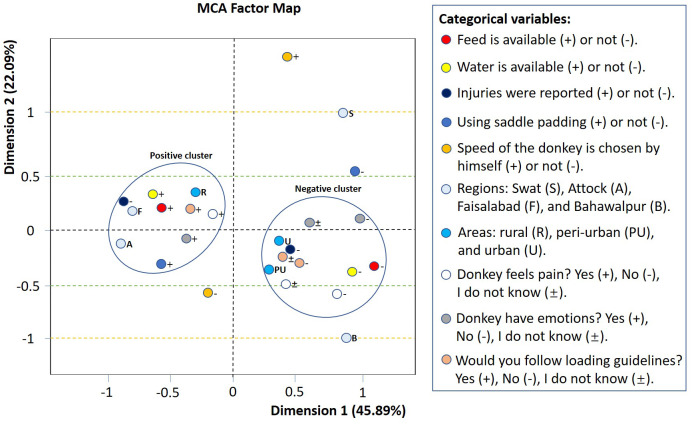
Working donkeys () support human living standards globally. However, there is little information on the effect of human perceptions of emotion and pain on the welfare of working donkeys. We interviewed donkey owners ( = 332) in Pakistan to determine the relationship between human perspectives on donkey sentience: emotions and the ability to feel pain, and the routine working practices that could impact donkey welfare. The majority of donkey owners used padding under the saddle ( = 211; 63.6%; 95% CI (58.3%-68.9%)) and provided access to food ( = 213; 64.2%; 95% CI (58.9%-69.3%)) and water ( = 195; 58.7%; 95% CI (53.4%-64.1%)) during the working day. Owners reported that at some point in their donkey's life, 65.3% (95% CI (60.2%-70.5%)) had load-associated injuries, of which 27.7% ( = 92; 95% CI (22.8%-32.5%)) were wounds, 20.5% ( = 68; 95% CI (16.1%-24.8%)) were lameness and 7.2% ( = 24; 95% CI 4.4%-10.0%) were back pain. In total, 81.3% (95% CI 77.1%-85.5%; = 270) of owners believed that their donkeys felt pain, and 70.2% (95% CI (65.2%-75.1%; = 233) of owners believed that their donkeys had emotions. Multiple correspondence analysis (MCA) was used to understand the relationship between owners' recognition of emotions and pain in donkeys and their working practices. The MCA factor map revealed two clusters, named positive and negative clusters. The positive cluster included owner's recognition of donkey pain and emotions, the availability of food and water, use of padding under the saddle, absence of injuries along with the willingness to follow loading guidelines. The negative cluster represented practices that did not benefit donkey welfare, such as using saddles without padding and a lack of food and water during work. The presence of injuries, owners not recognizing that donkeys feel pain and emotion along with an unwillingness to follow loading guidelines were also found in the negative cluster. We show that the owners who recognized sentience in their donkeys were more likely to use practices that are good for donkey welfare. The ability of owners to identify sentience in donkeys, along with their willingness to follow welfare guidelines, are important factors in improving the lives of working donkeys.
工作驴()支持全球人类的生活水平。然而,关于人类对情感和疼痛感知如何影响工作驴福利的信息却很少。我们采访了巴基斯坦的驴主人(=332),以确定人类对驴的感知能力的看法:情感和感受疼痛的能力,以及可能影响驴福利的常规工作实践之间的关系。大多数驴主人在鞍下使用衬垫(=211;63.6%;95%置信区间(58.3%-68.9%)),并在工作期间提供食物(=213;64.2%;95%置信区间(58.9%-69.3%))和水(=195;58.7%;95%置信区间(53.4%-64.1%))。主人报告说,在他们的驴的生命中的某个时刻,65.3%(95%置信区间(60.2%-70.5%))有与负载相关的损伤,其中 27.7%(=92;95%置信区间(22.8%-32.5%))是伤口,20.5%(=68;95%置信区间(16.1%-24.8%))是跛行,7.2%(=24;95%置信区间 4.4%-10.0%)是背痛。总的来说,81.3%(95%置信区间 77.1%-85.5%;=270)的主人认为他们的驴感到疼痛,70.2%(95%置信区间(65.2%-75.1%;=233)的主人认为他们的驴有情绪。多元对应分析(MCA)用于理解主人对驴的情感和疼痛的认知与其工作实践之间的关系。MCA 因子图显示了两个聚类,分别命名为积极聚类和消极聚类。积极聚类包括主人对驴疼痛和情绪的认知、食物和水的供应、鞍下使用衬垫、没有损伤以及愿意遵循负载指南。消极聚类代表对驴福利不利的做法,例如使用没有衬垫的马鞍,以及在工作期间没有食物和水。在消极聚类中还发现了受伤、主人不承认驴感到疼痛和情绪以及不愿意遵循负载指南等情况。我们表明,那些认识到驴有感知能力的主人更有可能采取有利于驴福利的做法。主人识别驴的感知能力,以及他们愿意遵循福利指南,是改善工作驴生活的重要因素。