Nakano Arihiro, Hirooka Yoshiki, Yamamura Takeshi, Watanabe Osamu, Nakamura Masanao, Funasaka Kohei, Ohno Eizaburo, Kawashima Hiroki, Miyahara Ryoji, Goto Hidemi
Department of Gastroenterology and Hepatology, Nagoya University Graduate School of Medicine, Showa-ku, Nagoya, Japan.
Department of Endoscopy, Nagoya University Hospital, Showa-ku, Nagoya, Japan.
Endosc Int Open. 2017 Apr;5(4):E224-E231. doi: 10.1055/s-0043-102400.
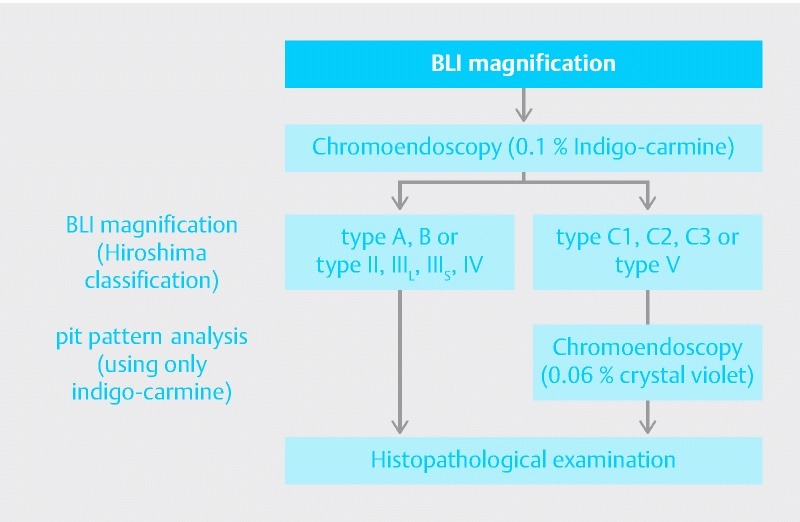
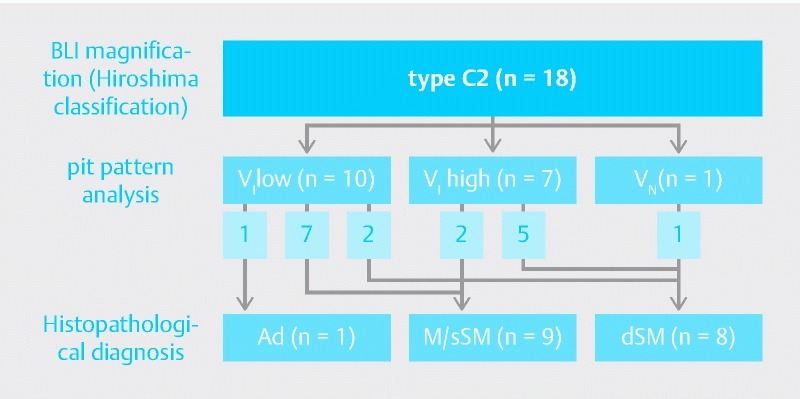
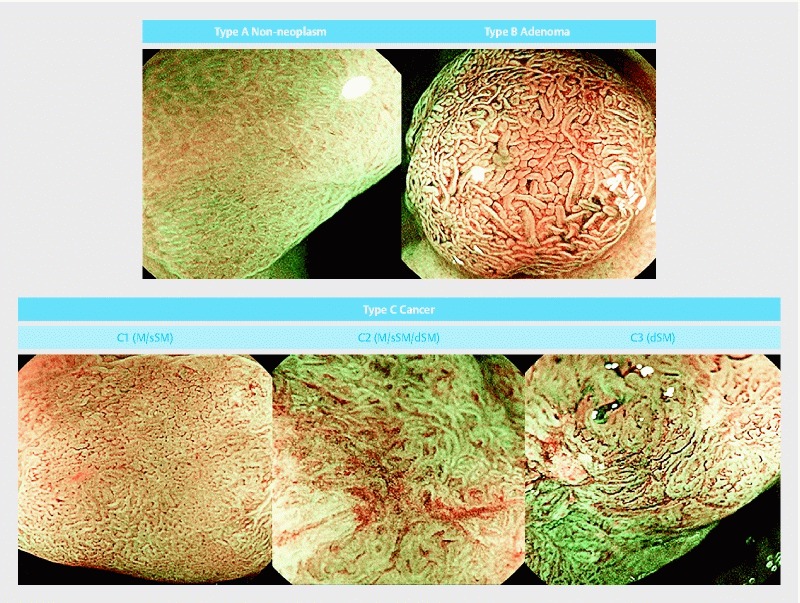
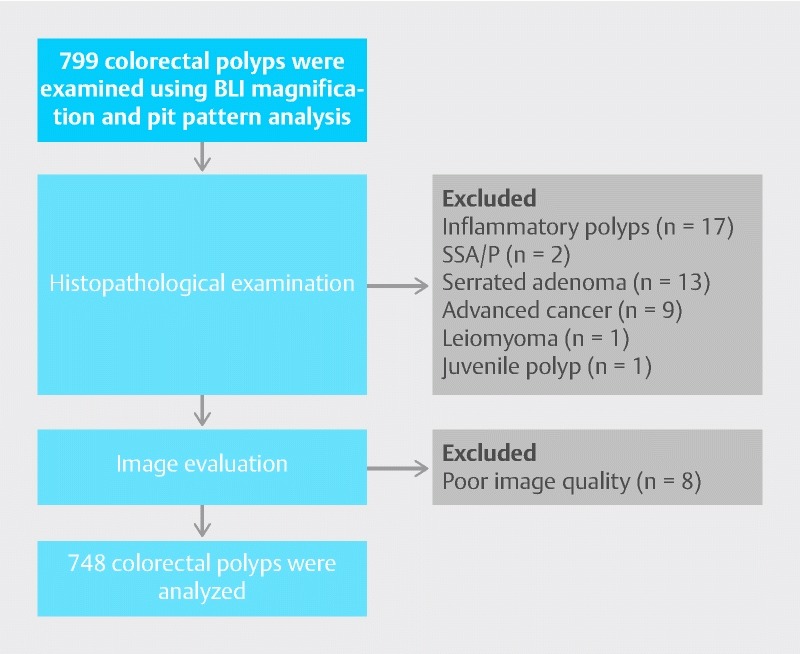
There have been few evaluations of the diagnostic ability of new narrow band light observation blue laser imaging (BLI). The present prospective study compared the diagnostic ability of BLI magnification and pit pattern analysis for colorectal polyps. We collected lesions prospectively, and the analysis of images was made by two endoscopists, retrospectively. A total of 799 colorectal polyps were examined by BLI magnification and pit pattern analysis at Nagoya University Hospital. The Hiroshima narrow-band imaging classification was used for BLI. Differentiation of neoplastic from non-neoplastic lesions and diagnosis of deeply invasive submucosal cancer (dSM) were compared between BLI magnification and pit pattern analysis. Type C2 in the Hiroshima classification was evaluated separately, because application of this category as an index of the depth of cancer invasion was considered difficult. We analyzed 748 colorectal polyps, excluding 51 polyps that were inflammatory polyps, sessile serrated adenoma/polyps, serrated adenomas, advanced colorectal cancers, or other lesions. The accuracy of differential diagnosis between neoplastic and non-neoplastic lesions was 98.4 % using BLI magnification and 98.7 % with pit pattern analysis. In addition, the diagnostic accuracy of BLI magnification and pit pattern analysis for dSM for cancer was 89.5 % and 92.1 %, respectively. When type C2 lesions were excluded, the diagnostic accuracy of BLI for dSM was 95.9 %. The 18 type C2 lesions comprised 1 adenoma, 9 intramucosal or slightly invasive submucosal cancers, and 8 dSM. Pit pattern analysis allowed accurate diagnosis of the depth of invasion in 13 lesions (72.2 %). Most colorectal polyps could be diagnosed accurately by BLI magnification without pit pattern analysis, but we should add pit pattern analysis for type C2 lesions in the Hiroshima classification.
关于新型窄带光观察蓝色激光成像(BLI)诊断能力的评估较少。本前瞻性研究比较了BLI放大内镜和pit模式分析对大肠息肉的诊断能力。我们前瞻性地收集病变,并由两名内镜医师对图像进行回顾性分析。名古屋大学医院对799例大肠息肉进行了BLI放大内镜和pit模式分析检查。BLI采用广岛窄带成像分类。比较了BLI放大内镜和pit模式分析在鉴别肿瘤性病变与非肿瘤性病变以及诊断深层浸润性黏膜下癌(dSM)方面的差异。广岛分类中的C2型单独进行评估,因为将该类别用作癌症浸润深度的指标被认为存在困难。我们分析了748例大肠息肉,排除了51例炎性息肉、无蒂锯齿状腺瘤/息肉、锯齿状腺瘤、进展期大肠癌或其他病变。使用BLI放大内镜鉴别肿瘤性病变与非肿瘤性病变的诊断准确率为98.4%,pit模式分析为98.7%。此外,BLI放大内镜和pit模式分析对dSM癌的诊断准确率分别为89.5%和92.1%。排除C2型病变后,BLI对dSM的诊断准确率为95.9%。18例C2型病变包括1例腺瘤、9例黏膜内或轻度浸润性黏膜下癌和8例dSM。pit模式分析能够准确诊断13例病变(72.2%)的浸润深度。大多数大肠息肉无需pit模式分析仅通过BLI放大内镜就能准确诊断,但对于广岛分类中的C2型病变,我们应增加pit模式分析。