
谷氨酸脱羧酶和胰岛抗原 2 抗体谱在成年发病的糖尿病患者中的特征:新加坡和德国混合种族人群的比较。
Glutamic acid decarboxylase and islet antigen 2 antibody profiles in people with adult-onset diabetes mellitus: a comparison between mixed ethnic populations in Singapore and Germany.
机构信息
Lee Kong Chian School of Medicine, Nanyang Technological University Singapore, Singapore.
Clinical Research Unit, Diabetes Centre, Khoo Teck Puat Hospital, Singapore.
出版信息
Diabet Med. 2017 Aug;34(8):1145-1153. doi: 10.1111/dme.13358. Epub 2017 May 22.
AIM
To gain insight into the presence of islet cell autoimmunity in an ethnic Asian compared with a white European population.
METHODS
For this cross-sectional study we recruited people with adult-onset diabetes (age of diagnosis 20-60 years), at tertiary referral centres in Germany (n=1020) and Singapore (n=1088). Glutamic acid decarboxylase and islet antigen 2 antibodies were measured according to Islet Autoantibody Standardization Program protocols.
RESULTS
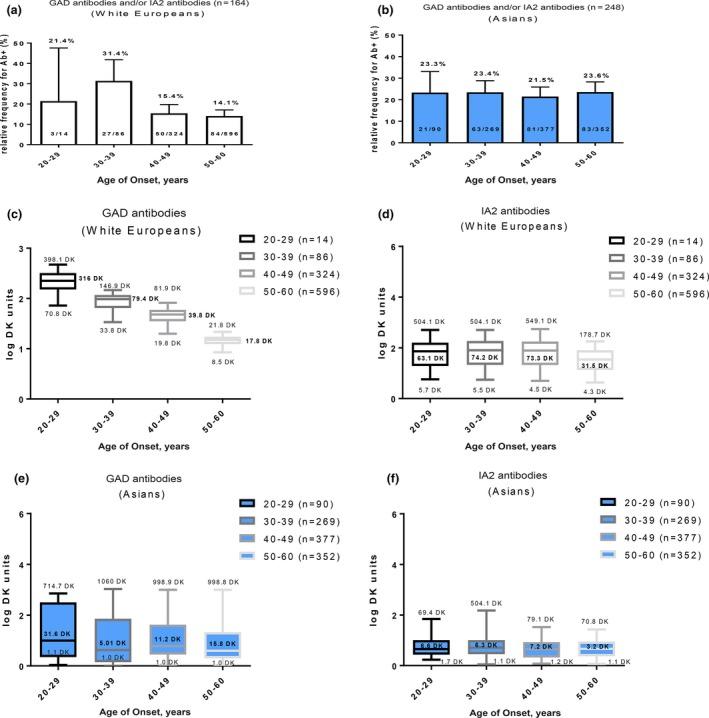
The prevalence of glutamic acid decarboxylase antibody positivity was 13.9% (95% CI 12.1-16.0; P<0.001) in the white European cohort compared with 6.8% (95% CI 5.5-8.4; P<0.001) in the Asian cohort. Glutamic acid decarboxylase antibody positivity was 11.4% (95% CI 7.7-16.6) in Indian, 6.0% (95% CI 3.6-9.9) in Malay and 5.8% (95% CI 4.3-7.7; P<0.001) in Chinese participants. In the white European participants, the prevalence of islet antigen 2 antibody positivity was 7.8% (95% CI 6.4-9.4) compared with 14.8% (95% CI 12.8-17.0; P<0.001) in the Asian cohort as a whole, and among the three ethnicities in the Asian cohort it was 12.4% (95% CI 8.6-17.7) in Indian, 16.8% (95% CI 12.6-22.2) in Malay and 15.7% (95% CI 13.2-18.6) in Chinese participants. Double antibody positivity was seen in 5.7% (95% CI 4.5-7.1) of white European participants compared with 1.6% (95% CI 1.0-2.5; P<0.01) of Asian participants. In the white European cohort, those who were glutamic acid decarboxylase autoantibody-positive had a lower BMI than those who were autoantibody-negative, but this trend was absent in the Asian cohort.
CONCLUSIONS
A marked prevalence of islet cell autoimmunity was observed in people with adult-onset diabetes. While glutamic acid decarboxylase antibodies were more frequent in the European cohort, islet antigen 2 antibody positivity was highest in the three ethnic groups in Singapore, suggesting ethnic-specific differences in antibody profiles.
目的
了解亚洲种族与白种欧洲人群中胰岛细胞自身免疫的存在情况。
方法
本横断面研究招募了在德国(n=1020)和新加坡(n=1088)三级转诊中心确诊为成年发病糖尿病(发病年龄 20-60 岁)的人群。根据胰岛自身抗体标准化计划方案检测谷氨酸脱羧酶和胰岛抗原 2 抗体。
结果
白种欧洲队列谷氨酸脱羧酶抗体阳性率为 13.9%(95%CI 12.1-16.0;P<0.001),而亚洲队列为 6.8%(95%CI 5.5-8.4;P<0.001)。谷氨酸脱羧酶抗体阳性率在印度人群中为 11.4%(95%CI 7.7-16.6),在马来人群中为 6.0%(95%CI 3.6-9.9),在华裔人群中为 5.8%(95%CI 4.3-7.7;P<0.001)。在白种欧洲人群中,胰岛抗原 2 抗体阳性率为 7.8%(95%CI 6.4-9.4),而整个亚洲队列为 14.8%(95%CI 12.8-17.0;P<0.001),在亚洲三个种族中,印度人为 12.4%(95%CI 8.6-17.7),马来人为 16.8%(95%CI 12.6-22.2),华裔人为 15.7%(95%CI 13.2-18.6)。白种欧洲人群中双抗体阳性率为 5.7%(95%CI 4.5-7.1),而亚洲人群中为 1.6%(95%CI 1.0-2.5;P<0.01)。在白种欧洲队列中,谷氨酸脱羧酶自身抗体阳性者的 BMI 低于自身抗体阴性者,但在亚洲队列中未观察到这种趋势。
结论
在成年发病糖尿病患者中观察到明显的胰岛细胞自身免疫流行。虽然谷氨酸脱羧酶抗体在欧洲队列中更为常见,但在新加坡的三个种族中,胰岛抗原 2 抗体阳性率最高,提示抗体谱存在种族特异性差异。

 Zotero 插件