Mayati Abdullah, Moreau Amélie, Le Vée Marc, Stieger Bruno, Denizot Claire, Parmentier Yannick, Fardel Olivier
Institut de Recherches en Santé, Environnement et Travail (IRSET), UMR INSERM U1085, Faculté de Pharmacie, 2 Avenue du Pr Léon Bernard, 35043 Rennes, France.
Centre de Pharmacocinétique, Technologie Servier, 25-27 Rue Eugène Vignat, 45000 Orléans, France.
Int J Mol Sci. 2017 Apr 4;18(4):764. doi: 10.3390/ijms18040764.
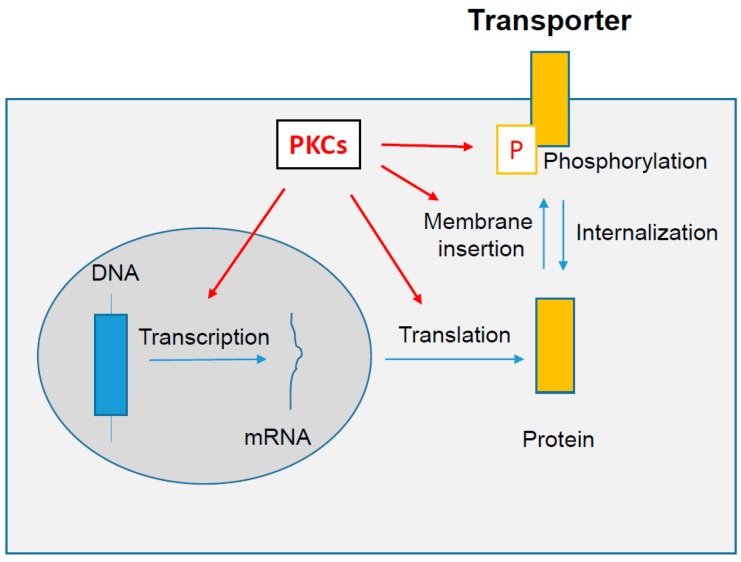
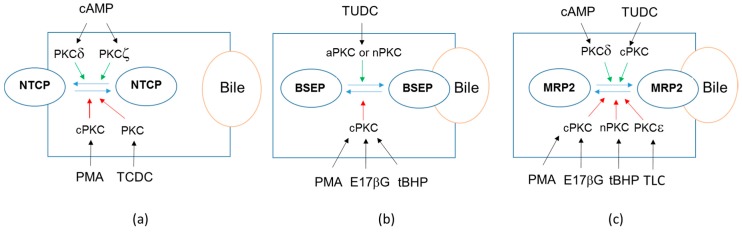
Drug transporters are now recognized as major actors in pharmacokinetics, involved notably in drug-drug interactions and drug adverse effects. Factors that govern their activity, localization and expression are therefore important to consider. In the present review, the implications of protein kinases C (PKCs) in transporter regulations are summarized and discussed. Both solute carrier (SLC) and ATP-binding cassette (ABC) drug transporters can be regulated by PKCs-related signaling pathways. PKCs thus target activity, membrane localization and/or expression level of major influx and efflux drug transporters, in various normal and pathological types of cells and tissues, often in a PKC isoform-specific manner. PKCs are notably implicated in membrane insertion of bile acid transporters in liver and, in this way, are thought to contribute to cholestatic or choleretic effects of endogenous compounds or drugs. The exact clinical relevance of PKCs-related regulation of drug transporters in terms of drug resistance, pharmacokinetics, drug-drug interactions and drug toxicity remains however to be precisely determined. This issue is likely important to consider in the context of the development of new drugs targeting PKCs-mediated signaling pathways, for treating notably cancers, diabetes or psychiatric disorders.
药物转运体如今被公认为是药代动力学中的主要参与者,尤其涉及药物相互作用和药物不良反应。因此,了解调控其活性、定位和表达的因素至关重要。在本综述中,我们总结并讨论了蛋白激酶C(PKC)在转运体调控中的作用。溶质载体(SLC)和ATP结合盒(ABC)药物转运体均可受PKC相关信号通路的调控。PKC通常以PKC亚型特异性的方式,在各种正常和病理类型的细胞及组织中,靶向主要药物流入和流出转运体的活性、膜定位及/或表达水平。PKC尤其与肝脏中胆汁酸转运体的膜插入有关,因此被认为在内源性化合物或药物的胆汁淤积或利胆作用中发挥作用。然而,PKC相关的药物转运体调控在耐药性、药代动力学、药物相互作用和药物毒性方面的确切临床相关性仍有待精确确定。在开发针对PKC介导信号通路的新药(尤其是用于治疗癌症、糖尿病或精神疾病)时,考虑这一问题可能很重要。