Fricke Fabia, Lee Jennifer, Michalak Malwina, Warnken Uwe, Hausser Ingrid, Suarez-Carmona Meggy, Halama Niels, Schnölzer Martina, Kopitz Jürgen, Gebert Johannes
Department of Applied Tumor Biology, Institute of Pathology, University Hospital Heidelberg, Im Neuenheimer Feld 224, 69120, Heidelberg, Germany.
Department of Cancer Early Detection, German Cancer Research Centre (DKFZ), Im Neuenheimer Feld 224, 69120, Heidelberg, Germany.
Cell Commun Signal. 2017 Apr 4;15(1):14. doi: 10.1186/s12964-017-0169-y.
Colorectal cancers (CRCs) that lack DNA mismatch repair function exhibit the microsatellite unstable (MSI) phenotype and are characterized by the accumulation of frameshift mutations at short repetitive DNA sequences (microsatellites). These tumors recurrently show inactivating frameshift mutations in the tumor suppressor Transforming Growth Factor Beta Receptor Type 2 (TGFBR2) thereby abrogating downstream signaling. How altered TGFBR2 signaling affects exosome-mediated communication between MSI tumor cells and their environment has not been resolved. Here, we report on molecular alterations of exosomes shed by MSI cells and the biological response evoked in recipient cells.
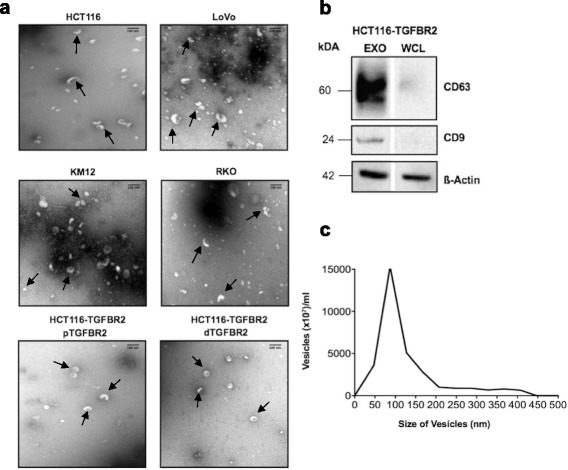
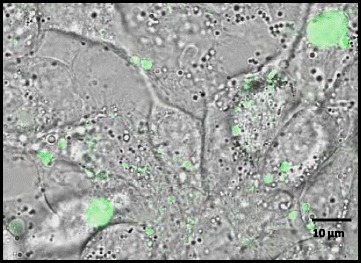
Exosomes were isolated and characterized by electron microscopy, nanoparticle tracking, and western blot analysis. TGFBR2-dependent effects on the cargo and functions of exosomes were studied in a MSI CRC model cell line enabling reconstituted and inducible TGFBR2 expression and signaling. Microsatellite frameshift mutations in exosomal and cellular DNA were examined by PCR-based DNA fragment analysis and exosomal protein profiles were identified by mass spectrometry. Uptake of fluorescent-labeled exosomes by hepatoma recipient cells was monitored by confocal microscopy. TGFBR2-dependent exosomal effects on secreted cytokine levels of recipient cells were analyzed by Luminex technology and ELISA.
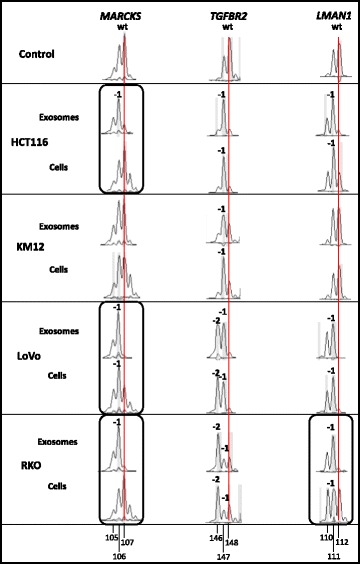
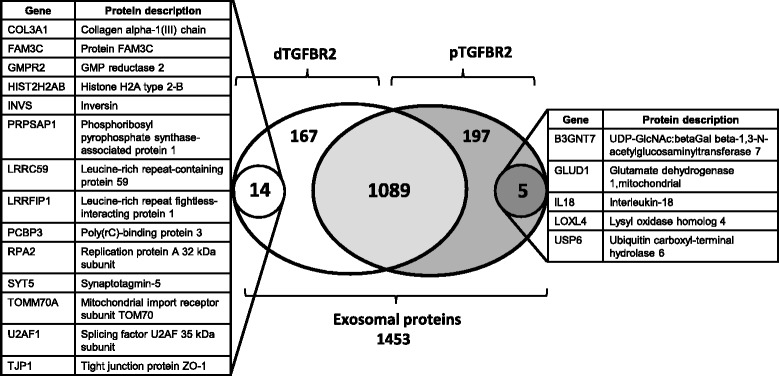
Frameshift mutation patterns in microsatellite stretches of TGFBR2 and other MSI target genes were found to be reflected in the cargo of MSI CRC-derived exosomes. At the proteome level, reconstituted TGFBR2 expression and signaling uncovered two protein subsets exclusively occurring in exosomes derived from TGFBR2-deficient (14 proteins) or TGFBR2-proficient (five proteins) MSI donor cells. Uptake of these exosomes by recipient cells caused increased secretion (2-6 fold) of specific cytokines (Interleukin-4, Stem Cell Factor, Platelet-derived Growth Factor-B), depending on the TGFBR2 expression status of the tumor cell.
Our results indicate that the coding MSI phenotype of DNA mismatch repair-deficient CRC cells is maintained in their exosomal DNA. Moreover, we uncovered that a recurrent MSI tumor driver mutation like TGFBR2 can reprogram the protein content of MSI cell-derived exosomes and in turn modulate the cytokine secretion profile of recipient cells. Apart from its diagnostic potential, these TGFBR2-dependent exosomal molecular and proteomic signatures might help to understand the signaling routes used by MSI tumors. Fricke et al. uncovered coding microsatellite instability-associated mutations of colorectal tumor driver genes like TGFBR2 in MSI tumor cellderived exosomes. Depending on the TGFBR2 expression status of their donor cells, shed exosomes show distinct proteomic signatures and promote altered cytokine secretion profiles in recipient cells.
缺乏DNA错配修复功能的结直肠癌(CRC)表现出微卫星不稳定(MSI)表型,其特征是在短重复DNA序列(微卫星)处发生移码突变的积累。这些肿瘤经常在肿瘤抑制因子转化生长因子β受体2型(TGFBR2)中出现失活的移码突变,从而废除下游信号传导。TGFBR2信号改变如何影响MSI肿瘤细胞与其环境之间的外泌体介导的通讯尚未得到解决。在此,我们报告了MSI细胞释放的外泌体的分子改变以及受体细胞中引发的生物学反应。
通过电子显微镜、纳米颗粒追踪和蛋白质印迹分析对外泌体进行分离和表征。在一个能够重建和诱导TGFBR2表达及信号传导的MSI CRC模型细胞系中,研究了TGFBR2对MSI CRC衍生外泌体的货物和功能的依赖性影响。通过基于PCR的DNA片段分析检测外泌体和细胞DNA中的微卫星移码突变,并通过质谱鉴定外泌体蛋白质谱。通过共聚焦显微镜监测肝癌受体细胞对荧光标记外泌体的摄取。通过Luminex技术和酶联免疫吸附测定(ELISA)分析TGFBR2依赖性外泌体对受体细胞分泌细胞因子水平的影响。
发现TGFBR2和其他MSI靶基因的微卫星片段中的移码突变模式反映在MSI CRC衍生的外泌体的货物中。在蛋白质组水平上,重建的TGFBR2表达和信号传导揭示了两个仅存在于源自TGFBR2缺陷(14种蛋白质)或TGFBR2正常(5种蛋白质)的MSI供体细胞的外泌体中的蛋白质亚群。受体细胞对这些外泌体的摄取导致特定细胞因子(白细胞介素-4、干细胞因子、血小板衍生生长因子-B)的分泌增加(2至6倍),这取决于肿瘤细胞的TGFBR2表达状态。
我们的结果表明,DNA错配修复缺陷的CRC细胞的编码MSI表型在其外泌体DNA中得以维持。此外,我们发现像TGFBR2这样反复出现的MSI肿瘤驱动突变可以重新编程MSI细胞衍生的外泌体的蛋白质含量,进而调节受体细胞的细胞因子分泌谱。除了其诊断潜力外,这些TGFBR2依赖性外泌体分子和蛋白质组学特征可能有助于理解MSI肿瘤所使用的信号传导途径。弗里克等人在MSI肿瘤细胞衍生的外泌体中发现了结直肠癌驱动基因(如TGFBR2)的编码微卫星不稳定性相关突变。根据其供体细胞的TGFBR2表达状态,释放的外泌体显示出独特的蛋白质组学特征,并促进受体细胞中细胞因子分泌谱的改变。