Lin Jeff Chien-Fu, Liang Wen-Miin
Department of Statistics, National Taipei University, Taipei, Taiwan.
Department of Orthopedic Surgery, Wan Fang Hospital, Taipei Medical University, Taipei, Taiwan.
BMC Musculoskelet Disord. 2017 Apr 4;18(1):144. doi: 10.1186/s12891-017-1493-5.
Osteoporotic hip fractures are associated with high mortality and morbidity in people of advanced age; however, few studies have investigated the complication rates in nonagenarians. In this study, we applied a competing risk analysis to estimate the mortality, readmission, and reoperation rates after surgery for hip fracture among nonagenarians.
A total of 11,184 nonagenarians (aged ≥ 90) who received surgery for hip fracture during the period 1 January 1997 and 31 December 2010 were selected from Taiwan's National Health Insurance (NHI) database. Nonagenarians were followed up until the end of 2012, death, or the date they left the NHI program. Cumulative mortality was estimated using the Kaplan-Meier analysis and risk factors for mortality were investigated using a Cox proportional hazards model. Competing risk analysis was used to estimate cumulative incidence rates and to assess the risk factors for reoperation and readmission.
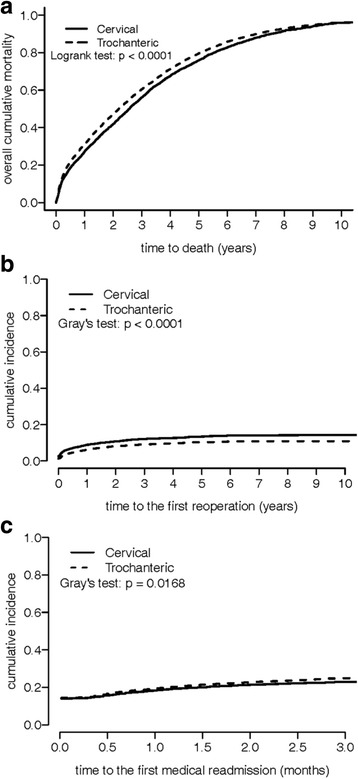
The mortality rates were 29.5% at 1 year, 45.0% at 2 years and 78.1% at 5 years. The cumulative incidence rates of reoperation were 7.3% at 1 year, 9.2% at 2 years and 11.6% at 5 years whereas those of readmission were 18.9% at 1 month and 24.1% at 3 months. Significant risk factors for death included age, male gender, trochanteric fracture, and higher Charlson comorbidity index (CCI) whereas those for reoperation were age, cervical fracture and higher CCI. Furthermore, age, male gender, and higher CCI were risk factors for readmission.
The overall 2-years mortality rate among nonagenarians in Taiwan was around 45%, the 2-years reoperation rate was around 9% and the 90-days medical complication rate was around 24%. High complication rates are associated with increased risk for death. Postoperative care to prevent medical complications is likely the most effective strategy to reduce mortality rates among nonagenarians with hip fracture.
骨质疏松性髋部骨折与高龄人群的高死亡率和高发病率相关;然而,很少有研究调查过九旬老人的并发症发生率。在本研究中,我们应用竞争风险分析来估计九旬老人髋部骨折手术后的死亡率、再入院率和再次手术率。
从台湾国民健康保险(NHI)数据库中选取了1997年1月1日至2010年12月31日期间接受髋部骨折手术的11184名九旬老人(年龄≥90岁)。对九旬老人进行随访直至2012年底、死亡或其退出NHI计划之日。使用Kaplan-Meier分析估计累积死亡率,并使用Cox比例风险模型研究死亡的危险因素。采用竞争风险分析来估计累积发生率,并评估再次手术和再入院的危险因素。
1年时死亡率为29.5%,2年时为45.0%,5年时为78.1%。再次手术的累积发生率1年时为7.3%,2年时为9.2%,5年时为11.6%,而再入院的累积发生率1个月时为18.9%,3个月时为24.1%。死亡的显著危险因素包括年龄、男性、转子间骨折和较高的Charlson合并症指数(CCI),而再次手术的危险因素为年龄、颈椎骨折和较高的CCI。此外,年龄、男性和较高的CCI是再入院的危险因素。
台湾九旬老人的总体2年死亡率约为45%,2年再次手术率约为9%,90天医疗并发症率约为24%。高并发症发生率与死亡风险增加相关。预防医疗并发症的术后护理可能是降低髋部骨折九旬老人死亡率的最有效策略。