Jiang Huijuan, Hu Xigang, Zhang Hongzhi, Li Wenbo
Department of Radiotherapy, Huaihe Hospital of Henan University, No.1 Baobei Road, Gulou District, Kaifeng, 475000, China.
Radiat Oncol. 2017 Apr 4;12(1):65. doi: 10.1186/s13014-017-0802-3.
Long non-coding RNAs (lncRNAs) have been reported to regulate the sensitivity of different cancer cells to chemoradiotherapy. Aberrant expression of lncRNA Taurine-upregulated gene 1 (TUG1) has been found to be involved in the development of bladder cancer, however, its function and underlying mechanism in the radioresistance of bladder cancer remains unclear.
Quantitative real-time PCR (qRT-PCR) was conducted to measure the expression of TUG1 and HMGB1 mRNA in bladder cancer tissues and cell lines. HMGB1 protein levels were tested by western blot assays. Different doses of X-ray were used for radiation treatment of bladder cancer cells. Colony survival and cell viability were detected by clonogenic assay and CCK-8 Kit, respectively. Cell apoptosis was determined by flow cytometry. A xenograft mouse model was constructed to observe the effect of TUG1 on tumor growth in vivo.
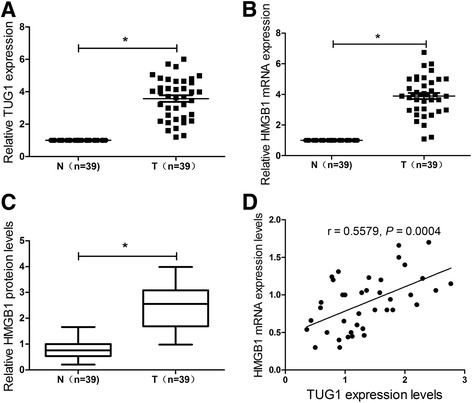
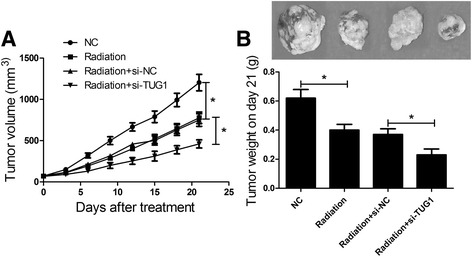
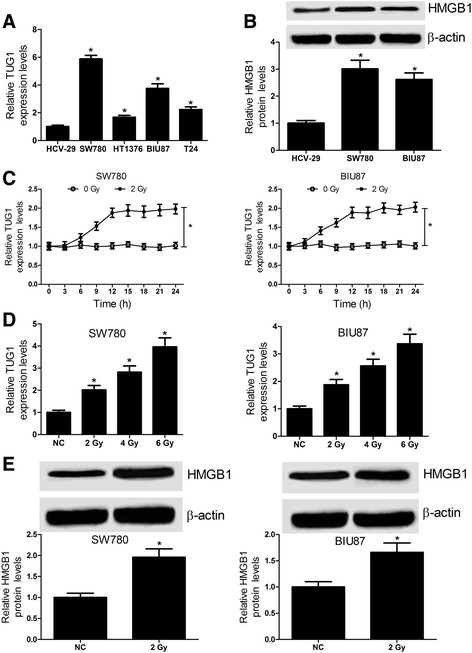
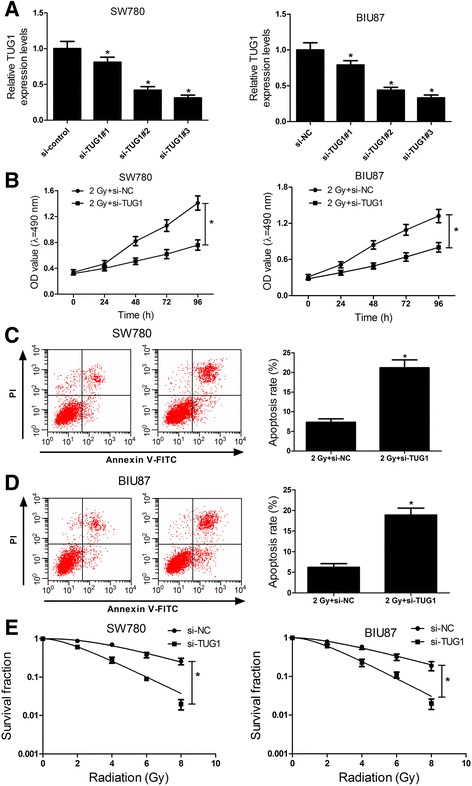
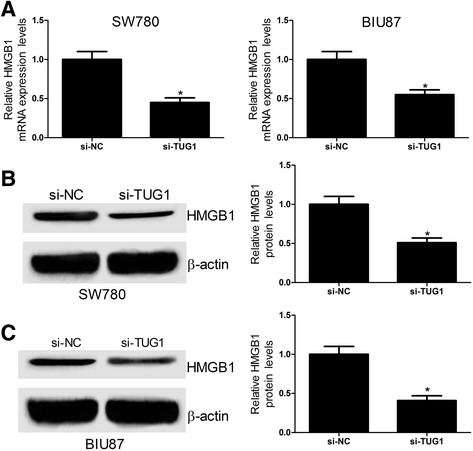
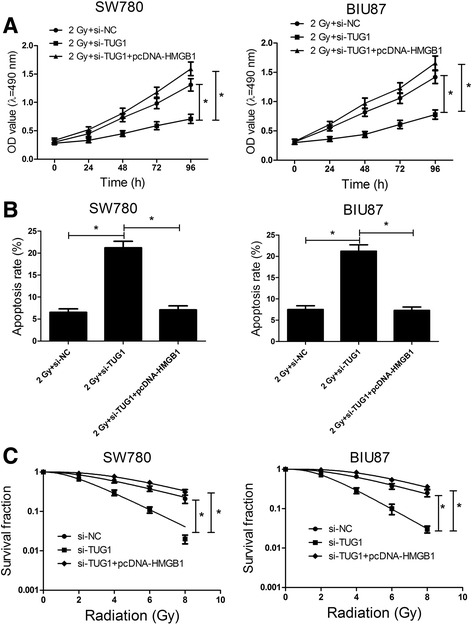
The levels of TUG1 and HMGB1 were remarkably increased in bladder cancer tissues and cell lines. Radiation treatment markedly elevated the expression of TUG1 and HMGB1. TUG1 knockdown inhibited cell proliferation, promoted cell apoptosis and decreased colony survival in SW780 and BIU87 cells under radiation. Moreover, TUG1 depletion suppressed the HMGB1 mRNA and protein levels. Furthermore, overexpression of HMGB1 reversed TUG1 knockdown-induced effect in bladder cancer cells. Radiation treatment dramatically reduced the tumor volume and weight in xenograft model, and this effect was more obvious when combined with TUG1 silencing.
LncRNA TUG1 knockdown enhances radiosensitivity of bladder cancer by suppressing HMGB1 expression. TUG1 acts as a potential regulator of radioresistance of bladder cancer, and it may represent a promising therapeutic target for bladder cancer patients.
据报道,长链非编码RNA(lncRNAs)可调节不同癌细胞对放化疗的敏感性。已发现lncRNA牛磺酸上调基因1(TUG1)的异常表达与膀胱癌的发生发展有关,然而,其在膀胱癌放射抵抗中的功能及潜在机制仍不清楚。
采用定量实时PCR(qRT-PCR)检测膀胱癌组织及细胞系中TUG1和HMGB1 mRNA的表达。通过蛋白质印迹法检测HMGB1蛋白水平。使用不同剂量的X射线对膀胱癌细胞进行放射治疗。分别通过克隆形成试验和CCK-8试剂盒检测集落存活率和细胞活力。通过流式细胞术测定细胞凋亡。构建异种移植小鼠模型以观察TUG1对体内肿瘤生长的影响。
膀胱癌组织和细胞系中TUG1和HMGB1的水平显著升高。放射治疗显著提高了TUG1和HMGB1的表达。在放射条件下,敲低TUG1可抑制SW780和BIU87细胞的增殖,促进细胞凋亡并降低集落存活率。此外,TUG1缺失抑制了HMGB1 mRNA和蛋白水平。此外,HMGB1的过表达逆转了TUG1敲低诱导的膀胱癌细胞效应。放射治疗显著减小了异种移植模型中的肿瘤体积和重量,当与TUG1沉默联合使用时,这种效果更明显。
敲低lncRNA TUG1通过抑制HMGB1表达增强膀胱癌的放射敏感性。TUG1作为膀胱癌放射抵抗的潜在调节因子,可能是膀胱癌患者有前景的治疗靶点。