Liu Gang, Chen Shuai, Zhong Jin, Teng Kunling, Yin Yulong
Key Laboratory of Agro-Ecological Processes in Subtropical Region, Institute of Subtropical Agriculture, Chinese Academy of Sciences, National Engineering Laboratory for Pollution Control and Waste Utilization in Livestock and Poultry Production, Hunan Provincial Engineering Research Center of Healthy Livestock, Scientific Observing and Experimental Station of Animal Nutrition and Feed Science in South-Central, Ministry of Agriculture, Hunan Co-Innovation Center of Animal Production Safety, Hunan 410125, China.
State Key Laboratory of Microbial Resources, Institute of Microbiology, Chinese Academy of Sciences, Beijing 100101, China; University of Chinese Academy of Sciences, Beijing 100049, China.
Oxid Med Cell Longev. 2017;2017:1602074. doi: 10.1155/2017/1602074. Epub 2017 Mar 9.
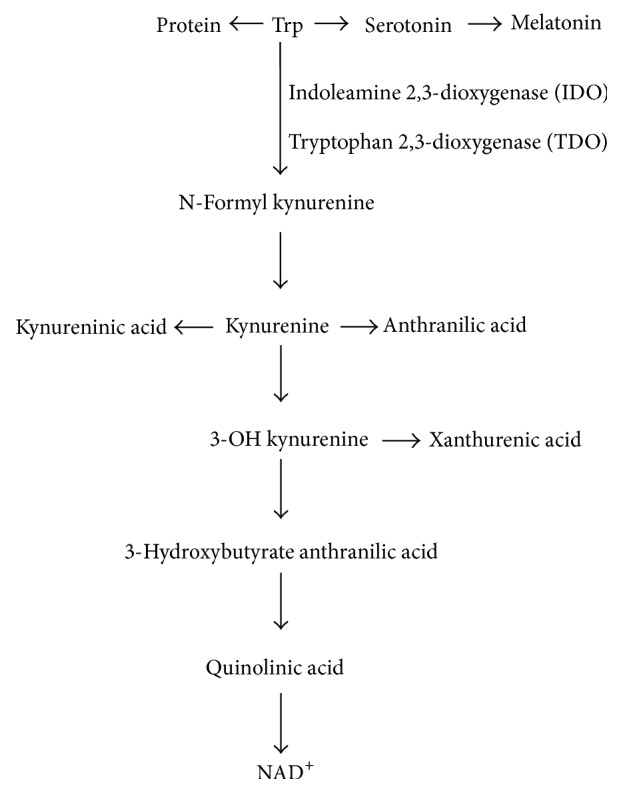
The cardiovascular diseases (CVD) associated with the highest rates of morbidity are coronary heart disease and stroke, and the primary etiological factor leading to these conditions is atherosclerosis. This long-lasting inflammatory disease, characterized by how it affects the artery wall, results from maladaptive immune responses linked to the vessel wall. Tryptophan (Trp) is oxidized in a constitutive manner by tryptophan 2,3-dioxygenase in liver cells, and for alternative cell types, it is catalyzed in the presence of a differently inducible indoleamine 2,3-dioxygenase (IDO1) in the context of a specific pathophysiological environment. Resultantly, this leads to a rise in the production of kynurenine (Kyn) metabolites. Inflammation in the preliminary stages of atherosclerosis has a significant impact on IDO1, and IDO1 and the IDO1-associated pathway constitute critical mediating agents associated with the immunoinflammatory responses that characterize advanced atherosclerosis. The purpose of this review is to survey the recent literature addressing the kynurenine pathway of tryptophan degradation in CVD, and the author will direct attention to the function performed by IDO1-mediated tryptophan metabolism.
发病率最高的心血管疾病(CVD)是冠心病和中风,导致这些疾病的主要病因是动脉粥样硬化。这种持续性炎症性疾病的特征在于其对动脉壁的影响方式,它是由与血管壁相关的适应性免疫反应失调引起的。肝细胞中的色氨酸2,3-双加氧酶以组成型方式氧化色氨酸,而对于其他细胞类型,在特定病理生理环境中,它在不同诱导型吲哚胺2,3-双加氧酶(IDO1)存在的情况下被催化。结果,这导致犬尿氨酸(Kyn)代谢产物的产生增加。动脉粥样硬化早期的炎症对IDO1有重大影响,IDO1及其相关途径构成了与晚期动脉粥样硬化特征性免疫炎症反应相关的关键介导因子。本综述的目的是调查近期关于心血管疾病中色氨酸降解的犬尿氨酸途径的文献,作者将关注IDO1介导的色氨酸代谢所发挥的作用。