Center for the Study of Applied Psychology, Key Laboratory of Mental Health and Cognitive Science of Guangdong Province, School of Psychology, South China Normal University, Guangzhou, China.
Guangdong Science Center, Guangzhou, China.
Sci Rep. 2017 Apr 6;7:46072. doi: 10.1038/srep46072.
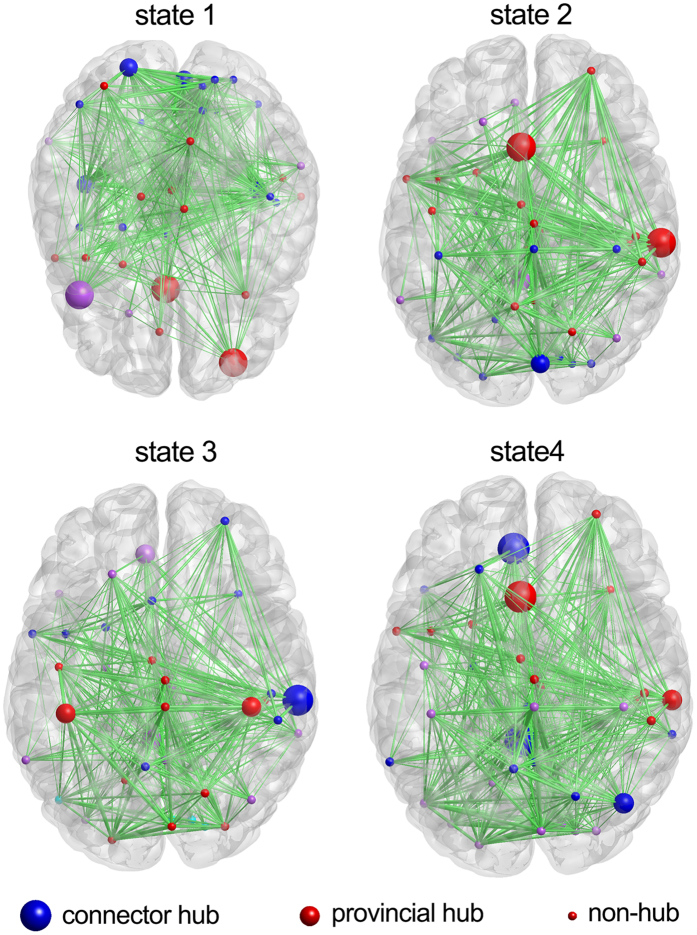
Creativity is thought to require the flexible reconfiguration of multiple brain regions that interact in transient and complex communication patterns. In contrast to prior emphases on searching for specific regions or networks associated with creative performance, we focused on exploring the association between the reconfiguration of dynamic functional connectivity states and creative ability. We hypothesized that a high frequency of dynamic functional connectivity state transitions will be associated with creative ability. To test this hypothesis, we recruited a high-creative group (HCG) and a low-creative group (LCG) of participants and collected resting-state fMRI (R-fMRI) data and Torrance Tests of Creative Thinking (TTCT) scores from each participant. By combining an independent component analysis with a dynamic network analysis approach, we discovered the HCG had more frequent transitions between dynamic functional connectivity (dFC) states than the LCG. Moreover, a confirmatory analysis using multiplication of temporal derivatives also indicated that there were more frequent dFC state transitions in the HCG. Taken together, these results provided empirical evidence for a linkage between the flexible reconfiguration of dynamic functional connectivity states and creative ability. These findings have the potential to provide new insights into the neural basis of creativity.
创造力被认为需要多个大脑区域的灵活重新配置,这些区域以短暂而复杂的沟通模式相互作用。与之前强调寻找与创造性表现相关的特定区域或网络不同,我们专注于探索动态功能连接状态的重新配置与创造力之间的关联。我们假设动态功能连接状态转换的高频率将与创造力相关。为了验证这一假设,我们招募了一组高创造力组(HCG)和一组低创造力组(LCG)参与者,并从每位参与者收集静息态 fMRI(R-fMRI)数据和托兰斯创造性思维测验(TTCT)分数。通过将独立成分分析与动态网络分析方法相结合,我们发现 HCG 比 LCG 之间的动态功能连接(dFC)状态之间的转换更为频繁。此外,使用时间导数乘法的验证性分析也表明,HCG 中 dFC 状态的转换更为频繁。总之,这些结果为动态功能连接状态的灵活重新配置与创造力之间的联系提供了经验证据。这些发现有可能为创造力的神经基础提供新的见解。