Department of Pharmacology, Columbia University Medical Center, New York, New York 10032, USA.
Department of Physiology and Biophysics, Miller School of Medicine, University of Miami, Miami, Florida 33136, USA.
Sci Rep. 2017 Apr 6;7:45911. doi: 10.1038/srep45911.
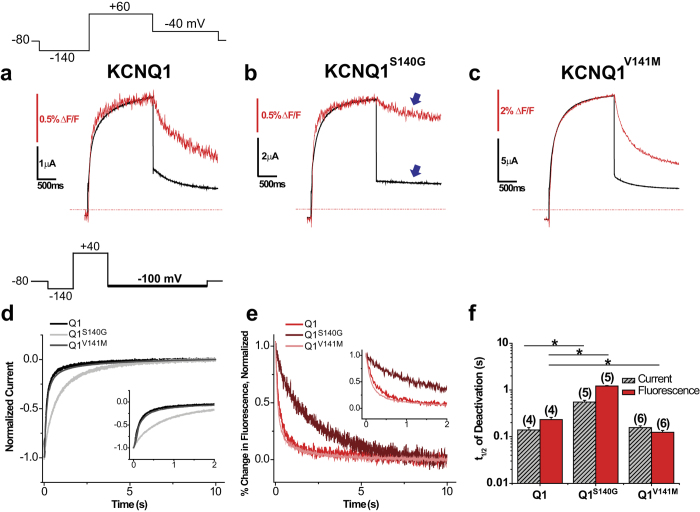
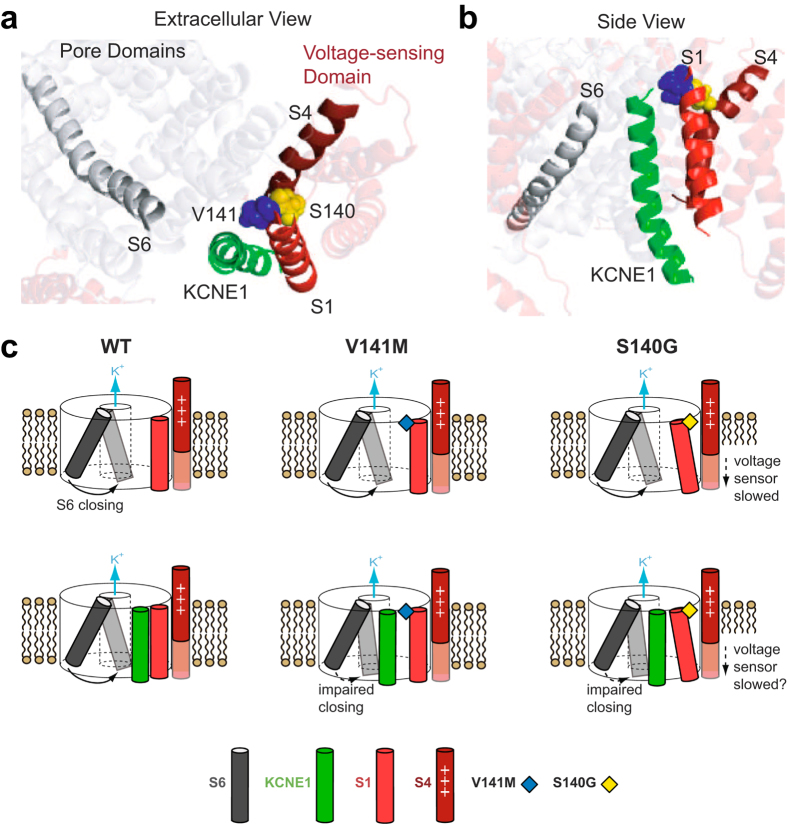
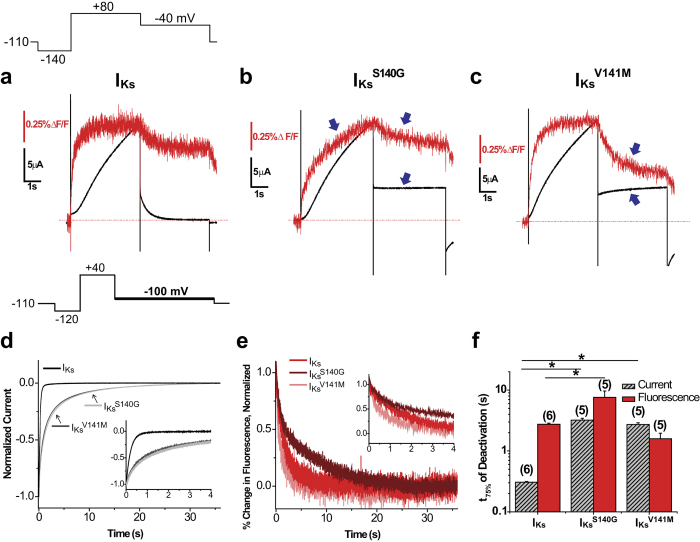
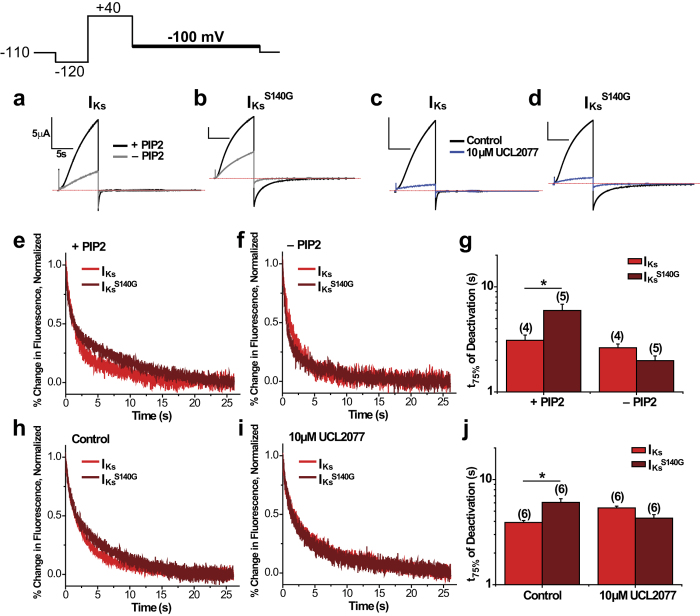
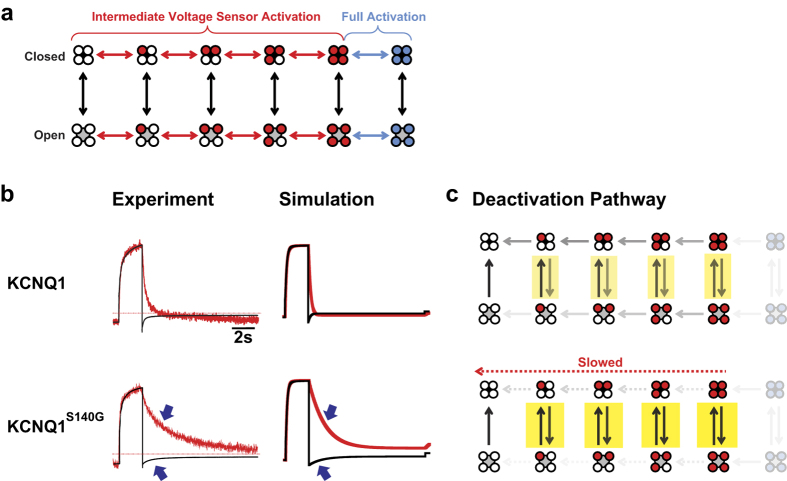
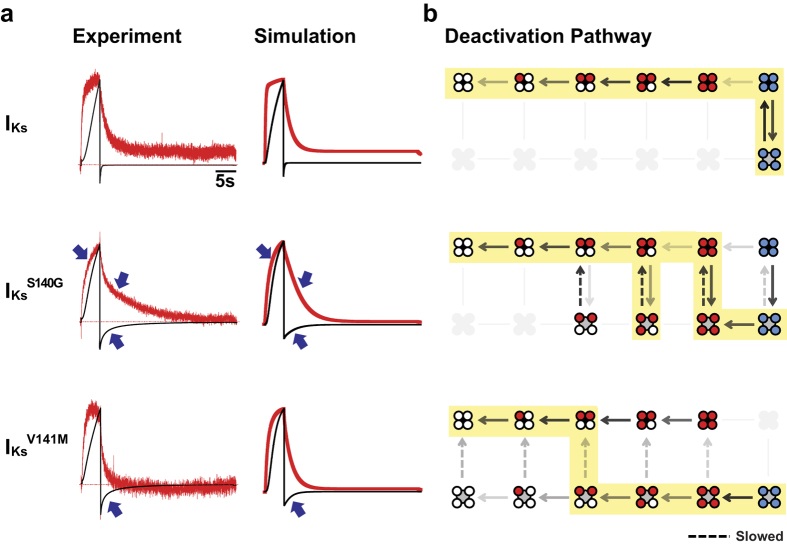
KCNQ1 is a voltage-gated potassium channel that is modulated by the beta-subunit KCNE1 to generate I, the slow delayed rectifier current, which plays a critical role in repolarizing the cardiac action potential. Two KCNQ1 gain-of-function mutations that cause a genetic form of atrial fibrillation, S140G and V141M, drastically slow I deactivation. However, the underlying gating alterations remain unknown. Voltage clamp fluorometry (VCF) allows simultaneous measurement of voltage sensor movement and current through the channel pore. Here, we use VCF and kinetic modeling to determine the effects of mutations on channel voltage-dependent gating. We show that in the absence of KCNE1, S140G, but not V141M, directly slows voltage sensor movement, which indirectly slows current deactivation. In the presence of KCNE1, both S140G and V141M slow pore closing and alter voltage sensor-pore coupling, thereby slowing current deactivation. Our results suggest that KCNE1 can mediate changes in pore movement and voltage sensor-pore coupling to slow I deactivation and provide a key step toward developing mechanism-based therapies.
KCNQ1 是一种电压门控钾通道,可被β亚基 KCNE1 调节,产生 I,即缓慢延迟整流电流,这在心脏动作电位复极化中起着关键作用。两种导致遗传性心房颤动的 KCNQ1 功能获得性突变,S140G 和 V141M,极大地减缓了 I 的失活。然而,潜在的门控改变仍不清楚。电压钳荧光法(VCF)允许同时测量电压传感器的运动和通过通道孔的电流。在这里,我们使用 VCF 和动力学建模来确定突变对通道电压依赖性门控的影响。我们表明,在没有 KCNE1 的情况下,S140G 但不是 V141M 直接减缓电压传感器的运动,这间接减缓了电流失活。在 KCNE1 存在的情况下,S140G 和 V141M 均减缓孔关闭并改变电压传感器-孔偶联,从而减缓电流失活。我们的结果表明,KCNE1 可以介导孔运动和电压传感器-孔偶联的变化,以减缓 I 的失活,并为开发基于机制的治疗方法提供了关键步骤。