Kouvaris Kostas, Clune Jeff, Kounios Loizos, Brede Markus, Watson Richard A
ECS, University of Southampton, Southampton, United Kingdom.
University of Wyoming, Laramie, Wyoming, United States of America.
PLoS Comput Biol. 2017 Apr 6;13(4):e1005358. doi: 10.1371/journal.pcbi.1005358. eCollection 2017 Apr.
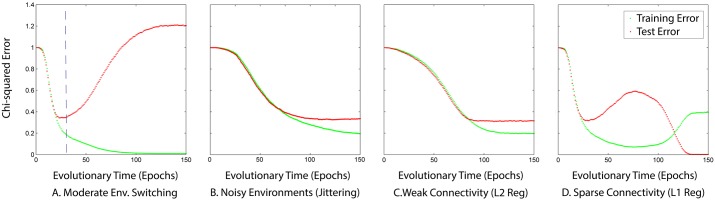
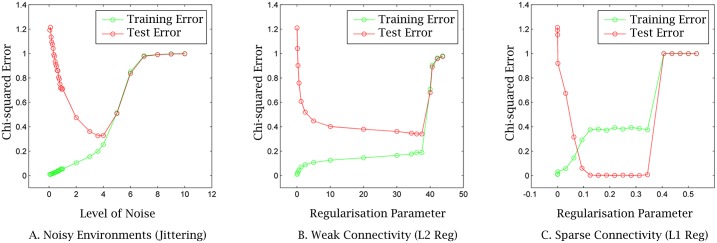
One of the most intriguing questions in evolution is how organisms exhibit suitable phenotypic variation to rapidly adapt in novel selective environments. Such variability is crucial for evolvability, but poorly understood. In particular, how can natural selection favour developmental organisations that facilitate adaptive evolution in previously unseen environments? Such a capacity suggests foresight that is incompatible with the short-sighted concept of natural selection. A potential resolution is provided by the idea that evolution may discover and exploit information not only about the particular phenotypes selected in the past, but their underlying structural regularities: new phenotypes, with the same underlying regularities, but novel particulars, may then be useful in new environments. If true, we still need to understand the conditions in which natural selection will discover such deep regularities rather than exploiting 'quick fixes' (i.e., fixes that provide adaptive phenotypes in the short term, but limit future evolvability). Here we argue that the ability of evolution to discover such regularities is formally analogous to learning principles, familiar in humans and machines, that enable generalisation from past experience. Conversely, natural selection that fails to enhance evolvability is directly analogous to the learning problem of over-fitting and the subsequent failure to generalise. We support the conclusion that evolving systems and learning systems are different instantiations of the same algorithmic principles by showing that existing results from the learning domain can be transferred to the evolution domain. Specifically, we show that conditions that alleviate over-fitting in learning systems successfully predict which biological conditions (e.g., environmental variation, regularity, noise or a pressure for developmental simplicity) enhance evolvability. This equivalence provides access to a well-developed theoretical framework from learning theory that enables a characterisation of the general conditions for the evolution of evolvability.
进化中最引人入胜的问题之一是生物体如何展现出合适的表型变异,以便在新的选择环境中迅速适应。这种变异性对进化能力至关重要,但人们对此了解甚少。特别是,自然选择如何青睐那些能在前所未见的环境中促进适应性进化的发育组织?这样一种能力暗示了一种远见,这与自然选择的短视概念不相容。一种潜在的解决方案是基于这样一种观点,即进化不仅可能发现并利用关于过去所选择的特定表型的信息,还包括其潜在的结构规律:具有相同潜在规律但具体细节新颖的新表型,可能在新环境中有用。如果这是真的,我们仍然需要了解自然选择在哪些条件下会发现这种深层规律,而不是利用“快速解决方案”(即那些在短期内提供适应性表型,但限制未来进化能力的解决方案)。在这里,我们认为进化发现这种规律的能力在形式上类似于人类和机器中熟悉的学习原则,这些原则能够从过去的经验中进行归纳。相反,未能增强进化能力的自然选择直接类似于过度拟合的学习问题以及随后无法进行归纳。我们通过表明学习领域的现有结果可以转移到进化领域,来支持进化系统和学习系统是同一算法原则的不同实例化这一结论。具体而言,我们表明减轻学习系统中过度拟合的条件能够成功预测哪些生物学条件(例如环境变异、规律性、噪声或发育简单性的压力)会增强进化能力。这种等效性提供了进入学习理论中一个完善的理论框架的途径,该框架能够对进化能力进化的一般条件进行刻画。