Then Chee-Kin, Chi Nai-Fang, Chung Kuo-Hsuan, Kuo Lynn, Liu Kao-Hui, Hu Chaur-Jong, Shen Shing-Chuan, Lin Yen-Kuang
School of Medicine, College of Medicine, Taipei Medical University, Taipei, Taiwan.
Graduate Institute of Medical Sciences, College of Medicine, Taipei Medical University, Taipei, Taiwan.
PLoS One. 2017 Apr 6;12(4):e0175187. doi: 10.1371/journal.pone.0175187. eCollection 2017.
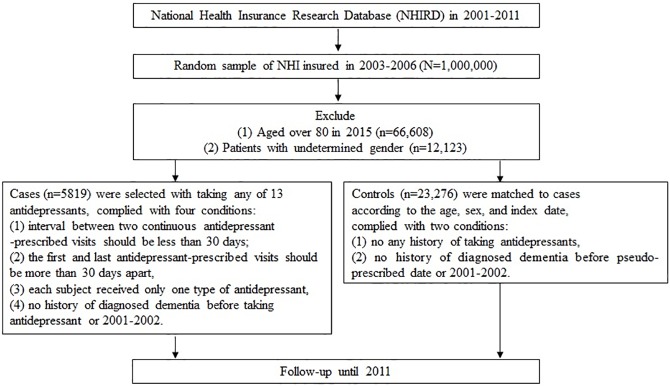
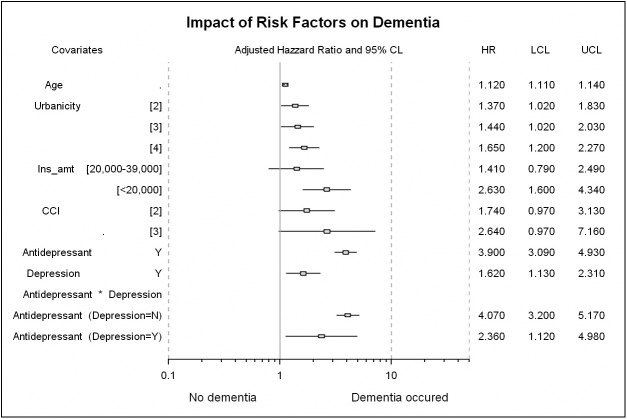
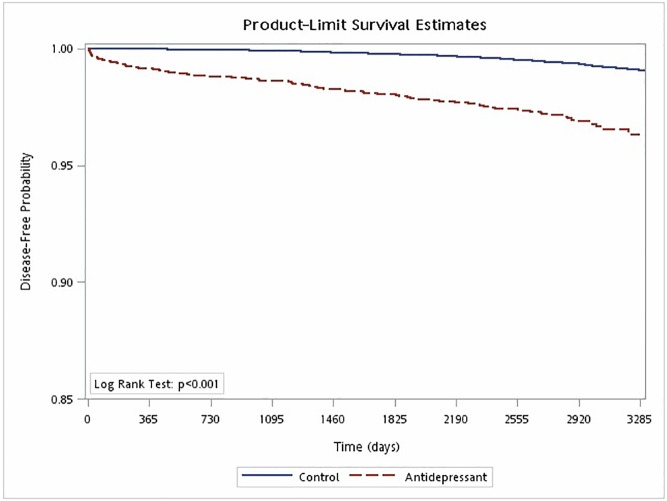
Depression and dementia are common mental health problems and are associated in several ways. Early-life depression is associated with increased risk of later life dementia, and depression can present as a preclinical symptom or consequence of dementia. Despite the plausible relationship between these two clinical entities, the potential association between antidepressant medication and dementia has rarely been investigated. We conducted a 9-year retrospective analysis of Taiwan's National Health Insurance Research Database (NHIRD), enrolling 5819 cases who had received prescriptions of antidepressants between 2003 and 2006, and 23,276 (with ratio of 1:4) age, sex, and index date-matched controls. The hazard ratio (HR) of dementia among antidepressant users with depression was 2.42 (95% confidence interval (CI): 1.15-5.10), for those without depression was 4.05 (95% CI: 3.19-5.15), compared to antidepressant non-users respectively. Among the 6 classes of common antidepressants used in Taiwan, the adjusted HRs were 3.66 (95% CI: 2.62-5.09) for SSRIs, 4.73 (95% CI: 2.54-8.80) for SNRI, 3.26 (95% CI: 2.30-4.63) for TCAs, 6.62 (95% CI: 3.34-13.13) for TeCA, 4.94 (95% CI: 2.17-11.24) for MAOI, and 4.48 (95% CI: 3.13-6.40) for SARI. Furthermore, the multivariate analysis result showed that the adjusted HRs of cumulative defined daily doses (cDDDs) were 3.74 (95% CI: 2.91-4.82), 3.73 (95% CI: 2.39-5.80) and 5.22 (95% CI: 3.35-8.14) for those who had cDDDs of <90, 90-180 and >180 compared to those who had taken no antidepressant medication. This is a retrospective study based on secondary data, hence, we could not claim causality between antidepressant medication and dementia. However, a potential association between antidepressant and occurrence of dementia after controlling for the status of depression was observed. Lack of patients' data about smoking status and body mass index in NHIRD, which are considered related to dementia, was also a limitation in this study. In this study, we concluded that antidepressant medication is a potential risk factor for dementia, independent from any effect of depression itself.
抑郁症和痴呆症是常见的心理健康问题,二者在多个方面存在关联。早年患抑郁症会增加晚年患痴呆症的风险,而且抑郁症可能表现为痴呆症的临床前症状或后果。尽管这两种临床病症之间的关系看似合理,但抗抑郁药物与痴呆症之间的潜在关联却很少被研究。我们对台湾地区国民健康保险研究数据库(NHIRD)进行了一项为期9年的回顾性分析,纳入了2003年至2006年间接受抗抑郁药物处方的5819例患者,以及23276例(比例为1:4)年龄、性别和索引日期匹配的对照。与未使用抗抑郁药物的患者相比,患有抑郁症的抗抑郁药物使用者患痴呆症的风险比(HR)为2.42(95%置信区间(CI):1.15 - 5.10),未患抑郁症的使用者患痴呆症的风险比为4.05(95%CI:3.19 - 5.15)。在台湾使用的6类常见抗抑郁药物中,选择性5-羟色胺再摄取抑制剂(SSRI)的调整后HR为3.66(95%CI:2.62 - 5.09),5-羟色胺及去甲肾上腺素再摄取抑制剂(SNRI)为4.73(95%CI:2.54 - 8.80),三环类抗抑郁药(TCA)为3.26(95%CI:2.30 - 4.63),四环类抗抑郁药(TeCA)为6.62(95%CI:3.34 - 13.13),单胺氧化酶抑制剂(MAOI)为4.94(95%CI:2.17 - 11.24),5-羟色胺拮抗剂及再摄取抑制剂(SARI)为4.48(95%CI:3.13 - 6.40)。此外,多变量分析结果显示,与未服用抗抑郁药物的患者相比,累积限定日剂量(cDDD)<90、90 - 180和>180的患者调整后HR分别为3.74(95%CI:2.91 - 4.82)、3.73(95%CI:2.39 - 5.80)和5.22(95%CI:3.35 - 8.14)。这是一项基于二手数据的回顾性研究,因此,我们无法确定抗抑郁药物与痴呆症之间存在因果关系。然而,在控制抑郁症状态后,观察到抗抑郁药物与痴呆症发生之间存在潜在关联。国民健康保险研究数据库中缺乏与痴呆症相关的患者吸烟状况和体重指数数据,这也是本研究的一个局限性。在本研究中,我们得出结论,抗抑郁药物是痴呆症的一个潜在风险因素,独立于抑郁症本身的任何影响。