Fu Jingcheng, Zhang Weixiong, Wu Jianliang
School of Mathematics, Shandong University, Jinan, 250100, China.
Department of Computer Science and Engineering, Washington University, St. Louis, MO, 63130, USA.
Sci Rep. 2017 Apr 6;7(1):704. doi: 10.1038/s41598-017-00718-3.
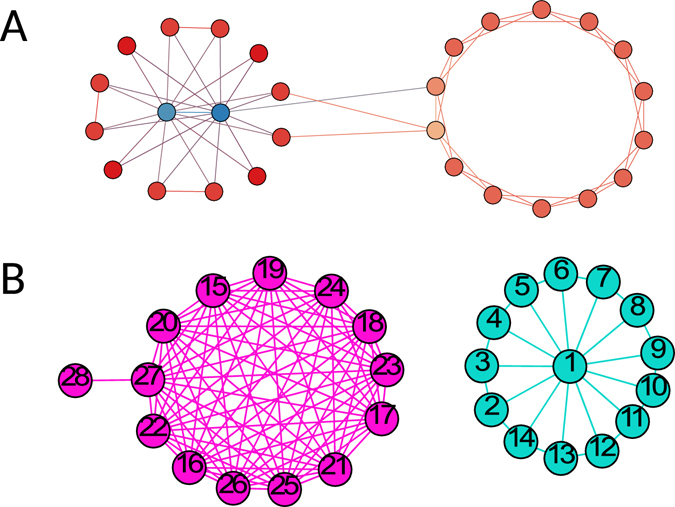
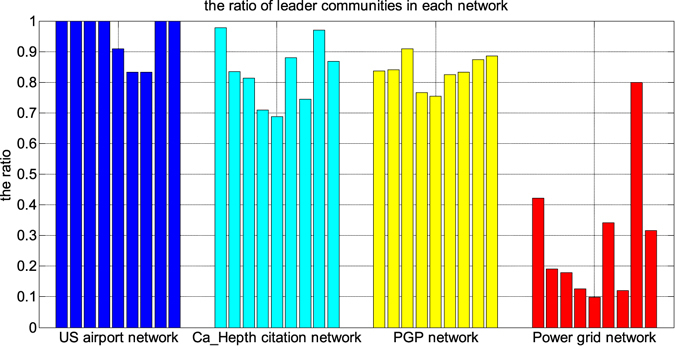
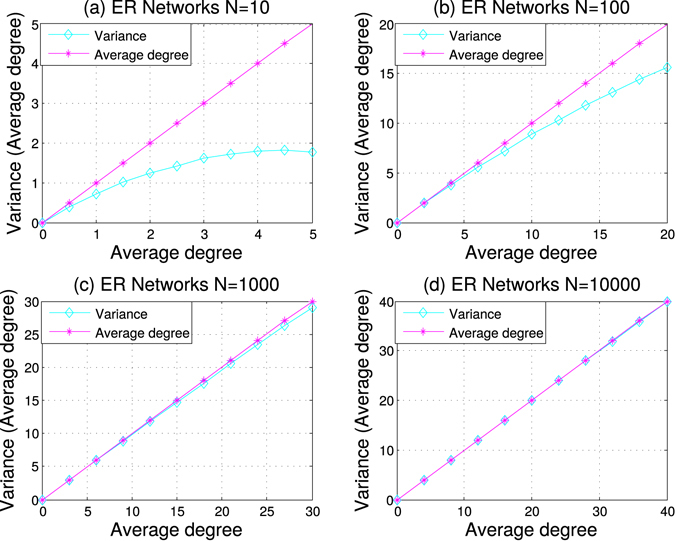
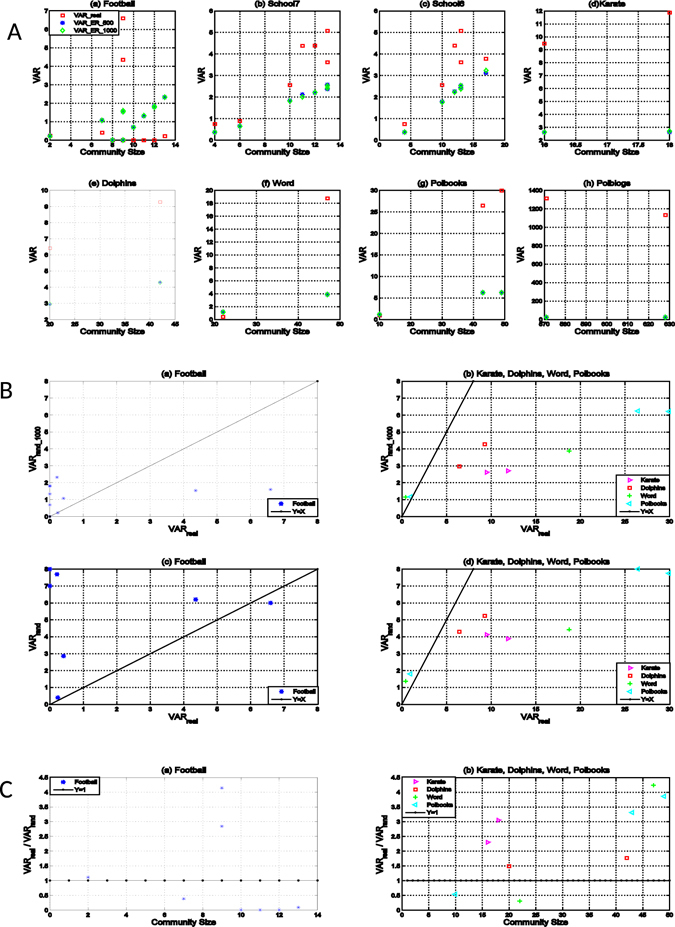
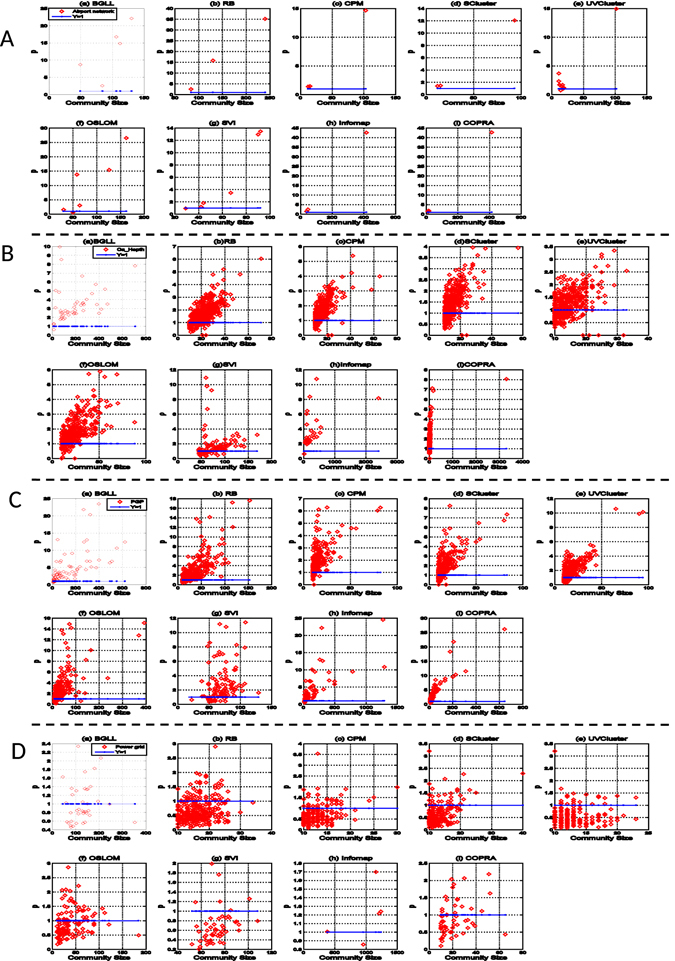
Community or module structure is a natural property of complex networks. Leader communities and self-organizing communities have been introduced recently to characterize networks and understand how communities arise in complex networks. However, identification of leader and self-organizing communities is technically challenging since no adequate quantification has been developed to properly separate the two types of communities. We introduced a new measure, called ratio of node degree variances, to distinguish leader communities from self-organizing communities, and developed a statistical model to quantitatively characterize the two types of communities. We experimentally studied the power and robustness of the new method on several real-world networks in combination of some of the existing community identification methods. Our results revealed that social networks and citation networks contain more leader communities whereas technological networks such as power grid network have more self-organizing communities. Moreover, our results also indicated that self-organizing communities tend to be smaller than leader communities. The results shed new lights on community formation and module structures in complex systems.
社区或模块结构是复杂网络的一种自然属性。近期引入了主导社区和自组织社区来描述网络特征,并理解复杂网络中社区是如何形成的。然而,识别主导社区和自组织社区在技术上具有挑战性,因为尚未开发出足够的量化方法来恰当地区分这两种类型的社区。我们引入了一种名为节点度方差比的新度量,以区分主导社区和自组织社区,并开发了一个统计模型来定量描述这两种类型的社区。我们结合一些现有的社区识别方法,在几个真实世界的网络上对新方法的有效性和稳健性进行了实验研究。我们的结果表明,社交网络和引用网络包含更多的主导社区,而诸如电网网络等技术网络则有更多的自组织社区。此外,我们的结果还表明,自组织社区往往比主导社区更小。这些结果为复杂系统中的社区形成和模块结构提供了新的见解。