Institut de Systématique, Évolution, Biodiversité, ISYEB - UMR 7205-CNRS MNHN UPMC EPHE, Muséum National d'Histoire Naturelle, Sorbonne Universités, 57 rue Cuvier CP50 F-75005, Paris, France.
Departamento de Zoologia and Museu de Zoologia, Instituto de Biologia, Universidade Estadual de Campinas, Campinas, São Paulo, Brazil.
Sci Rep. 2017 Apr 7;7:45966. doi: 10.1038/srep45966.
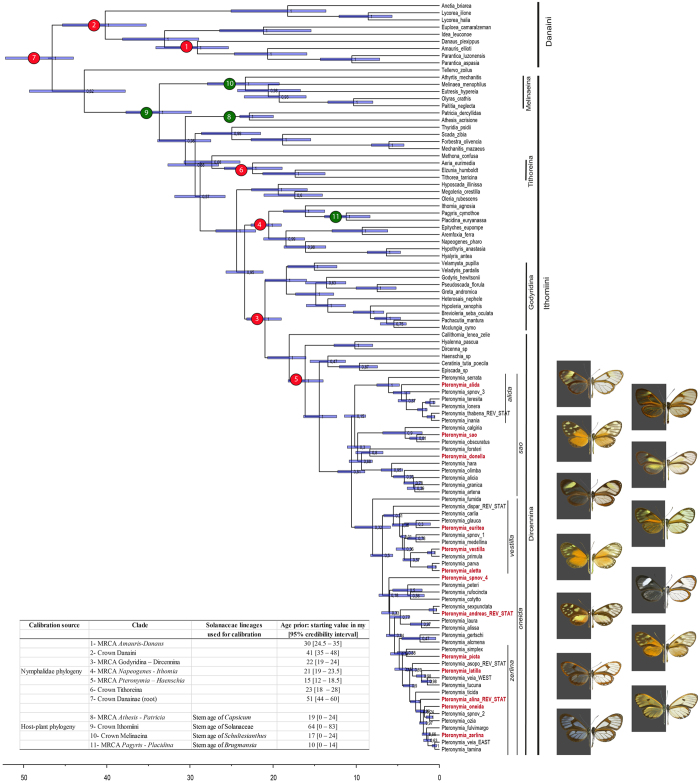
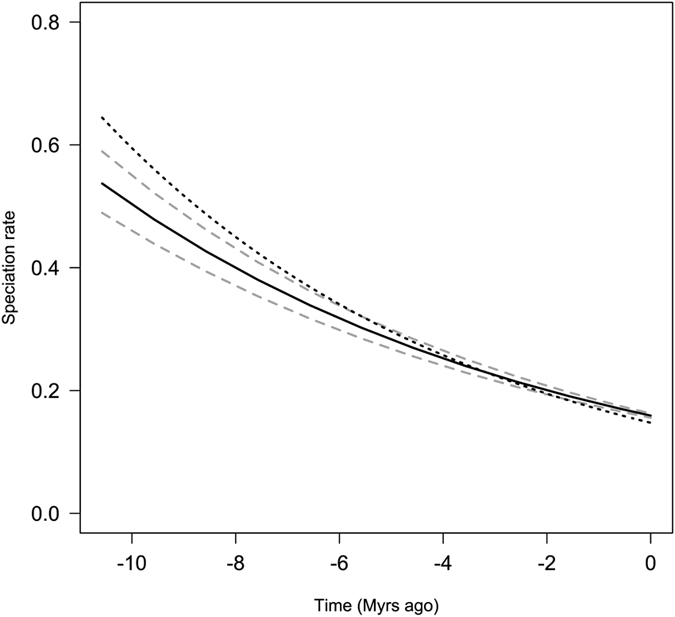
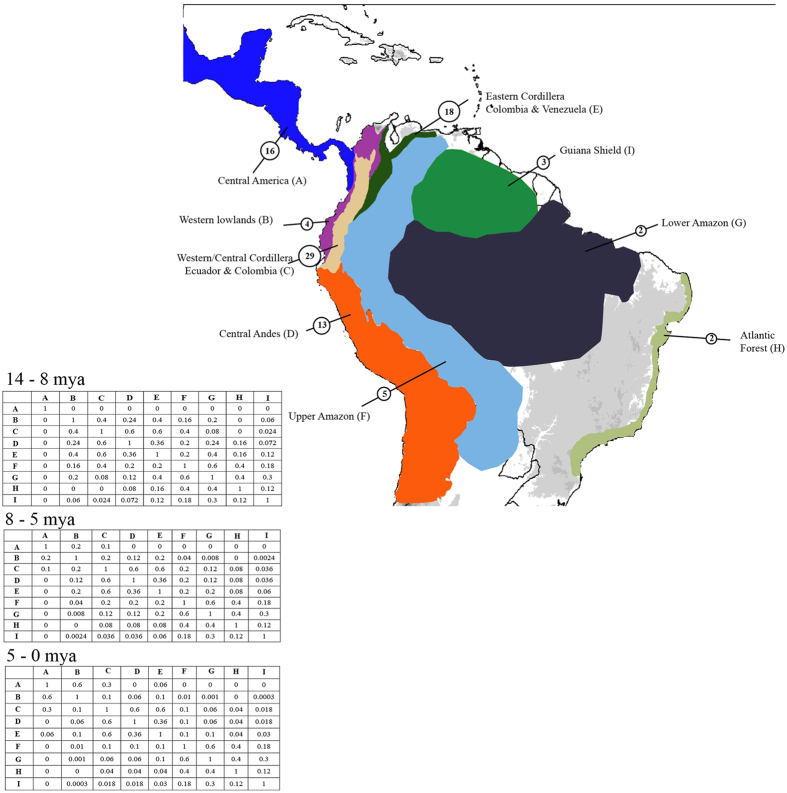
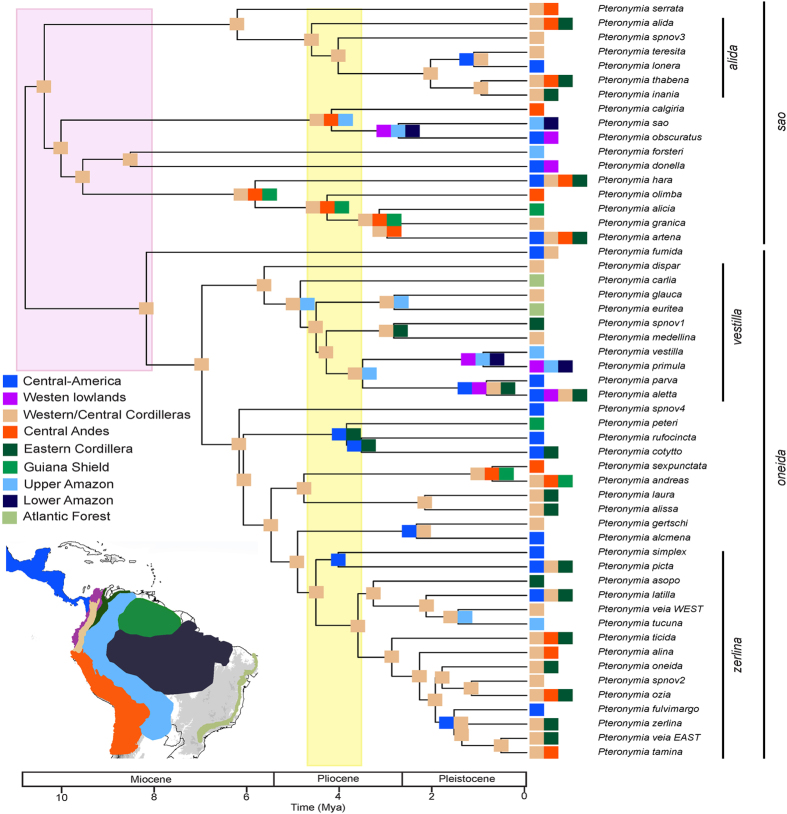
The Neotropics harbour the most diverse flora and fauna on Earth. The Andes are a major centre of diversification and source of diversity for adjacent areas in plants and vertebrates, but studies on insects remain scarce, even though they constitute the largest fraction of terrestrial biodiversity. Here, we combine molecular and morphological characters to generate a dated phylogeny of the butterfly genus Pteronymia (Nymphalidae: Danainae), which we use to infer spatial, elevational and temporal diversification patterns. We first propose six taxonomic changes that raise the generic species total to 53, making Pteronymia the most diverse genus of the tribe Ithomiini. Our biogeographic reconstruction shows that Pteronymia originated in the Northern Andes, where it diversified extensively. Some lineages colonized lowlands and adjacent montane areas, but diversification in those areas remained scarce. The recent colonization of lowland areas was reflected by an increase in the rate of evolution of species' elevational ranges towards present. By contrast, speciation rate decelerated with time, with no extinction. The geological history of the Andes and adjacent regions have likely contributed to Pteronymia diversification by providing compartmentalized habitats and an array of biotic and abiotic conditions, and by limiting dispersal between some areas while promoting interchange across others.
新热带地区拥有地球上最多样化的动植物。安第斯山脉是植物和脊椎动物多样化的主要中心,也是邻近地区多样性的来源,但昆虫的研究仍然很少,尽管它们构成了陆地生物多样性的最大部分。在这里,我们结合分子和形态特征,生成了蝴蝶属 Pteronymia(鳞翅目:蛱蝶科)的一个有时间分辨率的系统发育,我们用它来推断空间、海拔和时间多样化模式。我们首先提出了六个分类学上的变化,将属种总数增加到 53 种,使 Pteronymia 成为 Ithomiini 部落中最多样化的属。我们的生物地理学重建表明,Pteronymia 起源于北安第斯山脉,在那里它广泛多样化。一些谱系殖民了低地和相邻的山地地区,但这些地区的多样化仍然很少。物种海拔范围的进化速度最近向现在增加,反映了低地地区的最近殖民化。相比之下,随着时间的推移,物种形成率减缓,没有灭绝。安第斯山脉和邻近地区的地质历史可能通过提供分隔的栖息地和一系列生物和非生物条件,以及限制一些地区的扩散而促进其他地区的交流,促进了 Pteronymia 的多样化。