Xu Rui, Feng Jintao, Hong Yang, Lv Chao, Zhao Dengyun, Lin Jiaojiao, Lu Ke, Li Hao, Liu Jinming, Cao Xiaodan, Wang Tao, Zai Jinli, Wang Zhaozhe, Jia Bingguang, Han Qian, Zhu Chuangang
Key Laboratory of Animal Parasitology, Ministry of Agriculture of China, Shanghai Veterinary Research Institute, Chinese Academy of Agricultural Sciences, No.518, Ziyue Road, Minhang District, Shanghai, 200241, China.
Jiangsu Co-innovation Center for Prevention and Control of Important Animal Infectious Diseases and Zoonoses, Yangzhou, 225000, China.
Infect Dis Poverty. 2017 Apr 7;6(1):84. doi: 10.1186/s40249-017-0297-z.
Schistosomiasis remains a major public health concern in China and an epidemiological survey has revealed that schistosome-infected bovines and goats are the main transmission sources for the disease. Therefore, development of a sensitive technique for the diagnosis of schistosomiasis in domestic animals is necessary.
A novel colloidal gold immunochromatography assay (GICA) strip was developed for detecting Schistosoma japonicum in domestic animals. The colloidal gold was conjugated with recombinant streptococcal protein G (rSPG). As the test and control lines, the schistosome soluble egg antigen and rSPG, respectively, were blotted on nitrocellulose membrane.
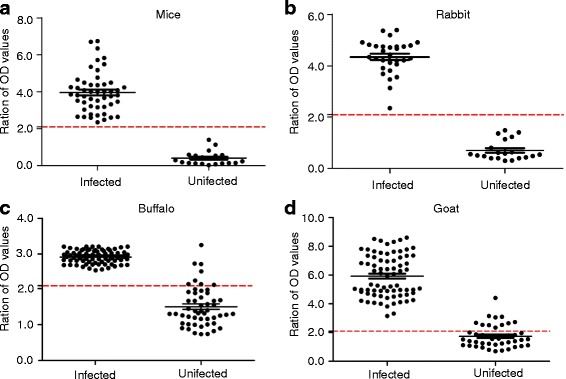
The lowest detectable serum dilution was 1∶640 for schistosome-infected buffaloes. The cross-reaction rate of GICA was 14.29% with Paramphistomum sp. in buffaloes, 16.67% with Haemonchus sp. in goats, and 33.33% with Orientobilharzia sp. in goats. These results were slightly lower and similar to those obtained through ELISA. Moreover, the strips for detecting S. japonicum in mice, rabbits, buffaloes, and goats showed high sensitivity (100.00%, 100.00%, 100.00%, and 100.00%, respectively) and specificity (100.00%, 100.00%, 94.23%, and 88.64%, respectively). And the sensitivity or specificity of the GICA strips did not present any significant differences after storage for 12 months at room temperature. When compared with ELISA, the GICA strips exhibited similar sensitivity and specificity in the diagnosis of schistosomiasis in mice, rabbits, buffaloes, and goats. Besides, only 5 μl of serum are required for the test and the detection can be completed within 5 min.
This study is the first to develop a GICA strip using gold-rSPG conjugate for the diagnosing of schistosomiasis in domestic animals, and preliminary results showed that the developed strip may be suitable for large-scale screening of schistosomiasis in endemic areas.
血吸虫病仍是中国主要的公共卫生问题,一项流行病学调查显示,感染血吸虫的牛和山羊是该病的主要传播源。因此,开发一种用于家畜血吸虫病诊断的灵敏技术很有必要。
开发了一种新型胶体金免疫层析检测(GICA)试纸条,用于检测家畜中的日本血吸虫。胶体金与重组链球菌蛋白G(rSPG)偶联。分别将血吸虫可溶性虫卵抗原和rSPG作为检测线和对照线,点样于硝酸纤维素膜上。
感染血吸虫的水牛血清最低可检测稀释度为1∶640。GICA与水牛体内的姜片吸虫交叉反应率为14.29%,与山羊体内的血矛线虫交叉反应率为16.67%,与山羊体内的东方血吸虫交叉反应率为33.33%。这些结果略低于酶联免疫吸附测定(ELISA)的结果且与之相似。此外,用于检测小鼠、兔子、水牛和山羊体内日本血吸虫的试纸条显示出高灵敏度(分别为100.00%、100.00%、100.00%和100.00%)和特异性(分别为100.00%、100.00%、94.23%和88.64%)。在室温下储存12个月后,GICA试纸条的灵敏度或特异性没有出现任何显著差异。与ELISA相比,GICA试纸条在小鼠、兔子、水牛和山羊血吸虫病诊断中表现出相似的灵敏度和特异性。此外,检测仅需5 μl血清,且5分钟内即可完成检测。
本研究首次开发了一种使用金-rSPG偶联物的GICA试纸条用于家畜血吸虫病的诊断,初步结果表明,所开发的试纸条可能适用于流行地区血吸虫病的大规模筛查。