Torres Jaime Rafael, Orduna Tomás Agustín, Piña-Pozas Maricela, Vázquez-Vega Daniela, Sarti Elsa
Instituto de Medicina Tropical, Universidad Central de Venezuela, Caracas, Venezuela.
Unidad de Medicina Tropical y Medicina del Viajero, Hospital de Infecciosas F. J. Muñiz, Buenos Aires, Argentina.
J Trop Med. 2017;2017:8045435. doi: 10.1155/2017/8045435. Epub 2017 Mar 14.
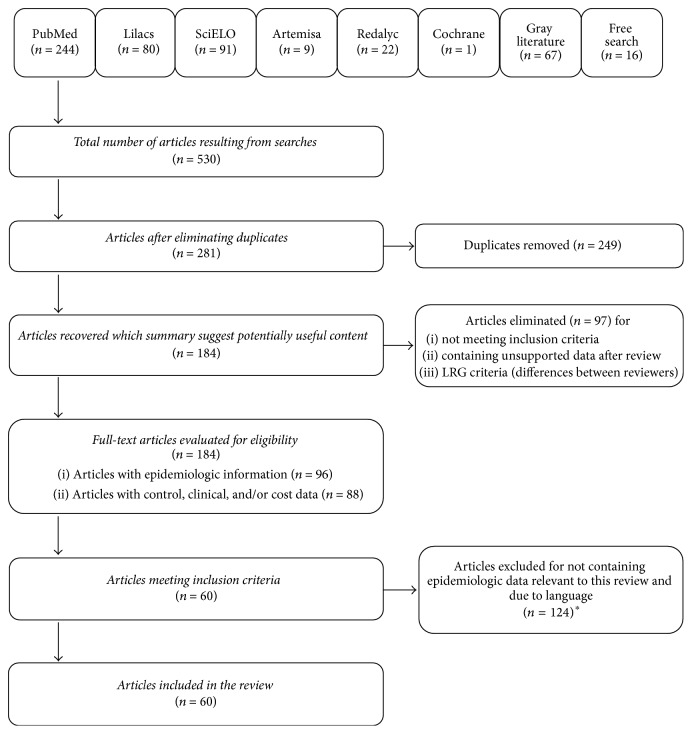
Dengue, an important mosquito-borne virus transmitted mainly by , is a major public health issue in Latin America and the Caribbean. National epidemiological surveillance systems, usually based on passive detection of symptomatic cases, while underestimating the true burden of dengue disease, can provide valuable insight into disease trends and excess reporting and potential outbreaks. We carried out a systematic review of the literature to characterize the recent epidemiology of dengue disease in Latin America and the English-speaking and Hispanic Caribbean Islands. We identified 530 articles, 60 of which met criteria for inclusion. In general, dengue seropositivity across the region was high and increased with age. All four virus serotypes were reported to circulate in the region. These observations varied considerably between and within countries and over time, potentially due to climatic factors (temperature, rainfall, and relative humidity) and their effect on mosquito densities and differences in socioeconomic factors. This review provides important insight into the major epidemiological characteristics of dengue in distinct regions of Latin America and the Caribbean, allowing gaps in current knowledge and future research needs to be identified.
登革热是一种主要由蚊子传播的重要病毒,在拉丁美洲和加勒比地区是一个重大的公共卫生问题。国家流行病学监测系统通常基于对有症状病例的被动检测,虽然会低估登革热疾病的真实负担,但能为疾病趋势、超额报告及潜在疫情提供有价值的见解。我们对文献进行了系统综述,以描述拉丁美洲以及英语和西班牙语加勒比岛屿登革热疾病的近期流行病学特征。我们共识别出530篇文章,其中60篇符合纳入标准。总体而言,该地区的登革热血清阳性率较高且随年龄增长而上升。据报道,所有四种病毒血清型都在该地区传播。这些观察结果在不同国家之间、国家内部以及不同时间存在很大差异,这可能是由于气候因素(温度、降雨和相对湿度)及其对蚊子密度的影响以及社会经济因素的差异所致。本综述为拉丁美洲和加勒比不同地区登革热的主要流行病学特征提供了重要见解,有助于识别当前知识的空白以及未来的研究需求。