Émond Marcel, Grenier David, Morin Jacques, Eagles Debra, Boucher Valérie, Le Sage Natalie, Mercier Éric, Voyer Philippe, Lee Jacques S
Centre d'Excellence sur le Vieillissement de Québec, Québec, QC, Canada; CHU de Québec-Hôpital de l'Enfant-Jésus, Québec, QC, Canada; Département de médecine familiale et de médecine d'urgence, Université Laval, Québec, QC, Canada.
Ottawa Health Research Institute, Ottawa, ON, Canada.
Can Geriatr J. 2017 Mar 31;20(1):10-14. doi: 10.5770/cgj.20.246. eCollection 2017 Mar.
Caring for older patients can be challenging in the Emergency Department (ED). A > 12 hr ED stay could lead to incident episodes of delirium in those patients. The aim of this study was to assess the incidence and impacts of ED-stay associated delirium.
A historical cohort of patients who presented to a Canadian ED in 2009 and 2011 was randomly constituted. Included patients were aged ≥ 65 years old, admitted to any hospital ward, non-delirious upon arrival and had at least a 12-hour ED stay. Delirium was detected using a modified chart-based Confusion Assessment Method (CAM) tool. Hospital length of stay (LOS) was log-transformed and linear regression assessed differences between groups. Adjustments were made for age and comorbidity profile.
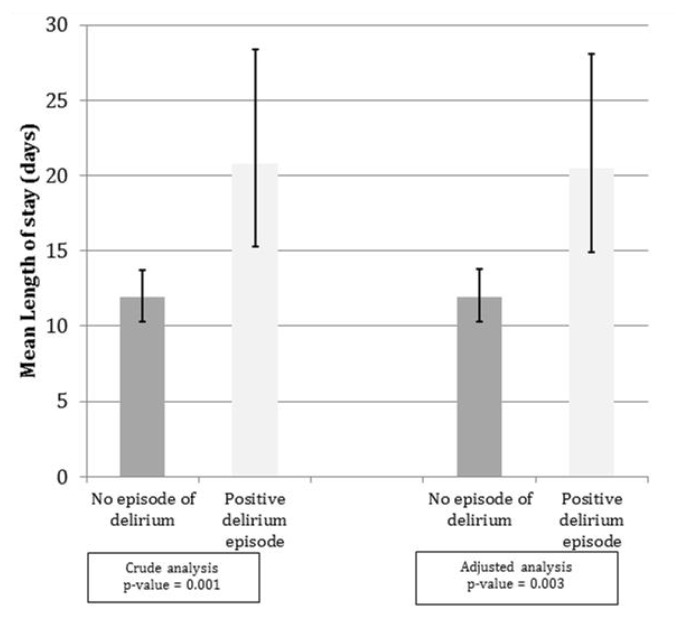
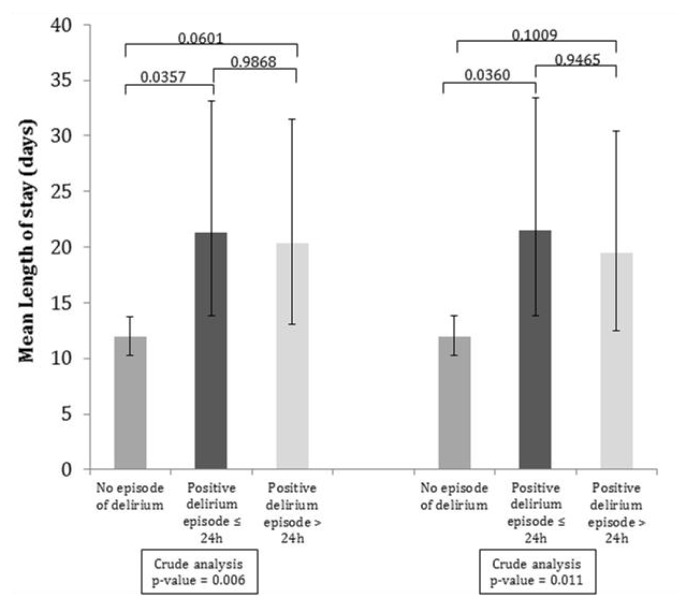
200 records were reviewed, 55.5% were female, median age was 78.9 yrs (SD:7.3). 36(18%) patients experienced ED-stay associated delirium. Nearly 50% of episodes started in the ED and within 36 hours of arrival. Comorbidity profile was similar between the positive CAM group and the negative CAM group. Mean adjusted hospital LOS were 20.5 days and 11.9 days respectively (<.03).
1 older adult out of 5 became delirious after a 12 hr ED stay. Since delirium increases hospital LOS by more than a week, better screening and implementation of preventing measures for delirium could reduce LOS and overcrowding in the ED.
在急诊科(ED)护理老年患者可能具有挑战性。急诊停留超过12小时可能会导致这些患者出现谵妄发作。本研究的目的是评估与急诊停留相关的谵妄的发生率和影响。
随机选取2009年和2011年到加拿大急诊科就诊的患者组成一个历史队列。纳入的患者年龄≥65岁,入住任何医院病房,入院时无谵妄且在急诊科至少停留12小时。使用改良的基于图表的谵妄评估方法(CAM)工具检测谵妄。将住院时间(LOS)进行对数转换,并通过线性回归评估组间差异。对年龄和合并症情况进行了调整。
共审查了200份记录,55.5%为女性,中位年龄为78.9岁(标准差:7.3)。36名(18%)患者出现了与急诊停留相关的谵妄。近50%的发作始于急诊科且在到达后36小时内。CAM阳性组和阴性组的合并症情况相似。调整后的平均住院时间分别为20.5天和11.9天(<.03)。
每5名老年患者中就有1名在急诊停留12小时后出现谵妄。由于谵妄会使住院时间增加超过一周,更好地筛查和实施谵妄预防措施可以减少住院时间和急诊科的拥挤情况。