Cho Charles J, Myung Seung-Jae, Chang Suhwan
Department of Biomedical Sciences, University of Ulsan College of Medicine, Asan Medical Center, Seoul 05505, Korea.
Department of Gastroenterology and Convergence Medicine, University of Ulsan College of Medicine, Asan Medical Center, Seoul 05505, Korea.
Int J Mol Sci. 2017 Apr 11;18(4):799. doi: 10.3390/ijms18040799.
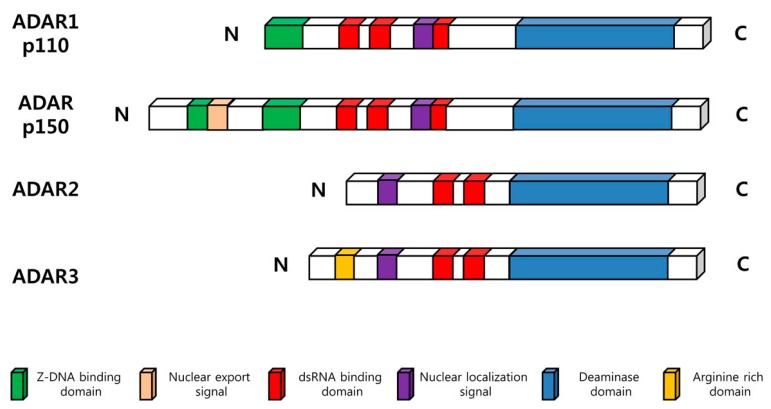
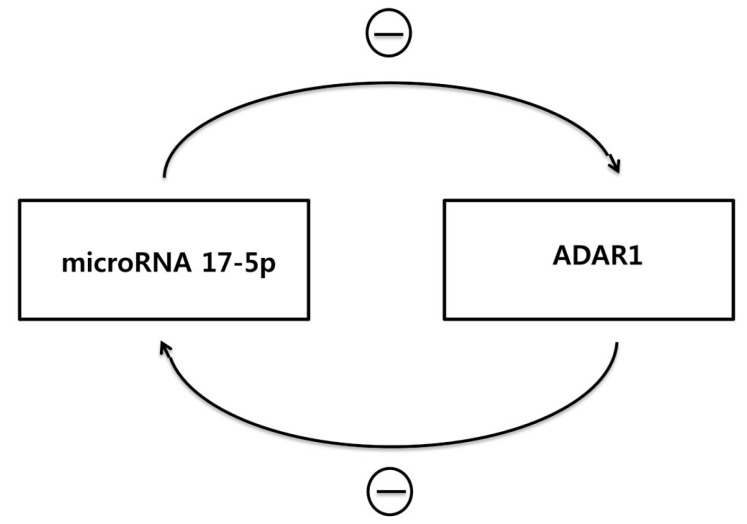
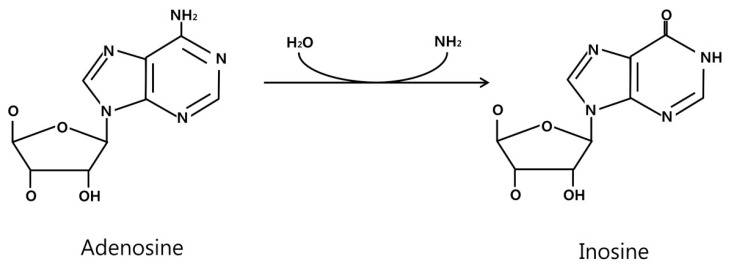
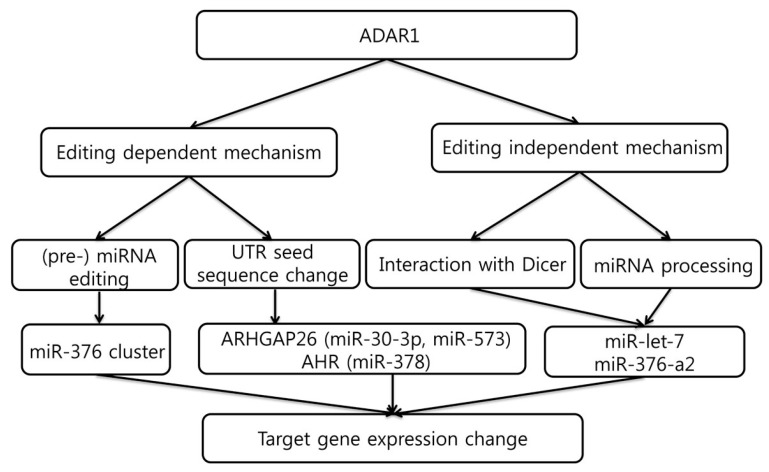
The evolution of cancer cells is believed to be dependent on genetic or epigenetic alterations. However, this concept has recently been challenged by another mode of nucleotide alteration, RNA editing, which is frequently up-regulated in cancer. RNA editing is a biochemical process in which either Adenosine or Cytosine is deaminated by a group of RNA editing enzymes including ADAR (Adenosine deaminase; RNA specific) or APOBEC3B (Apolipoprotein B mRNA Editing Enzyme Catalytic Subunit 3B). The result of RNA editing is usually adenosine to inosine (A-to-I) or cytidine to uridine (C-to-U) transition, which can affect protein coding, RNA stability, splicing and microRNA-target interactions. The functional impact of these alterations is largely unclear and is a subject of extensive research. In the present review, we will specifically focus on the influence of ADARs on carcinogenesis via the regulation of microRNA processing and functioning. This follows a brief review of the current knowledge of properties of ADAR enzyme, RNA editing, and microRNA processing.
癌细胞的进化被认为依赖于基因或表观遗传改变。然而,这一概念最近受到了另一种核苷酸改变模式——RNA编辑的挑战,RNA编辑在癌症中经常上调。RNA编辑是一种生化过程,其中腺苷或胞嘧啶被一组RNA编辑酶脱氨基,这些酶包括ADAR(腺苷脱氨酶;RNA特异性)或APOBEC3B(载脂蛋白B mRNA编辑酶催化亚基3B)。RNA编辑的结果通常是腺苷到次黄苷(A-to-I)或胞苷到尿苷(C-to-U)的转变,这会影响蛋白质编码、RNA稳定性、剪接和微小RNA-靶标相互作用。这些改变的功能影响在很大程度上尚不清楚,是广泛研究的主题。在本综述中,我们将特别关注ADARs通过调节微小RNA加工和功能对致癌作用的影响。在此之前,先简要回顾一下目前关于ADAR酶、RNA编辑和微小RNA加工特性的知识。