Dassanayake Maheshi, Larkin John C
Department of Biological Sciences, Louisiana State University, Baton Rouge LA, USA.
Front Plant Sci. 2017 Mar 28;8:406. doi: 10.3389/fpls.2017.00406. eCollection 2017.
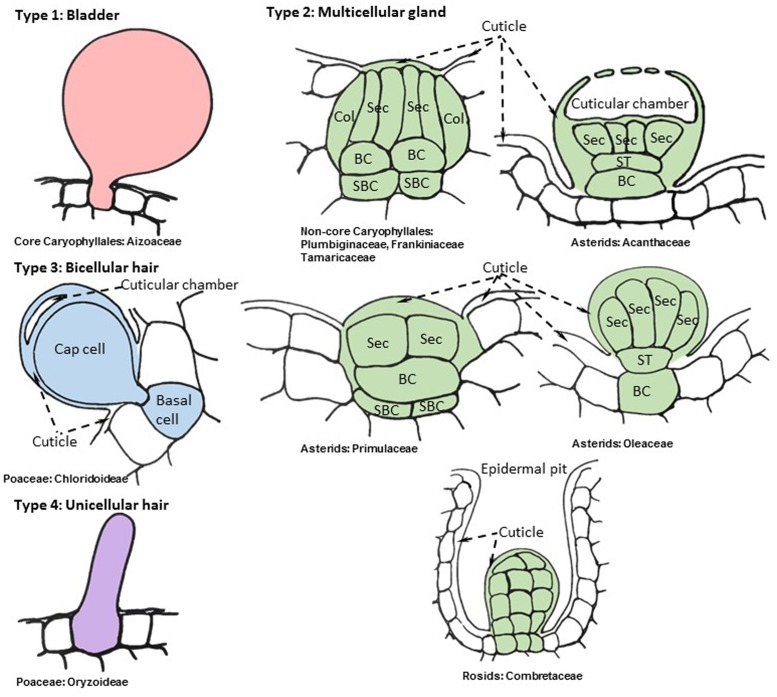
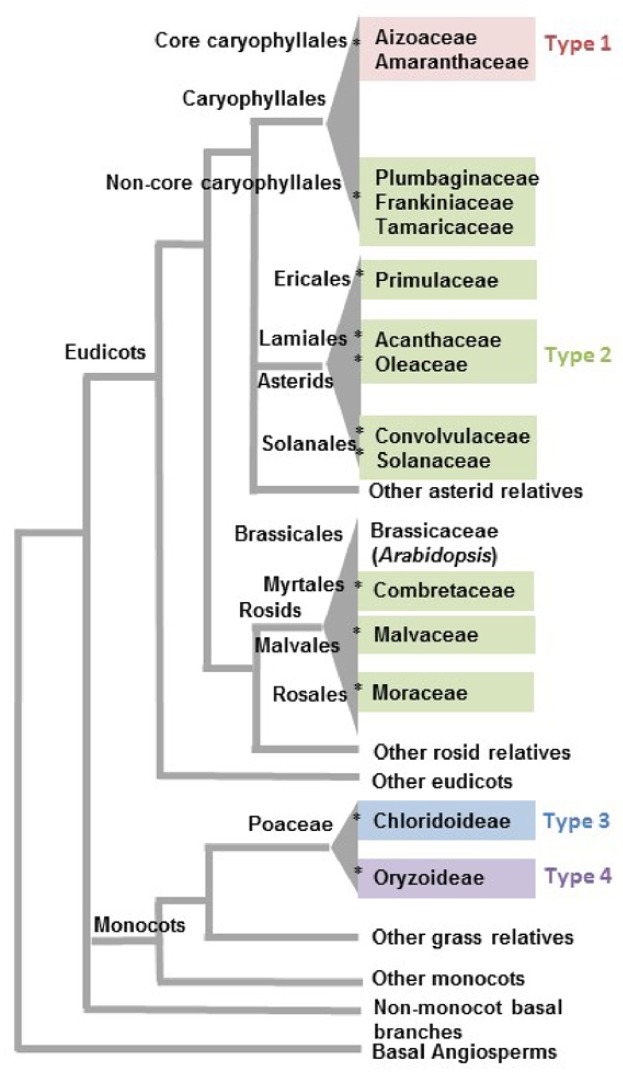
Salt stress is a complex trait that poses a grand challenge in developing new crops better adapted to saline environments. Some plants, called recretohalophytes, that have naturally evolved to secrete excess salts through salt glands, offer an underexplored genetic resource for examining how plant development, anatomy, and physiology integrate to prevent excess salt from building up to toxic levels in plant tissue. In this review we examine the structure and evolution of salt glands, salt gland-specific gene expression, and the possibility that all salt glands have originated via evolutionary modifications of trichomes. Salt secretion via salt glands is found in more than 50 species in 14 angiosperm families distributed in caryophyllales, asterids, rosids, and grasses. The salt glands of these distantly related clades can be grouped into four structural classes. Although salt glands appear to have originated independently at least 12 times, they share convergently evolved features that facilitate salt compartmentalization and excretion. We review the structural diversity and evolution of salt glands, major transporters and proteins associated with salt transport and secretion in halophytes, salt gland relevant gene expression regulation, and the prospect for using new genomic and transcriptomic tools in combination with information from model organisms to better understand how salt glands contribute to salt tolerance. Finally, we consider the prospects for using this knowledge to engineer salt glands to increase salt tolerance in model species, and ultimately in crops.
盐胁迫是一个复杂的性状,在培育更适应盐渍环境的新作物方面构成了巨大挑战。一些植物,即泌盐盐生植物,通过盐腺自然进化出分泌过量盐分的能力,为研究植物发育、解剖结构和生理机能如何整合以防止过量盐分在植物组织中积累到有毒水平提供了一个尚未充分探索的遗传资源。在这篇综述中,我们研究了盐腺的结构和进化、盐腺特异性基因表达,以及所有盐腺是否都起源于表皮毛的进化修饰的可能性。通过盐腺分泌盐分在石竹目、菊类植物、蔷薇类植物和禾本科的14个被子植物科的50多个物种中被发现。这些远缘分支的盐腺可分为四个结构类别。尽管盐腺似乎至少独立起源了12次,但它们具有趋同进化的特征,有利于盐分的区室化和排泄。我们综述了盐腺的结构多样性和进化、与盐生植物中盐分运输和分泌相关的主要转运蛋白和蛋白质、盐腺相关基因表达调控,以及利用新的基因组和转录组工具结合模式生物的信息来更好地理解盐腺如何促进耐盐性的前景。最后,我们考虑利用这些知识来设计盐腺以提高模式物种,最终提高作物耐盐性的前景。