
土壤压实条件下小麦的遗传多样性:根数作为早期植株活力的一个有前景的性状
Genetic Diversity under Soil Compaction in Wheat: Root Number as a Promising Trait for Early Plant Vigor.
作者信息
Colombi Tino, Walter Achim
机构信息
Institute of Agricultural Sciences ETH Zurich Zurich, Switzerland.
出版信息
Front Plant Sci. 2017 Mar 28;8:420. doi: 10.3389/fpls.2017.00420. eCollection 2017.
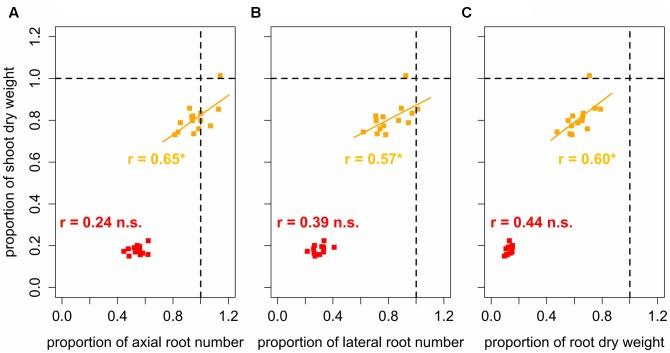
Soil compaction of arable land, caused by heavy machinery constitutes a major threat to agricultural soils in industrialized countries. The degradation of soil structure due to compaction leads to decreased (macro-) porosity resulting in increased mechanical impedance, which adversely affects root growth and crop productivity. New crop cultivars, with root systems that are adapted to conditions of increased soil strength, are needed to overcome the limiting effects of soil compaction on plant growth. This study aimed (i) to quantify the genetic diversity of early root system development in wheat and to relate this to shoot development under different soil bulk densities and (ii) to test whether root numbers are suitable traits to assess the genotypic tolerance to soil compaction. Fourteen wheat genotypes were grown for 3 weeks in a growth chamber under low (1.3 g cm), moderate (1.45 g cm), and high soil bulk density (1.6 g cm). Using X-ray computed tomography root system development was quantified in weekly intervals, which was complemented by weekly measurements of plant height. The development of the root system, quantified via the number of axial and lateral roots was strongly correlated (0.78 < < 0.88, < 0.01) to the development of plant height. Furthermore, significant effects ( < 0.01) of the genotype on root system development and plant vigor traits were observed. Under moderate soil strength final axial and lateral root numbers were significantly correlated (0.57 < < 0.84, < 0.05) to shoot dry weight. Furthermore, broad-sense heritability of axial and lateral root number was higher than 50% and comparable to values calculated for shoot traits. Our results showed that there is genetic diversity in wheat with respect to root system responses to increased soil strength and that root numbers are suitable indicators to explain the responses and the tolerance to such conditions. Since root numbers are heritable and can be assessed at high throughput rates under laboratory and field conditions, root number is considered a promising trait for screening toward compaction tolerant varieties.
在工业化国家,重型机械导致的耕地土壤压实对农业土壤构成了重大威胁。压实导致的土壤结构退化会使(大)孔隙度降低,进而增加机械阻抗,对根系生长和作物生产力产生不利影响。需要培育具有适应土壤强度增加条件的根系的新作物品种,以克服土壤压实对植物生长的限制作用。本研究旨在:(i)量化小麦早期根系发育的遗传多样性,并将其与不同土壤容重下的地上部发育相关联;(ii)测试根数量是否是评估基因型对土壤压实耐受性的合适性状。14个小麦基因型在生长室中于低(1.3 g/cm³)、中(1.45 g/cm³)和高土壤容重(1.6 g/cm³)条件下生长3周。使用X射线计算机断层扫描每周对根系发育进行量化,并每周测量株高作为补充。通过轴向根和侧根数量量化的根系发育与株高发育密切相关(0.78<r<0.88,P<0.01)。此外,观察到基因型对根系发育和植株活力性状有显著影响(P<0.01)。在中等土壤强度下,最终轴向根和侧根数量与地上部干重显著相关(0.57<r<0.84,P<0.05)。此外,轴向根和侧根数量的广义遗传力高于50%,与地上部性状计算值相当。我们的结果表明,小麦在根系对土壤强度增加的响应方面存在遗传多样性,根数量是解释对这种条件的响应和耐受性的合适指标。由于根数量具有遗传性,并且可以在实验室和田间条件下进行高通量评估,因此根数量被认为是筛选耐压实品种的一个有前景的性状。


 Zotero 插件