Department of Plant Science, The Pennsylvania State University, University Park, Pennsylvania, USA.
School of Biosciences, University of Nottingham, Leicestershire, UK.
Plant Cell Environ. 2022 Mar;45(3):620-636. doi: 10.1111/pce.14213. Epub 2021 Nov 29.
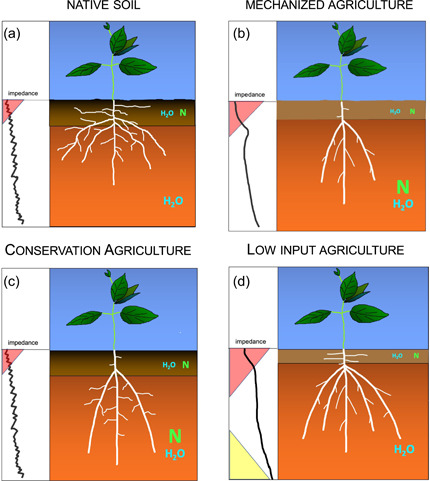
Mechanical impedance constrains root growth in most soils. Crop cultivation changed the impedance characteristics of native soils, through topsoil erosion, loss of organic matter, disruption of soil structure and loss of biopores. Increasing adoption of Conservation Agriculture in high-input agroecosystems is returning cultivated soils to the soil impedance characteristics of native soils, but in the low-input agroecosystems characteristic of developing nations, ongoing soil degradation is generating more challenging environments for root growth. We propose that root phenotypes have evolved to adapt to the altered impedance characteristics of cultivated soil during crop domestication. The diverging trajectories of soils under Conservation Agriculture and low-input agroecosystems have implications for strategies to develop crops to meet global needs under climate change. We present several root ideotypes as breeding targets under the impedance regimes of both high-input and low-input agroecosystems, as well as a set of root phenotypes that should be useful in both scenarios. We argue that a 'whole plant in whole soil' perspective will be useful in guiding the development of future crops for future soils.
机械阻抗限制了大多数土壤中根系的生长。作物栽培通过表土侵蚀、有机质损失、土壤结构破坏和生物孔损失,改变了原生土壤的阻抗特性。高投入农业生态系统中保护性农业的日益普及正在使耕作土壤恢复到原生土壤的土壤阻抗特性,但在发展中国家具有低投入农业生态系统特征的情况下,土壤的持续退化正在为根系生长创造更具挑战性的环境。我们提出,在作物驯化过程中,根表型已经进化以适应耕作土壤改变后的阻抗特性。保护性农业和低投入农业生态系统下土壤的不同轨迹对制定应对气候变化下满足全球需求的作物发展战略具有重要意义。我们提出了几种根理想型作为高投入和低投入农业生态系统中阻抗条件下的选育目标,以及一套在两种情况下都可能有用的根表型。我们认为,“整个植株在整个土壤中”的观点将有助于指导未来土壤中未来作物的开发。