Bailey Lane B, Thigpen Charles A, Hawkins Richard J, Beattie Paul F, Shanley Ellen
Memorial Hermann's Ironman Sports Medicine Institute, Houston, Texas.
ATI Physical Therapy, Greenville, South Carolina.
Sports Health. 2017 May/Jun;9(3):230-237. doi: 10.1177/1941738117702835. Epub 2017 Apr 12.
Baseball players displaying deficits in shoulder range of motion (ROM) are at increased risk of arm injury. Currently, there is a lack of consensus regarding the best available treatment options to restore shoulder ROM.
Instrumented manual therapy with self-stretching will result in clinically significant deficit reductions when compared with self-stretching alone.
Controlled laboratory study.
Shoulder ROM and humeral torsion were assessed in 60 active baseball players (mean age, 19 ± 2 years) with ROM deficits (nondominant - dominant, ≥15°). Athletes were randomly assigned to receive a single treatment of instrumented manual therapy plus self-stretching (n = 30) or self-stretching only (n = 30). Deficits in internal rotation, horizontal adduction, and total arc of motion were compared between groups immediately before and after a single treatment session. Treatment effectiveness was determined by mean comparison data, and a number-needed-to-treat (NNT) analysis was used for assessing the presence of ROM risk factors.
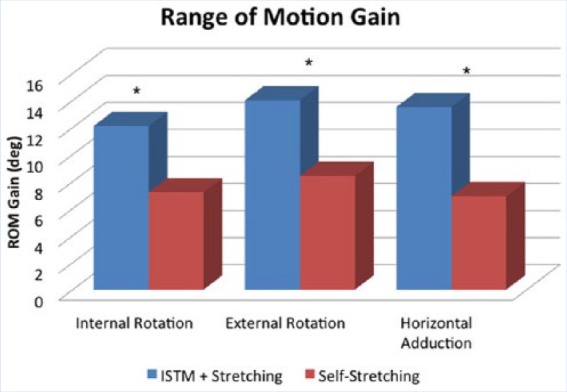
Prior to intervention, players displayed significant ( P < 0.001) dominant-sided deficits in internal rotation (-26°), total arc of motion (-18°), and horizontal adduction (-17°). After the intervention, both groups displayed significant improvements in ROM, with the instrumented manual therapy plus self-stretching group displaying greater increases in internal rotation (+5°, P = 0.010), total arc of motion (+6°, P = 0.010), and horizontal adduction (+7°, P = 0.004) compared with self-stretching alone. For horizontal adduction deficits, the added use of instrumented manual therapy with self-stretching decreased the NNT to 2.2 (95% CI, 2.1-2.4; P = 0.010).
Instrumented manual therapy with self-stretching significantly reduces ROM risk factors in baseball players with motion deficits when compared with stretching alone.
The added benefits of manual therapy may help to reduce ROM deficits in clinical scenarios where stretching alone is ineffective.
肩部活动范围(ROM)存在缺陷的棒球运动员手臂受伤风险增加。目前,对于恢复肩部ROM的最佳可用治疗方案缺乏共识。
与单纯自我拉伸相比,仪器辅助手法治疗结合自我拉伸将导致临床上显著减少缺陷。
对照实验室研究。
对60名有ROM缺陷(非优势侧-优势侧,≥15°)的现役棒球运动员(平均年龄,19±2岁)进行肩部ROM和肱骨扭转评估。运动员被随机分配接受单次仪器辅助手法治疗加自我拉伸(n = 30)或仅自我拉伸(n = 30)。在单次治疗前和治疗后立即比较两组在内旋、水平内收和总运动弧方面的缺陷。通过平均比较数据确定治疗效果,并使用需治疗人数(NNT)分析来评估ROM风险因素的存在。
干预前,运动员在优势侧内旋(-26°)、总运动弧(-18°)和水平内收(-17°)方面存在显著(P < 0.001)缺陷。干预后,两组的ROM均有显著改善,与单纯自我拉伸相比,仪器辅助手法治疗加自我拉伸组在内旋(+5°,P = 0.010)、总运动弧(+6°,P = 0.010)和水平内收(+7°,P = 0.004)方面的增加更大。对于水平内收缺陷,仪器辅助手法治疗结合自我拉伸的额外使用将NNT降低至2.2(95%CI,2.1 - 2.4;P = 0.010)。
与单纯拉伸相比,仪器辅助手法治疗结合自我拉伸可显著降低有运动缺陷的棒球运动员的ROM风险因素。
手法治疗的额外益处可能有助于在单纯拉伸无效的临床情况下减少ROM缺陷。