Sun Xiao-Jie, Wang Qiang, Guo Baofeng, Liu Xian-Ying, Wang Bing
Department of Plastic and Reconstruction Surgery, China-Japan Union Hospital of Jilin University, Changchun, China.
Department of Obstetrics and Gynecology, Second Hospital of Jilin University, Changchun, China.
Oncotarget. 2017 May 23;8(21):34236-34244. doi: 10.18632/oncotarget.15880.
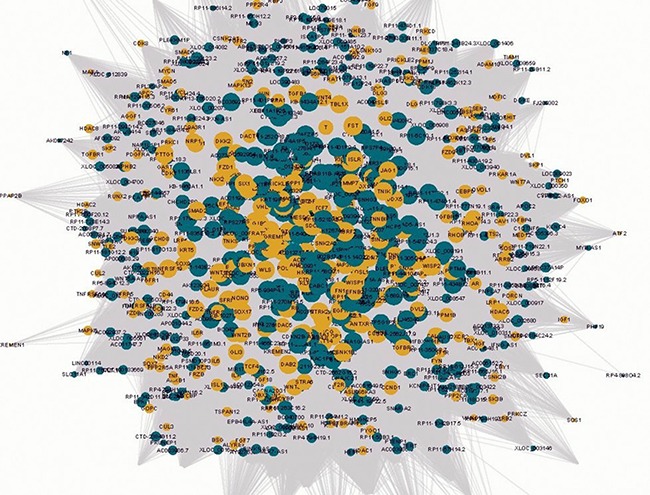
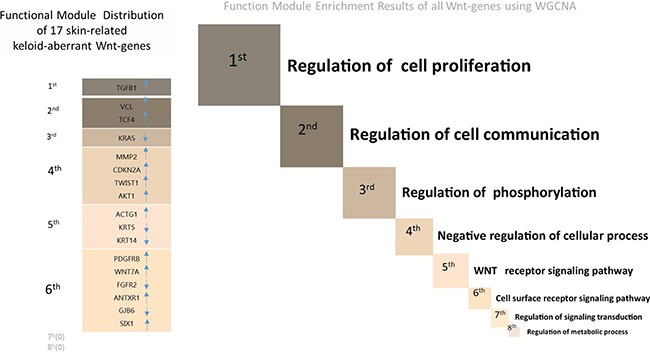
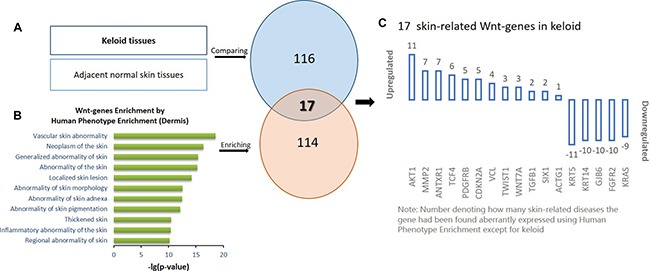
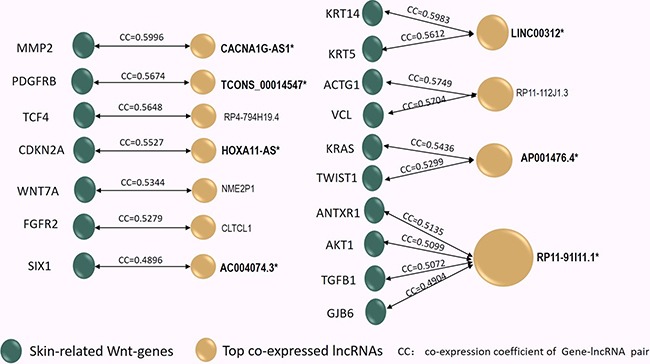
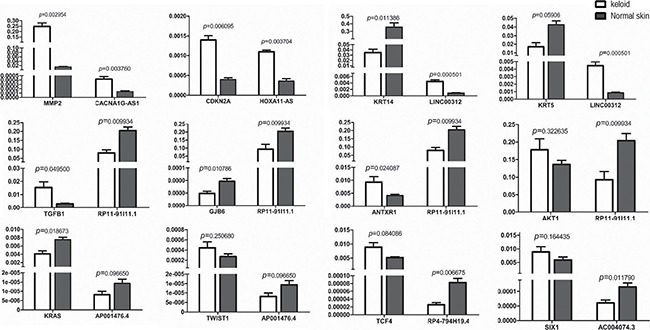
The long non-coding RNAs (lncRNAs) regulating encoding transcripts/genes involved in Wnt signalling pathway in keloids is largely unclear. We used a pathway-focused lncRNA microarray to detect the differentiated expression profiles of both lncRNAs and genes involved in Wnt pathway, thus a total of 116 Wnt-targeted genes and 69 Wnt-related lncRNAs aberrantly expressed in keloids were initially identified. A stepwise bioinformatics was further performed to find skin-related lncRNA/gene pairs in Wnt pathway in keloids. Firstly, an lncRNA/gene co-expression network with clustered functional modules was constructed; simultaneously, 114 Wnt-genes regarding to dermis were online enriched using Phenotype Enrichment. Secondly, 17 skin-related keloid-aberrant Wnt-genes were acquired by overlapping the 114 skin-related Wnt-genes with the 116 keloid-aberrant Wnt-genes. Thirdly, after co-expression coefficient of each lncRNA/gene profile being ranked respectively, 11 top co-expressed lncRNAs characterized with the highest co-expression coefficients to the 17 genes were identified. Fourthly, seven of the 11 top co-expressed lncRNAs exhibiting array-detected aberrant expression in keloids, together with their 12 most interactive Wnt-genes, were selected to undergo in-pair intracellularly quantitative PCR validation in keloids. As a result, four lncRNAs including CACNA1G-AS1, HOXA11-AS, LINC00312 and RP11-91I11.1 with their six paired Wnt-genes undergoing both array-and-qPCR as well as lncRNA-and-gene double validation were finally identified as skin-related lncRNA/gene pairs that involved in Wnt signalling pathway in keloids. In conclusion, in-depth exploration on these easily-accessible lncRNAs in keloids might aid to find the novel target on how to maintain highly recurrent tumours benign via Wnt-involved network regulation.
瘢痕疙瘩中调控参与Wnt信号通路的编码转录本/基因的长链非编码RNA(lncRNA)情况在很大程度上尚不清楚。我们使用了一种针对通路的lncRNA微阵列来检测lncRNA和参与Wnt通路的基因的差异表达谱,从而初步鉴定出116个在瘢痕疙瘩中异常表达的Wnt靶向基因和69个与Wnt相关的lncRNA。进一步进行了逐步生物信息学分析,以寻找瘢痕疙瘩中Wnt通路中与皮肤相关的lncRNA/基因对。首先,构建了一个具有聚类功能模块的lncRNA/基因共表达网络;同时,使用表型富集在线富集了114个与真皮相关的Wnt基因。其次,通过将114个与皮肤相关的Wnt基因与116个瘢痕疙瘩异常Wnt基因进行重叠,获得了17个与皮肤相关的瘢痕疙瘩异常Wnt基因。第三,在分别对每个lncRNA/基因谱的共表达系数进行排序后,鉴定出了11个与17个基因共表达系数最高的顶级共表达lncRNA。第四,选择11个顶级共表达lncRNA中的7个在瘢痕疙瘩中表现出阵列检测到的异常表达,以及它们12个最具相互作用的Wnt基因,在瘢痕疙瘩中进行细胞内成对定量PCR验证。结果,最终鉴定出包括CACNA1G-AS1、HOXA11-AS、LINC00312和RP11-91I11.1在内的4个lncRNA及其6对配对的Wnt基因,它们经过了阵列和qPCR以及lncRNA和基因的双重验证,是参与瘢痕疙瘩中Wnt信号通路的与皮肤相关的lncRNA/基因对。总之,对瘢痕疙瘩中这些易于获取的lncRNA进行深入探索可能有助于找到通过Wnt相关网络调控使高复发性肿瘤保持良性的新靶点。