Amosova Alexandra V, Bolsheva Nadezhda L, Zoshchuk Svyatoslav A, Twardovska Maryana O, Yurkevich Olga Yu, Andreev Igor O, Samatadze Tatiana E, Badaeva Ekaterina D, Kunakh Viktor A, Muravenko Olga V
Engelhardt Institute of Molecular Biology, Russian Academy of Sciences, Moscow, Russian Federation.
Institute of Molecular Biology and Genetics, National Academy of Sciences of Ukraine, Kyiv, Ukraine.
PLoS One. 2017 Apr 13;12(4):e0175760. doi: 10.1371/journal.pone.0175760. eCollection 2017.
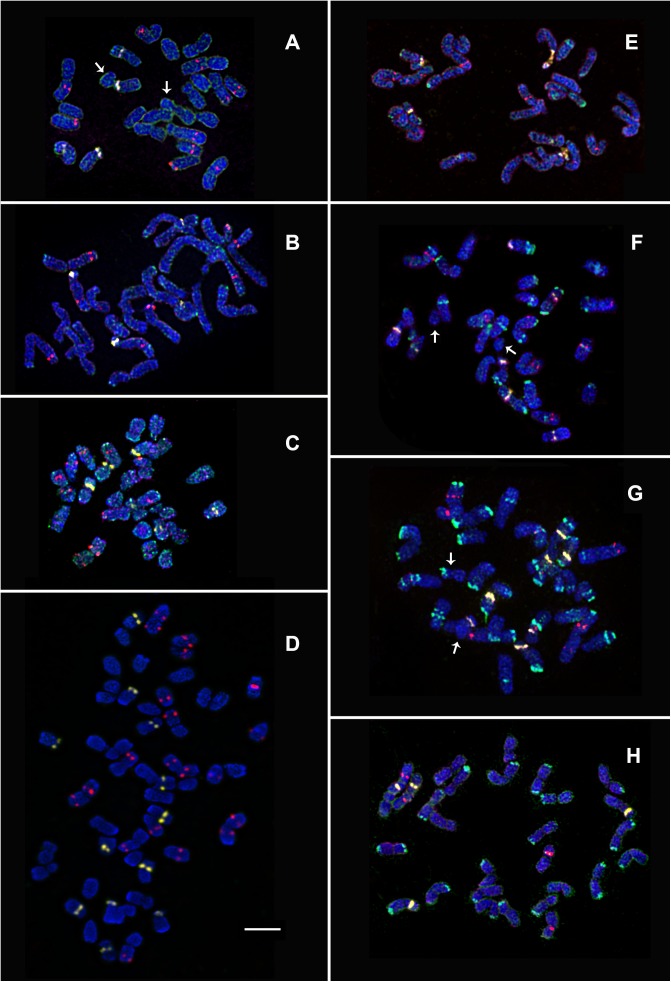
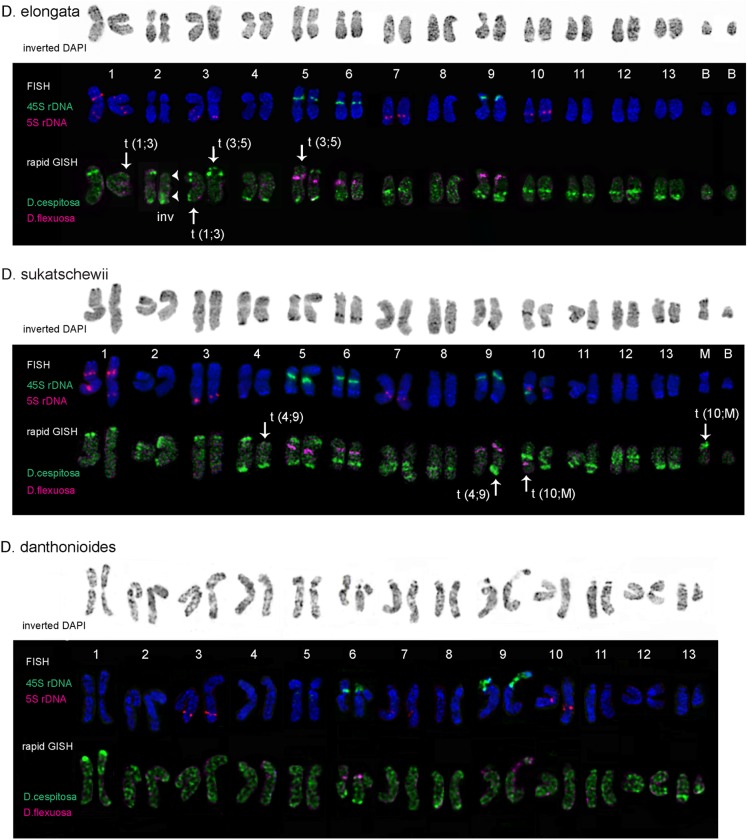
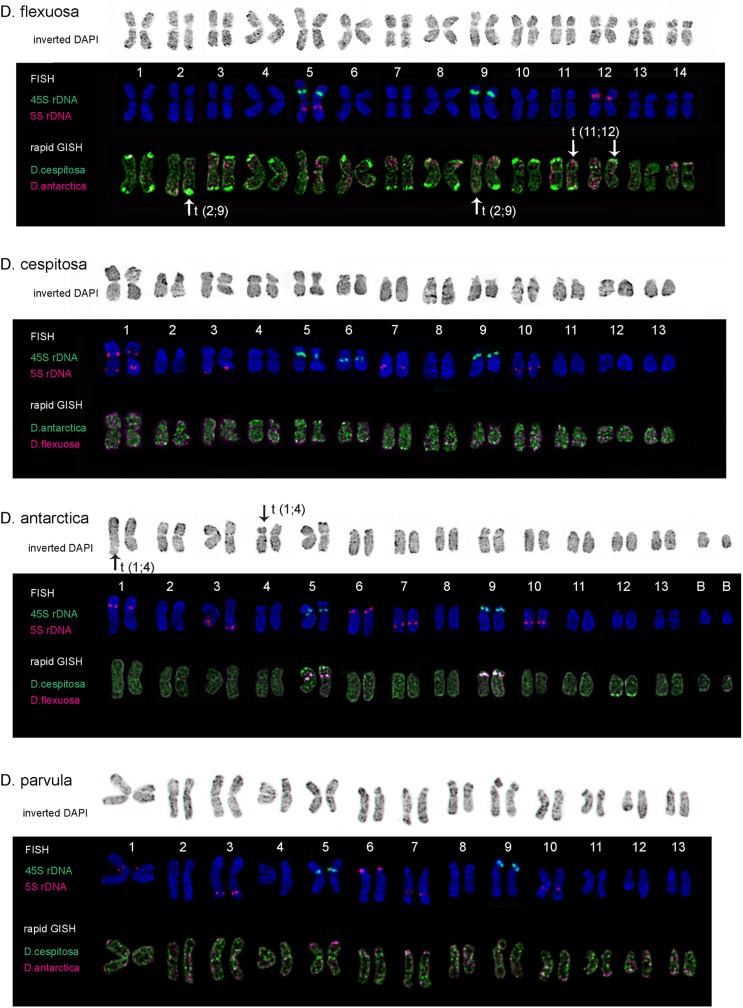
The genus Deschampsia P. Beauv (Poaceae) involves a group of widespread polymorphic species. Some of them are highly tolerant to stressful and variable environmental conditions, and D. antarctica is one of the only two vascular plants growing in Antarctic. This species is a source of useful for selection traits and a valuable model for studying an environmental stress tolerance in plants. Genome diversity and comparative chromosomal phylogeny within the genus have not been studied yet as karyotypes of most Deschampsia species are poorly investigated. We firstly conducted a comparative molecular cytogenetic analysis of D. antarctica (Antarctic Peninsula) and related species from various localities (D. cespitosa, D. danthonioides, D. elongata, D. flexuosa (= Avenella flexuosa), D. parvula and D. sukatschewii by fluorescence in situ hybridization with 45S and 5S rDNA, DAPI-banding and sequential rapid in situ hybridization with genomic DNA of D. antarctica, D. cespitosa, and D. flexuosa. Based on patterns of distribution of the examined markers, chromosomes of the studied species were identified. Within these species, common features as well as species peculiarities in their karyotypic structure and chromosomal distribution of molecular cytogenetic markers were characterized. Different chromosomal rearrangements were detected in D. antarctica, D. flexuosa, D. elongata and D. sukatschewii. In karyotypes of D. antarctica, D. cespitosa, D. elongata and D. sukatschewii, 0-3 B chromosomes possessed distinct DAPI-bands were observed. Our findings suggest that the genome evolution of the genus Deschampsia involved polyploidy and also different chromosomal rearrangements. The obtained results will help clarify the relationships within the genus Deschampsia, and can be a basis for the further genetic and biotechnological studies as well as for selection of plants tolerant to extreme habitats.
发草属(禾本科)包含一组广泛分布的多态性物种。其中一些物种对压力大且多变的环境条件具有高度耐受性,而南极发草是仅有的两种生长在南极洲的维管植物之一。该物种是选择性状的有用来源,也是研究植物环境胁迫耐受性的有价值模型。由于大多数发草属物种的核型研究较少,该属内的基因组多样性和比较染色体系统发育尚未得到研究。我们首先通过用45S和5S rDNA进行荧光原位杂交、DAPI带型分析以及用南极发草、丛生发草和曲芒发草的基因组DNA进行连续快速原位杂交,对南极发草(南极半岛)和来自不同地区的相关物种(丛生发草、丹氏发草、长轴发草、曲芒发草(= 柔发草属)、小发草和苏氏发草)进行了比较分子细胞遗传学分析。根据所检测标记的分布模式,鉴定了研究物种的染色体。在这些物种中,对它们的核型结构和分子细胞遗传学标记的染色体分布的共同特征以及物种特异性进行了表征。在南极发草、曲芒发草、长轴发草和苏氏发草中检测到不同的染色体重排。在南极发草、丛生发草、长轴发草和苏氏发草的核型中,观察到0 - 3条具有明显DAPI带的B染色体。我们的研究结果表明,发草属的基因组进化涉及多倍体以及不同的染色体重排。所获得的结果将有助于阐明发草属内的关系,并可为进一步的遗传和生物技术研究以及耐极端生境植物的选择提供依据。