Zhao Yang, Hu Xingbin, Liu Yajing, Dong Shumin, Wen Zhaowei, He Wanming, Zhang Shuyi, Huang Qiong, Shi Min
Department of Oncology, Nanfang Hospital, Southern Medical University, Guangzhou, China.
Mol Cancer. 2017 Apr 13;16(1):79. doi: 10.1186/s12943-017-0648-1.
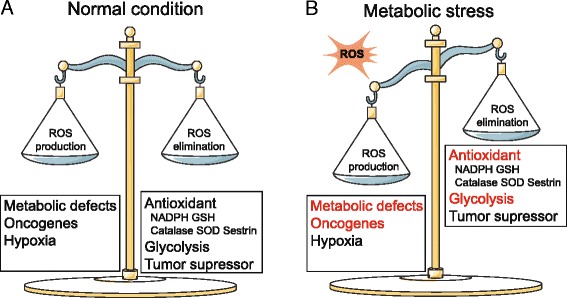
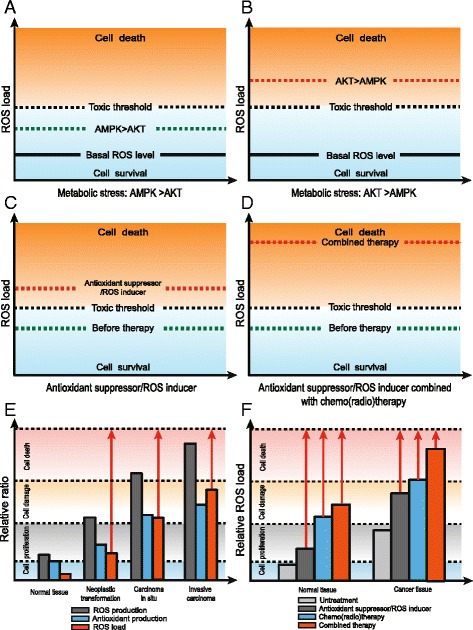
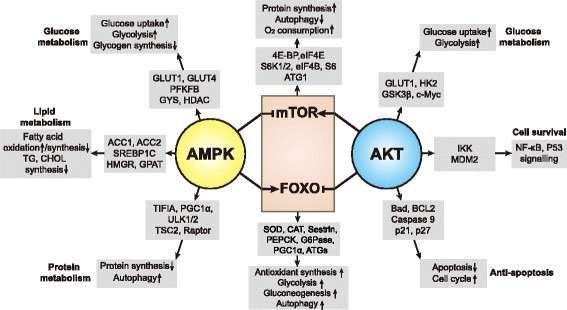
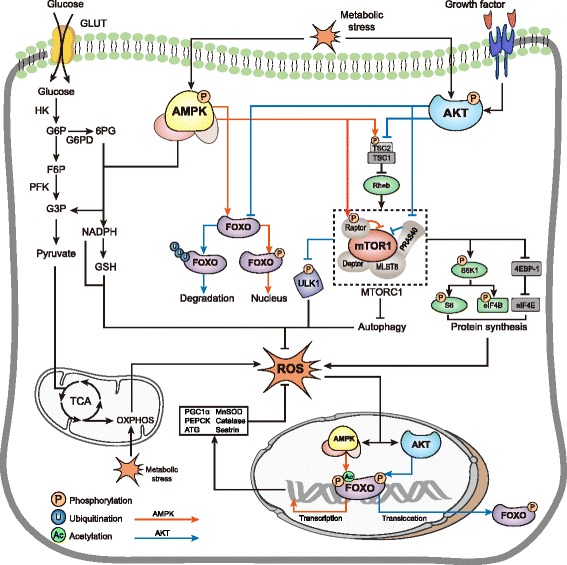
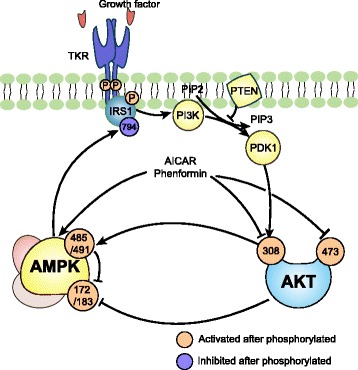
Cancer cells are frequently confronted with metabolic stress in tumor microenvironments due to their rapid growth and limited nutrient supply. Metabolic stress induces cell death through ROS-induced apoptosis. However, cancer cells can adapt to it by altering the metabolic pathways. AMPK and AKT are two primary effectors in response to metabolic stress: AMPK acts as an energy-sensing factor which rewires metabolism and maintains redox balance. AKT broadly promotes energy production in the nutrient abundance milieu, but the role of AKT under metabolic stress is in dispute. Recent studies show that AMPK and AKT display antagonistic roles under metabolic stress. Metabolic stress-induced ROS signaling lies in the hub between metabolic reprogramming and redox homeostasis. Here, we highlight the cross-talk between AMPK and AKT and their regulation on ROS production and elimination, which summarizes the mechanism of cancer cell adaptability under ROS stress and suggests potential options for cancer therapeutics.
由于癌细胞生长迅速且营养供应有限,它们在肿瘤微环境中经常面临代谢应激。代谢应激通过活性氧(ROS)诱导的细胞凋亡导致细胞死亡。然而,癌细胞可以通过改变代谢途径来适应这种应激。AMPK和AKT是应对代谢应激的两个主要效应器:AMPK作为一种能量感应因子,可重塑代谢并维持氧化还原平衡。AKT在营养丰富的环境中广泛促进能量产生,但AKT在代谢应激下的作用存在争议。最近的研究表明,AMPK和AKT在代谢应激下发挥拮抗作用。代谢应激诱导的ROS信号处于代谢重编程和氧化还原稳态之间的枢纽位置。在此,我们强调AMPK和AKT之间的相互作用及其对ROS产生和消除的调节,总结了ROS应激下癌细胞适应性的机制,并提出了癌症治疗的潜在选择。