Tschentscher Nadja, Mitchell Daniel, Duncan John
Medical Research Council, Cognition and Brain Sciences Unit, Cambridge CB2 7EF, United Kingdom and
Max Planck Institute for Human Cognitive and Brain Sciences, 04103 Leipzig, Germany.
J Neurosci. 2017 May 3;37(18):4841-4847. doi: 10.1523/JNEUROSCI.2478-16.2017. Epub 2017 Apr 13.
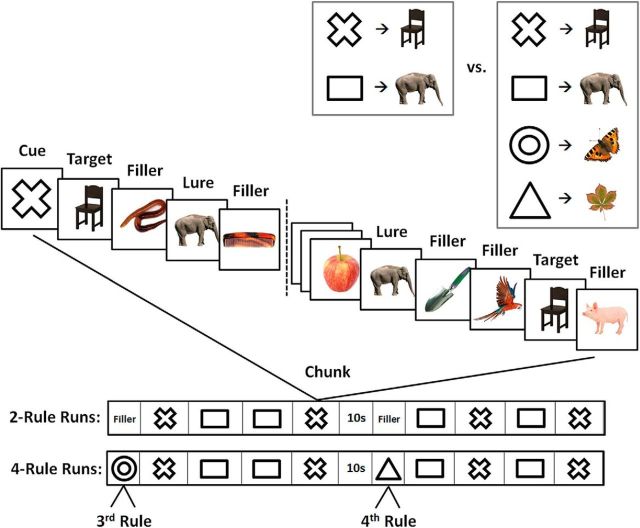
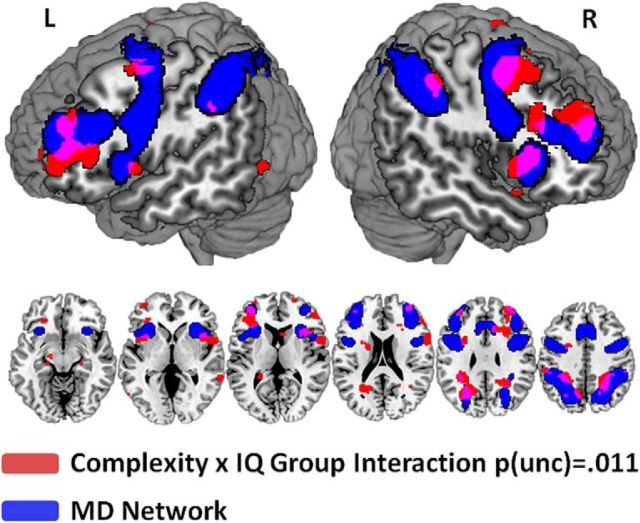
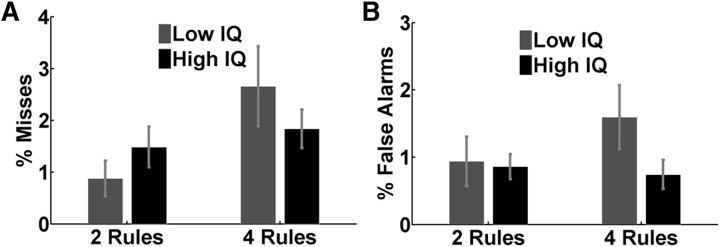
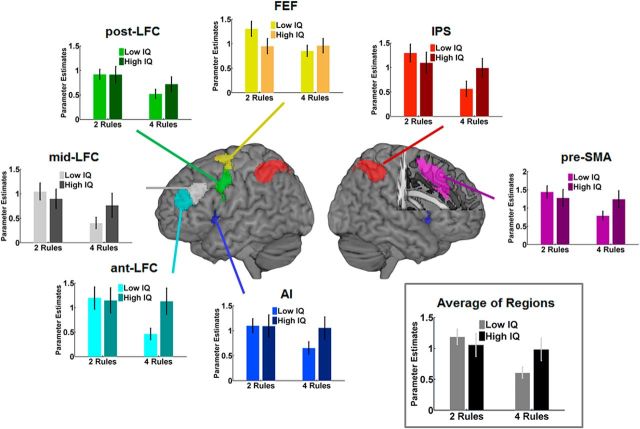
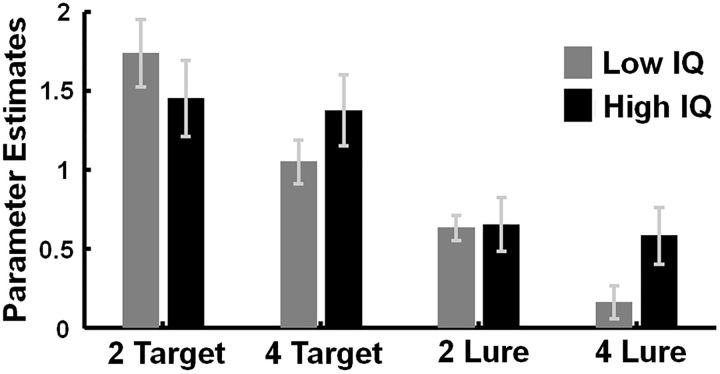
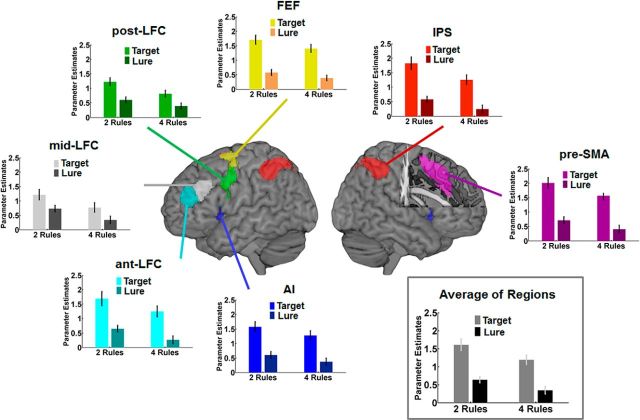
Fluid intelligence has been associated with a distributed cognitive control or multiple-demand (MD) network, comprising regions of lateral frontal, insular, dorsomedial frontal, and parietal cortex. Human fluid intelligence is also intimately linked to task complexity, and the process of solving complex problems in a sequence of simpler, more focused parts. Here, a complex target detection task included multiple independent rules, applied one at a time in successive task epochs. Although only one rule was applied at a time, increasing task complexity (i.e., the number of rules) impaired performance in participants of lower fluid intelligence. Accompanying this loss of performance was reduced response to rule-critical events across the distributed MD network. The results link fluid intelligence and MD function to a process of attentional focus on the successive parts of complex behavior. Fluid intelligence is intimately linked to the ability to structure complex problems in a sequence of simpler, more focused parts. We examine the basis for this link in the functions of a distributed frontoparietal or multiple-demand (MD) network. With increased task complexity, participants of lower fluid intelligence showed reduced responses to task-critical events. Reduced responses in the MD system were accompanied by impaired behavioral performance. Low fluid intelligence is linked to poor foregrounding of task-critical information across a distributed MD system.
流体智力与一种分布式认知控制或多需求(MD)网络相关联,该网络包括外侧额叶、岛叶、背内侧额叶和顶叶皮质区域。人类流体智力还与任务复杂性以及将复杂问题分解为一系列更简单、更聚焦的部分来解决的过程密切相关。在此,一项复杂目标检测任务包含多个独立规则,在连续的任务阶段依次应用一个规则。虽然每次仅应用一个规则,但任务复杂性的增加(即规则数量)会损害流体智力较低的参与者的表现。伴随着这种表现的下降,分布式MD网络对规则关键事件的反应也会减少。这些结果将流体智力和MD功能与对复杂行为连续部分的注意力聚焦过程联系起来。流体智力与将复杂问题构建为一系列更简单、更聚焦部分的能力密切相关。我们在分布式额顶叶或多需求(MD)网络的功能中研究这种联系的基础。随着任务复杂性的增加,流体智力较低的参与者对任务关键事件的反应减少。MD系统中的反应减少伴随着行为表现受损。低流体智力与分布式MD系统中任务关键信息的前景化不佳有关。