Ly Sovann, Arashiro Takeshi, Ieng Vanra, Tsuyuoka Reiko, Parry Amy, Horwood Paul, Heng Seng, Hamid Sarah, Vandemaele Katelijn, Chin Savuth, Sar Borann, Arima Yuzo
Communicable Disease Control Department, Ministry of Health, Phnom Penh, Cambodia.
WHO Representative Office in Cambodia, Phnom Penh, Cambodia.
Western Pac Surveill Response J. 2017 Mar 15;8(1):22-32. doi: 10.5365/WPSAR.2017.8.1.002. eCollection 2017 Jan-Mar.
To establish seasonal and alert thresholds and transmission intensity categories for influenza to provide timely triggers for preventive measures or upscaling control measures in Cambodia.
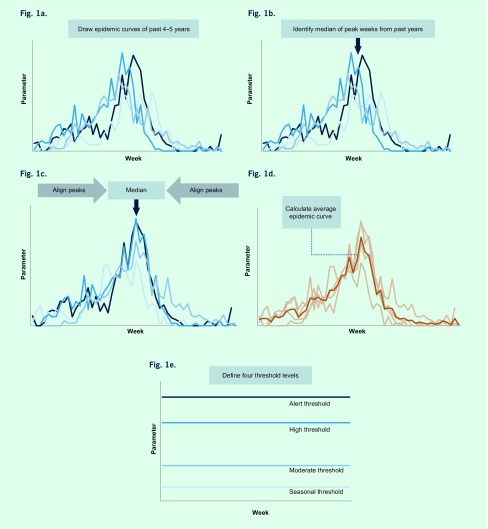
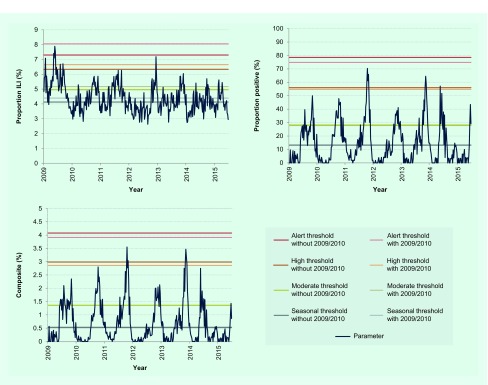
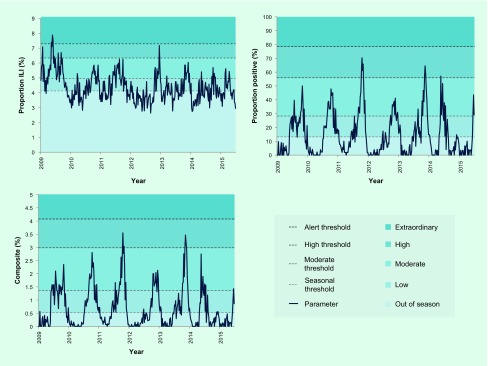
Using Cambodia's influenza-like illness (ILI) and laboratory-confirmed influenza surveillance data from 2009 to 2015, three parameters were assessed to monitor influenza activity: the proportion of ILI patients among all outpatients, proportion of ILI samples positive for influenza and the product of the two. With these parameters, four threshold levels (seasonal, moderate, high and alert) were established and transmission intensity was categorized based on a World Health Organization alignment method. Parameters were compared against their respective thresholds.
Distinct seasonality was observed using the two parameters that incorporated laboratory data. Thresholds established using the composite parameter, combining syndromic and laboratory data, had the least number of false alarms in declaring season onset and were most useful in monitoring intensity. Unlike in temperate regions, the syndromic parameter was less useful in monitoring influenza activity or for setting thresholds.
Influenza thresholds based on appropriate parameters have the potential to provide timely triggers for public health measures in a tropical country where monitoring and assessing influenza activity has been challenging. Based on these findings, the Ministry of Health plans to raise general awareness regarding influenza among the medical community and the general public. Our findings have important implications for countries in the tropics/subtropics and in resource-limited settings, and categorized transmission intensity can be used to assess severity of potential pandemic influenza as well as seasonal influenza.
建立柬埔寨流感的季节性和警戒阈值以及传播强度类别,以便为预防措施或扩大控制措施提供及时触发信号。
利用柬埔寨2009年至2015年的流感样疾病(ILI)和实验室确诊流感监测数据,评估三个参数以监测流感活动:所有门诊患者中ILI患者的比例、ILI样本中流感阳性的比例以及两者的乘积。基于这些参数,建立了四个阈值水平(季节性、中度、高度和警戒),并根据世界卫生组织的比对方法对传播强度进行分类。将参数与其各自的阈值进行比较。
使用纳入实验室数据的两个参数观察到明显的季节性。使用综合参数(结合症状和实验室数据)建立的阈值在宣布季节开始时误报次数最少,并且在监测强度方面最有用。与温带地区不同,症状参数在监测流感活动或设定阈值方面用处较小。
基于适当参数的流感阈值有可能在一个监测和评估流感活动具有挑战性的热带国家为公共卫生措施提供及时触发信号。基于这些发现,卫生部计划提高医学界和公众对流感的普遍认识。我们的研究结果对热带/亚热带地区和资源有限环境中的国家具有重要意义,并且分类的传播强度可用于评估潜在大流行性流感以及季节性流感的严重程度。