Han Jinil, Choi Yoon-La, Kim Haein, Choi Jun Young, Lee Se Kyung, Lee Jeong Eon, Choi Joon-Seok, Park Sarah, Choi Jong-Sun, Kim Young Deug, Nam Seok Jin, Nam Byung-Ho, Kwon Mi Jeong, Shin Young Kee
Gencurix, Inc., Seoul, 08394, Korea.
Laboratory of Cancer Genomics and Molecular Pathology, Samsung Medical Center, Sungkyunkwan University School of Medicine, Seoul, 06356, Korea.
Breast Cancer Res Treat. 2017 Jul;164(1):41-56. doi: 10.1007/s10549-017-4234-4. Epub 2017 Apr 13.
More accurate prediction of patient outcome based on molecular subtype is required to identify patients who will benefit from specific treatments.
We selected novel 16 candidate prognostic genes, including 10 proliferation-related genes (p-genes) and 6 immune response-related genes (i-genes), from the gene list identified in our previous study. We then analyzed the association between their expression, measured by quantitative real-time reverse transcription-PCR in formalin-fixed, paraffin-embedded tissues, and clinical outcome in 819 breast cancer patients according to molecular subtype.
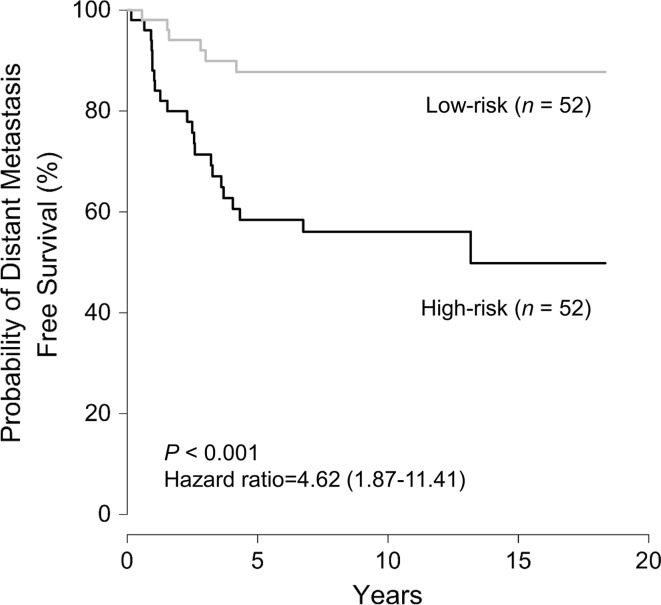
The prognostic significance of clinical and gene variables varied according to the molecular subtype. Univariate analysis showed that positive lymph node status was significantly correlated with the increased risk of distant metastasis in all subtypes except the hormone receptor-negative, HER2-positive (HR-/HER2+) subtype. Most p-genes were significantly associated with poor prognosis in patients with the HR+/HER2- subtype, whereas i-genes correlated with a favorable outcome in patients with HR-/HER2+ breast cancer. In HR-/HER2+ breast cancer, four genes (three i-genes BTN3A2, CD2, and TRBC1 and the p-gene MMP11) were significantly associated with distant metastasis-free survival (DMFS). A new prognostic model for HR-/HER2+ breast cancer based on the expression of MMP11 and CD2 was developed and the DMFS for patients in the high-risk group according to our model was significantly lower than that for those in the low-risk group. Multivariate analyses revealed that our risk score is an independent prognostic factor for DMFS. Moreover, C-index showed that our risk score has a superior prognostic performance to traditional clinicopathological factors.
Our new prognostic model for HR-/HER2+ breast cancer provides more accurate information on the risk of distant metastasis than traditional clinical prognostic factors and may be used to identify patients with a good prognosis in this aggressive subtype of breast cancer.
为了识别能从特定治疗中获益的患者,需要基于分子亚型更准确地预测患者预后。
我们从之前研究确定的基因列表中挑选了16个新的候选预后基因,包括10个增殖相关基因(p基因)和6个免疫反应相关基因(i基因)。然后我们通过定量实时逆转录聚合酶链反应在福尔马林固定、石蜡包埋组织中测量它们的表达,并根据分子亚型分析其与819例乳腺癌患者临床结局之间的关联。
临床和基因变量的预后意义因分子亚型而异。单因素分析显示,除激素受体阴性、人表皮生长因子受体2阳性(HR-/HER2+)亚型外,在所有亚型中,阳性淋巴结状态与远处转移风险增加显著相关。大多数p基因与HR+/HER2-亚型患者的不良预后显著相关,而i基因与HR-/HER2+乳腺癌患者的良好结局相关。在HR-/HER2+乳腺癌中,四个基因(三个i基因BTN3A2、CD2和TRBC1以及p基因MMP11)与无远处转移生存期(DMFS)显著相关。基于MMP11和CD2表达建立了一种新的HR-/HER2+乳腺癌预后模型,根据我们的模型,高危组患者的DMFS显著低于低危组患者。多因素分析显示,我们的风险评分是DMFS的独立预后因素。此外,C指数显示我们的风险评分比传统临床病理因素具有更好的预后性能。
我们新的HR-/HER2+乳腺癌预后模型比传统临床预后因素能提供更准确的远处转移风险信息,可用于识别这种侵袭性乳腺癌亚型中预后良好的患者。