• 文献检索
  • 文档翻译
  • 深度研究
  • 学术资讯
  • Suppr Zotero 插件Zotero 插件
  • 邀请有礼
  • 套餐&价格
  • 历史记录
应用&插件
Suppr Zotero 插件Zotero 插件浏览器插件Mac 客户端Windows 客户端微信小程序
定价
高级版会员购买积分包购买API积分包
服务
文献检索文档翻译深度研究API 文档MCP 服务
关于我们
关于 Suppr公司介绍联系我们用户协议隐私条款
关注我们

Suppr 超能文献

核心技术专利:CN118964589B侵权必究
粤ICP备2023148730 号-1Suppr @ 2026

文献检索

告别复杂PubMed语法,用中文像聊天一样搜索,搜遍4000万医学文献。AI智能推荐,让科研检索更轻松。

立即免费搜索

文件翻译

保留排版,准确专业,支持PDF/Word/PPT等文件格式,支持 12+语言互译。

免费翻译文档

深度研究

AI帮你快速写综述,25分钟生成高质量综述,智能提取关键信息,辅助科研写作。

立即免费体验

唐氏综合征患者通过非沉浸式虚拟现实任务进行的短期运动学习

Short-term motor learning through non-immersive virtual reality task in individuals with down syndrome.

作者信息

de Mello Monteiro Carlos Bandeira, da Silva Talita Dias, de Abreu Luiz Carlos, Fregni Felipe, de Araujo Luciano Vieira, Ferreira Fernando Henrique Inocêncio Borba, Leone Claudio

机构信息

School of Arts, Sciences and Humanities, University of São Paulo, Av. Arlindo Béttio, 1000, Ermelino Matarazzo, São Paulo, 03828-000, Brazil.

School of Public Health, University of São Paulo, São Paulo, Brazil.

出版信息

BMC Neurol. 2017 Apr 14;17(1):71. doi: 10.1186/s12883-017-0852-z.

DOI:10.1186/s12883-017-0852-z
PMID:28410583
原文链接:https://pmc.ncbi.nlm.nih.gov/articles/PMC5391542/
Abstract

BACKGROUND

Down syndrome (DS) has unique physical, motor and cognitive characteristics. Despite cognitive and motor difficulties, there is a possibility of intervention based on the knowledge of motor learning. However, it is important to study the motor learning process in individuals with DS during a virtual reality task to justify the use of virtual reality to organize intervention programs. The aim of this study was to analyze the motor learning process in individuals with DS during a virtual reality task.

METHODS

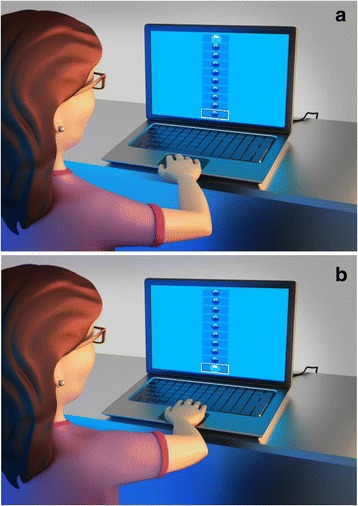
A total of 40 individuals participated in this study, 20 of whom had DS (24 males and 8 females, mean age of 19 years, ranging between 14 and 30 yrs.) and 20 typically developing individuals (TD) who were matched by age and gender to the individuals with DS. To examine this issue, we used software that uses 3D images and reproduced a coincidence-timing task.

RESULTS

The results showed that all individuals improved performance in the virtual task, but the individuals with DS that started the task with worse performance showed higher difference from the beginning. Besides that, they were able to retain and transfer the performance with increase of speed of the task.

CONCLUSION

Individuals with DS are able to learn movements from virtual tasks, even though the movement time was higher compared to the TD individuals. The results showed that individuals with DS who started with low performance improved coincidence- timing task with virtual objects, but were less accurate than typically developing individuals.

TRIAL REGISTRATION

ClinicalTrials.gov Identifier: NCT02719600 .

摘要

背景

唐氏综合征(DS)具有独特的身体、运动和认知特征。尽管存在认知和运动方面的困难,但基于运动学习的知识进行干预是有可能的。然而,研究唐氏综合征患者在虚拟现实任务中的运动学习过程对于证明使用虚拟现实来组织干预计划的合理性很重要。本研究的目的是分析唐氏综合征患者在虚拟现实任务中的运动学习过程。

方法

共有40人参与了本研究,其中20人患有唐氏综合征(24名男性和8名女性,平均年龄19岁,年龄范围在14至30岁之间),另外20名发育正常的个体(TD)在年龄和性别上与唐氏综合征患者相匹配。为了研究这个问题,我们使用了一种利用3D图像并再现同步计时任务的软件。

结果

结果表明,所有个体在虚拟任务中的表现都有所改善,但开始任务时表现较差的唐氏综合征患者从一开始就表现出更大的差异。除此之外,随着任务速度的增加,他们能够保持并转移这种表现。

结论

唐氏综合征患者能够从虚拟任务中学习动作,尽管与发育正常的个体相比,其动作时间更长。结果表明,开始时表现不佳的唐氏综合征患者在虚拟物体同步计时任务中有所改善,但不如发育正常的个体准确。

试验注册

ClinicalTrials.gov标识符:NCT02719600 。
https://cdn.ncbi.nlm.nih.gov/pmc/blobs/9ee8/5391542/3047bfe1f26c/12883_2017_852_Fig4_HTML.jpg
https://cdn.ncbi.nlm.nih.gov/pmc/blobs/9ee8/5391542/7828d729a909/12883_2017_852_Fig1_HTML.jpg
https://cdn.ncbi.nlm.nih.gov/pmc/blobs/9ee8/5391542/d10ef88da0a3/12883_2017_852_Fig2_HTML.jpg
https://cdn.ncbi.nlm.nih.gov/pmc/blobs/9ee8/5391542/92651fbaef98/12883_2017_852_Fig3_HTML.jpg
https://cdn.ncbi.nlm.nih.gov/pmc/blobs/9ee8/5391542/3047bfe1f26c/12883_2017_852_Fig4_HTML.jpg
https://cdn.ncbi.nlm.nih.gov/pmc/blobs/9ee8/5391542/7828d729a909/12883_2017_852_Fig1_HTML.jpg
https://cdn.ncbi.nlm.nih.gov/pmc/blobs/9ee8/5391542/d10ef88da0a3/12883_2017_852_Fig2_HTML.jpg
https://cdn.ncbi.nlm.nih.gov/pmc/blobs/9ee8/5391542/92651fbaef98/12883_2017_852_Fig3_HTML.jpg
https://cdn.ncbi.nlm.nih.gov/pmc/blobs/9ee8/5391542/3047bfe1f26c/12883_2017_852_Fig4_HTML.jpg

相似文献

1
Short-term motor learning through non-immersive virtual reality task in individuals with down syndrome.唐氏综合征患者通过非沉浸式虚拟现实任务进行的短期运动学习
BMC Neurol. 2017 Apr 14;17(1):71. doi: 10.1186/s12883-017-0852-z.
2
Motor learning from virtual reality to natural environments in individuals with Duchenne muscular dystrophy.杜氏肌营养不良症患者从虚拟现实到自然环境的运动学习。
Disabil Rehabil Assist Technol. 2019 Jan;14(1):12-20. doi: 10.1080/17483107.2017.1389998. Epub 2017 Nov 10.
3
Transfer of motor learning from virtual to natural environments in individuals with cerebral palsy.脑瘫患者运动学习从虚拟环境向自然环境的转移。
Res Dev Disabil. 2014 Oct;35(10):2430-7. doi: 10.1016/j.ridd.2014.06.006. Epub 2014 Jun 28.
4
The impact of positive, negative and neutral stimuli in a virtual reality cognitive-motor rehabilitation task: a pilot study with stroke patients.虚拟现实认知运动康复任务中阳性、阴性和中性刺激的影响:一项针对中风患者的初步研究。
J Neuroeng Rehabil. 2016 Aug 9;13(1):70. doi: 10.1186/s12984-016-0175-0.
5
The use of a task through virtual reality in cerebral palsy using two different interaction devices (concrete and abstract) - a cross-sectional randomized study.使用虚拟现实技术对脑瘫患者进行任务训练,使用两种不同的交互设备(具体和抽象)-一项横断面随机研究。
J Neuroeng Rehabil. 2020 Apr 29;17(1):59. doi: 10.1186/s12984-020-00689-z.
6
Motor performance of individuals with cerebral palsy in a virtual game using a mobile phone.使用手机在虚拟游戏中脑瘫患者的运动表现
Disabil Rehabil Assist Technol. 2018 Aug;13(6):609-613. doi: 10.1080/17483107.2017.1392620. Epub 2017 Nov 1.
7
Toward Physiological Detection of a "Just-Right" Challenge Level for Motor Learning in Immersive Virtual Reality: Protocol for a Cross-Sectional Study.朝向沉浸式虚拟现实中运动学习的“恰到好处”挑战水平的生理检测:一项横断面研究的方案。
JMIR Res Protoc. 2024 Sep 23;13:e55730. doi: 10.2196/55730.
8
Wayfinding behaviour in Down syndrome: a study with virtual environments.唐氏综合征的寻路行为:一项虚拟现实环境研究。
Res Dev Disabil. 2013 May;34(5):1825-31. doi: 10.1016/j.ridd.2013.02.023. Epub 2013 Mar 24.
9
Achievement of Virtual and Real Objects Using a Short-Term Motor Learning Protocol in People with Duchenne Muscular Dystrophy: A Crossover Randomized Controlled Trial.使用短期运动学习方案实现虚拟和真实物体的操作:一项杜氏肌营养不良症患者的交叉随机对照试验。
Games Health J. 2018 Apr;7(2):107-115. doi: 10.1089/g4h.2016.0088. Epub 2018 Apr 2.
10
Visuomotor skill learning in young adults with Down syndrome.年轻唐氏综合征患者的视动技能学习。
Res Dev Disabil. 2023 Jul;138:104535. doi: 10.1016/j.ridd.2023.104535. Epub 2023 May 19.

引用本文的文献

1
Use of Serious Games in Interventions of Executive Functions in Neurodiverse Children: Systematic Review.严肃游戏在神经发育障碍儿童执行功能干预中的应用:系统评价
JMIR Serious Games. 2024 Dec 18;12:e59053. doi: 10.2196/59053.
2
Comparison between Motor Performance of People with Multiple Sclerosis during a Virtual Reality Task Practiced on Concrete and Abstract Devices: A Cross-Sectional Randomized Study.在实体和抽象设备上进行虚拟现实任务时,多发性硬化症患者运动表现的比较:一项横断面随机研究
Brain Sci. 2024 Sep 12;14(9):916. doi: 10.3390/brainsci14090916.
3
Dohsa-hou training improves bimanual coordination among children with Down Syndrome.

本文引用的文献

1
Coincidence Anticipation Timing Performance during an Acute Bout of Brisk Walking in Older Adults: Effect of Stimulus Speed.老年人急性快走期间的巧合预期定时表现:刺激速度的影响。
Neural Plast. 2015;2015:210213. doi: 10.1155/2015/210213. Epub 2015 Aug 31.
2
Transfer of motor learning from virtual to natural environments in individuals with cerebral palsy.脑瘫患者运动学习从虚拟环境向自然环境的转移。
Res Dev Disabil. 2014 Oct;35(10):2430-7. doi: 10.1016/j.ridd.2014.06.006. Epub 2014 Jun 28.
3
The effects of low arched feet on foot rotation during gait in children with Down syndrome.
多萨疗法训练可改善唐氏综合征患儿的双手协调性。
Int J Dev Disabil. 2022 Mar 24;69(6):926-935. doi: 10.1080/20473869.2022.2052415. eCollection 2023.
4
Virtual reality as a telerehabilitation strategy for people with autism spectrum disorder during the COVID-19 quarantine scenario: physical activity, motor performance and enjoyment.虚拟现实作为 COVID-19 隔离场景中自闭症谱系障碍患者的远程康复策略:身体活动、运动表现和享受。
Disabil Rehabil Assist Technol. 2024 Jul;19(5):2046-2056. doi: 10.1080/17483107.2023.2249031. Epub 2023 Sep 11.
5
Analysis of Heart Rate, Perception of Physical Effort and Performance of Individuals with Down Syndrome Submitted to a Protocol of Virtual Games for Home-Based Telerehabilitation.对接受基于家庭的远程康复虚拟游戏方案的唐氏综合征患者的心率、体力感知和表现进行分析。
Healthcare (Basel). 2023 Jun 30;11(13):1894. doi: 10.3390/healthcare11131894.
6
Program evaluation of a virtual physical activity program for individuals with disabilities.针对残疾人的虚拟体育活动项目的项目评估
Front Sports Act Living. 2023 May 2;5:1128565. doi: 10.3389/fspor.2023.1128565. eCollection 2023.
7
Facial emotion recognition in patients with depression compared to healthy controls when using human avatars.使用人类化身时,比较抑郁症患者与健康对照者的面部情绪识别。
Sci Rep. 2023 Apr 12;13(1):6007. doi: 10.1038/s41598-023-31277-5.
8
Bilateral Transfer of Performance between Real and Non-Immersive Virtual Environments in Post-Stroke Individuals: A Cross-Sectional Study.脑卒中患者真实和非沉浸式虚拟现实环境之间的绩效双边转移:一项横断面研究。
Int J Environ Res Public Health. 2023 Feb 13;20(4):3301. doi: 10.3390/ijerph20043301.
9
Eight-week virtual reality training improves lower extremity muscle strength but not balance in adolescents with intellectual disability: A randomized controlled trial.为期八周的虚拟现实训练可增强智障青少年的下肢肌肉力量,但对平衡能力无改善:一项随机对照试验。
Front Physiol. 2022 Nov 22;13:1053065. doi: 10.3389/fphys.2022.1053065. eCollection 2022.
10
Effect of Longitudinal Practice in Real and Virtual Environments on Motor Performance, Physical Activity and Enjoyment in People with Autism Spectrum Disorder: A Prospective Randomized Crossover Controlled Trial.真实和虚拟环境中的纵向练习对自闭症谱系障碍患者的运动表现、身体活动和享受的影响:一项前瞻性随机交叉对照试验。
Int J Environ Res Public Health. 2022 Nov 8;19(22):14668. doi: 10.3390/ijerph192214668.
扁平足对唐氏综合征患儿步态中足部旋转的影响。
J Intellect Disabil Res. 2014 Aug;58(8):758-64. doi: 10.1111/jir.12087. Epub 2013 Aug 19.
4
Ultrastructural features of skeletal muscle in adult and aging Ts65Dn mice, a murine model of Down syndrome.成年和老龄 Ts65Dn 小鼠(一种唐氏综合征小鼠模型)骨骼肌的超微结构特征
Muscles Ligaments Tendons J. 2014 Feb 24;3(4):287-94. eCollection 2013 Oct.
5
On the role of auditory feedback in robot-assisted movement training after stroke: review of the literature.在脑卒中后机器人辅助运动训练中听觉反馈的作用:文献综述。
Comput Intell Neurosci. 2013;2013:586138. doi: 10.1155/2013/586138. Epub 2013 Dec 8.
6
Motor skills, cognitive development and balance functions of children with Down syndrome.唐氏综合征患儿的运动技能、认知发展和平衡功能
Ann Agric Environ Med. 2013;20(4):803-6.
7
Performance of Down syndrome subjects during a coincident timing task.唐氏综合征患者在同步计时任务中的表现。
Int Arch Med. 2013 Apr 24;6(1):15. doi: 10.1186/1755-7682-6-15.
8
Wayfinding behaviour in Down syndrome: a study with virtual environments.唐氏综合征的寻路行为:一项虚拟现实环境研究。
Res Dev Disabil. 2013 May;34(5):1825-31. doi: 10.1016/j.ridd.2013.02.023. Epub 2013 Mar 24.
9
Virtual reality aided training of combined arm and leg movements of children with CP.虚拟现实辅助对脑瘫儿童进行手臂和腿部联合运动训练。
Stud Health Technol Inform. 2013;184:349-55.
10
The effects of virtual reality game training on trunk to pelvis coupling in a child with cerebral palsy.虚拟现实游戏训练对脑瘫患儿躯干到骨盆耦合的影响。
J Neuroeng Rehabil. 2013 Feb 7;10:15. doi: 10.1186/1743-0003-10-15.