Fernández-Cadenas Israel, Mendióroz Maite, Giralt Dolors, Nafria Cristina, Garcia Elena, Carrera Caty, Gallego-Fabrega Cristina, Domingues-Montanari Sophie, Delgado Pilar, Ribó Marc, Castellanos Mar, Martínez Sergi, Freijo Marimar, Jiménez-Conde Jordi, Rubiera Marta, Alvarez-Sabín José, Molina Carlos A, Font Maria Angels, Grau Olivares Marta, Palomeras Ernest, Perez de la Ossa Natalia, Martinez-Zabaleta Maite, Masjuan Jaime, Moniche Francisco, Canovas David, Piñana Carlos, Purroy Francisco, Cocho Dolores, Navas Inma, Tejero Carlos, Aymerich Nuria, Cullell Natalia, Muiño Elena, Serena Joaquín, Rubio Francisco, Davalos Antoni, Roquer Jaume, Arenillas Juan Francisco, Martí-Fábregas Joan, Keene Keith, Chen Wei-Min, Worrall Bradford, Sale Michele, Arboix Adrià, Krupinski Jerzy, Montaner Joan
From the Stroke Pharmacogenomics and Genetics, Fundacio Docència i Recerca MutuaTerrassa, Spain (I.F.-C., E.G., C.G.-F., N.C., E.M.); Neurovascular Research Laboratory and Neurovascular Unit, Neurology and Medicine Departments-Universitat Autònoma de Barcelona (I.F.-C., M.M., D.G., C.N., C.C., S.D.-M., P.D., J.M.) and Neurology Department (M.Ribó, M.Rubiera, J.A.-S., C.A.M.), Vall d'Hebron Hospital, Barcelona, Spain; Neuroepigenetics Research Group, Navarrabiomed, Pamplona, Spain (M.M.); Department of Neurology, Hospital Universitari Dr Josep Trueta, Institut d'Investigació Biomèdica de Girona, Spain (M.C., J.S.); Department of Neurology, Hospital de la Santa Creu i Sant Pau, Barcelona, Spain (S.M., J.M.-F.); Department of Neurology, Hospital de Basurto, Bilbao, Spain (M.F.); Department of Neurology, Hospital del Mar and Centre de Regulació Genòmica, Universitat Pompeu Fabra, Barcelona, Spain (J.J.-C., J.R.); Department of Neurology, Hospital de Bellvitge, Hospitalet del Llobregat, Spain (M.A.F., F.R.); Department of Neurology, Hospital Universitari Sagrat Cor, Barcelona, Spain (M.G.O., A.A.); Department of Neurology, Hospital de Mataró, Spain (E.P.); Department of Neurology, Hospital Universitari Germans Trias i Pujol, Badalona, Spain (N.P.d.l.O., A.D.); Department of Neurology, Hospital Donostia, San Sebastián, Spain (M.M.-Z.); Department of Neurology, Hospital Ramón y Cajal, Madrid, Spain (J.M.); Department of Neurology, Hospital Universitario Virgen del Rocío, Sevilla, Spain (F.M.); Department of Neurology, Corporació Sanitària Parc Taulí, Sabadell, Spain (D.C.); Department of Neurology, Hospital Universitario Virgen de las Nieves, Granada, Spain (C.P.); Department of Neurology, Hospital Universitario Arnau De Vilanova, Lleida, Spain (F.P.); Department of Neurology, Hospital de Granollers, Spain (D.C.); Department of Neurology, Hospital Mútua de Terrassa, Spain (I.N., J.K.); Department of Neurology, Hospital Clinico Universitario Lozano Blesa, Zaragoza, Spain (C.T.); Department of Neurology, Hospital De Navarra, Pamplona, Spain (N.A.); Department of Neurology, Hospital Clínico Universitario de Valladolid, Spain (J.F.A.); Department of Biology, Center for Health Disparities, East Carolina University, Greenville, North Carolina (K.K.); Department of Public Health Sciences, Center for Public Health Genomics (W.-M.C.); Departments of Neurology (B.W.), Public Health Sciences (B.W., M.S.), and Biochemistry and Molecular Genetics (M.S.), and Center for Public Health Genomics (M.S.), University of Virginia, Charlottesville.
Stroke. 2017 May;48(5):1147-1153. doi: 10.1161/STROKEAHA.116.014322. Epub 2017 Apr 14.
Vascular recurrence occurs in 11% of patients during the first year after ischemic stroke (IS) or transient ischemic attack. Clinical scores do not predict the whole vascular recurrence risk; therefore, we aimed to find genetic variants associated with recurrence that might improve the clinical predictive models in IS.
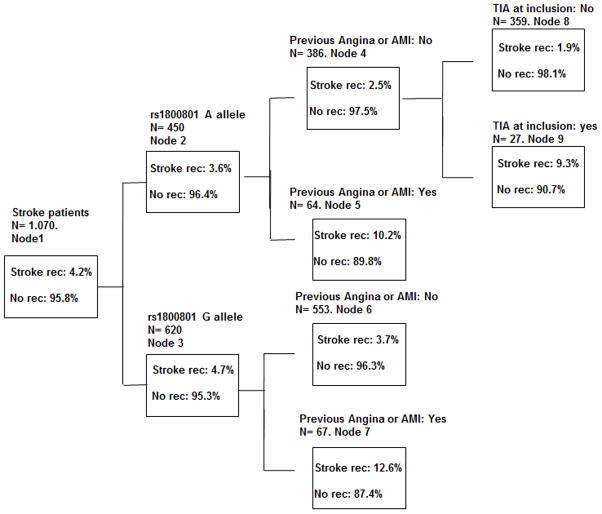
We analyzed 256 polymorphisms from 115 candidate genes in 3 patient cohorts comprising 4482 IS or transient ischemic attack patients. The discovery cohort was prospectively recruited and included 1494 patients, 6.2% of them developed a new IS during the first year of follow-up. Replication analysis was performed in 2988 patients using SNPlex or HumanOmni1-Quad technology. We generated a predictive model using Cox regression (GRECOS score [Genotyping Reurrence Risk of Stroke]) and generated risk groups using a classification tree method.
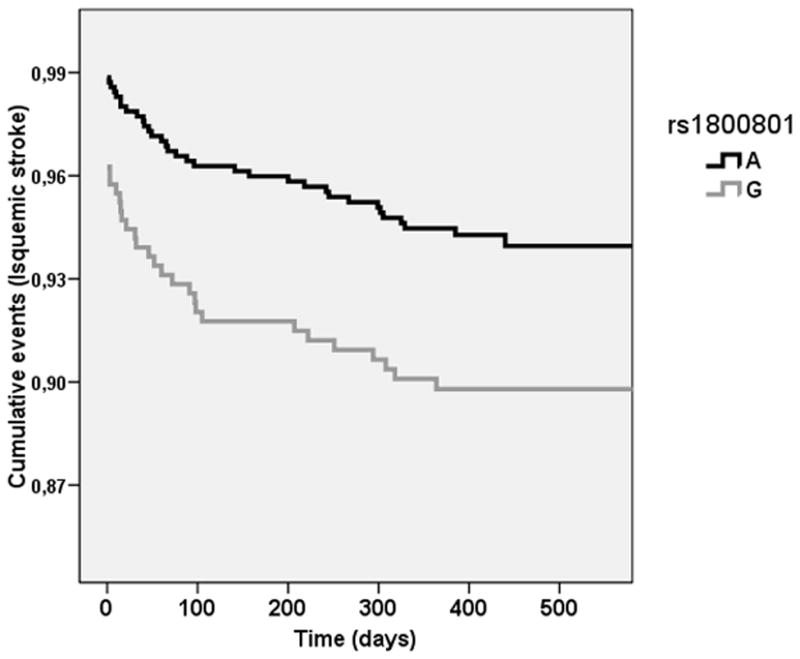
The analyses revealed that rs1800801 in the gene (hazard ratio, 1.33; =9×10), a gene related to artery calcification, was associated with new IS during the first year of follow-up. This polymorphism was replicated in a Spanish cohort (n=1.305); however, it was not significantly associated in a North American cohort (n=1.683). The GRECOS score predicted new IS (=3.2×10) and could classify patients, from low risk of stroke recurrence (1.9%) to high risk (12.6%). Moreover, the addition of genetic risk factors to the GRECOS score improves the prediction compared with previous Stroke Prognosis Instrument-II score (=0.03).
The use of genetics could be useful to estimate vascular recurrence risk after IS. Genetic variability in the gene was associated with vascular recurrence in the Spanish population.
在缺血性卒中(IS)或短暂性脑缺血发作后的第一年,11%的患者会出现血管性复发。临床评分无法预测全部的血管性复发风险;因此,我们旨在寻找与复发相关的基因变异,以改进IS的临床预测模型。
我们在由4482例IS或短暂性脑缺血发作患者组成的3个患者队列中分析了115个候选基因的256个多态性位点。发现队列是前瞻性招募的,包括1494例患者,其中6.2%在随访的第一年发生了新的IS。使用SNPlex或HumanOmni1-Quad技术在2988例患者中进行重复分析。我们使用Cox回归生成了一个预测模型(GRECOS评分[卒中基因分型复发风险]),并使用分类树方法生成了风险组。
分析显示,与动脉钙化相关的 基因中的rs1800801(风险比,1.33; =9×10)与随访第一年的新IS相关。这种多态性在一个西班牙队列(n = 1305)中得到了重复;然而,在一个北美队列(n = 1683)中它没有显著相关性。GRECOS评分可预测新的IS( = 3.2×10),并且可以将患者从低卒中复发风险(1.9%)分类到高风险(12.6%)。此外,与之前的卒中预后工具-II评分相比,将遗传风险因素添加到GRECOS评分中可改善预测( = 0.03)。
基因检测有助于估计IS后的血管性复发风险。 基因的遗传变异性与西班牙人群的血管性复发相关。