Pereira Beatriz Dos Santos, Fernandes Neimar da Silva, de Melo Nayara Pires, Abrita Renata, Grincenkov Fabiane Rossi Dos Santos, Fernandes Natália Maria da Silva
Psychology, Federal University of Juiz de Fora (UFJF) - Interdisciplinary Nuclei of Nephrology Studies and Researches (NIEPEN), Juiz de Fora, Brazil.
Exact Sciences, Federal University of Juiz de Fora (UFJF), Juiz de Fora, Brazil.
Health Qual Life Outcomes. 2017 Apr 17;15(1):74. doi: 10.1186/s12955-017-0646-4.
Patients with terminal chronic kidney disease (CKDT) requiring renal replacement therapies (RRT) undergo important changes in living habits and frequently need caregiving. These patients and their caregivers are risk groups for the development of physical and psychological symptoms. This study aimed to evaluate the prevalence of anxiety, depression, stress, fatigue, social support, and quality of life in patients with CKD and their caregivers.
This cross sectional study was conducted with 21 patients and their caregivers, from January to September 2015. We included patients aged over 18 years, with at least 6 months on dialysis treatment, and caregivers who were family members. The participants' social, demographic, clinical, laboratory, and psychological variables were evaluated. A descriptive analysis and an examination of the association between patients and caregivers were performed.
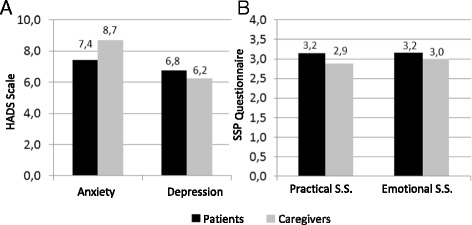
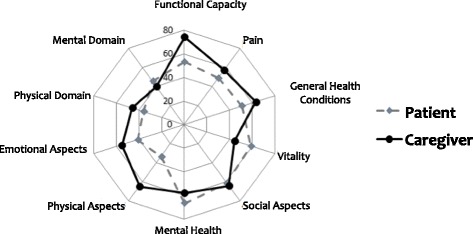
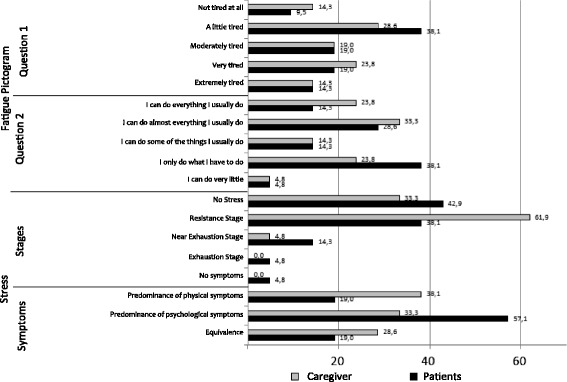
Among patients, we observed that 38.1% had symptoms that indicated anxiety and depression. The average score for practical social support was 3.15 ± 0.769 and that for emotional social support was 3.16 ± 0.79. As for fatigue, 14.3% of patients reported being 'extremely tired' and 14.3% reported that they engaged in all the activities they usually performed before the illness. Further, 57.1% presented stress, and of these, 66.7% were at the resistance stage, with predominance of psychological symptoms in 60.0%. The quality of life domain in terms of functional capacity (FC) presented a correlation with haemoglobin level (r = 0.581, p = 0.006) and non-anaemic patients presented better FC. Among caregivers, we observed symptoms that indicated anxiety and depression in 33.3% of the sample. Caregivers exhibited an average score of 2.88 ± 0.77 for practical social support and 3.0 ± 0.72 for emotional social support. Further, 14.3% reported being 'extremely tired' and 28.8% reported that they engaged in all activities that they usually performed before the patient's illness. When comparing the two groups (patients vs. caregivers), we observed that they presented similar results for the presence of anxiety, depression, and fatigue. Caregivers received less social support than patients did. Both groups presented similar predominance of stress levels; however, patients presented more predominance of psychological symptoms. With reference to quality of life, patients and caregivers presented similar results on the social aspects, vitality, mental health, and mental domains.
The mental health characteristics of patients and caregivers were similar, and within the context of dialysis for renal disease, both must undergo specific interventions.
需要肾脏替代治疗(RRT)的终末期慢性肾脏病(CKDT)患者生活习惯发生重大改变,且经常需要照料。这些患者及其照料者是出现身体和心理症状的风险群体。本研究旨在评估慢性肾脏病患者及其照料者焦虑、抑郁、压力、疲劳、社会支持及生活质量的患病率。
本横断面研究于2015年1月至9月对21例患者及其照料者进行。纳入年龄超过18岁、接受透析治疗至少6个月的患者以及作为家庭成员的照料者。对参与者的社会、人口统计学、临床、实验室及心理变量进行评估。进行描述性分析并检查患者与照料者之间的关联。
在患者中,我们观察到38.1%有表明焦虑和抑郁的症状。实际社会支持的平均得分为3.15±0.769,情感社会支持的平均得分为3.16±0.79。至于疲劳,14.3%的患者报告“极度疲劳”,14.3%的患者报告他们能进行患病前通常进行的所有活动。此外,57.1%的患者有压力,其中66.7%处于抵抗阶段,60.0%以心理症状为主。在功能能力(FC)方面的生活质量领域与血红蛋白水平呈相关性(r = 0.581,p = 0.006),非贫血患者的FC更好。在照料者中,我们观察到样本中33.3%有表明焦虑和抑郁的症状。照料者实际社会支持的平均得分为2.88±0.77,情感社会支持的平均得分为3.0±0.72。此外,14.3%的照料者报告“极度疲劳”,28.8%的照料者报告他们能进行患者患病前通常进行的所有活动。比较两组(患者与照料者)时,我们观察到他们在焦虑、抑郁和疲劳的存在方面结果相似。照料者获得的社会支持比患者少。两组压力水平的优势相似;然而,患者心理症状的优势更明显。关于生活质量,患者和照料者在社会方面、活力、心理健康和心理领域的结果相似。
患者和照料者的心理健康特征相似,在肾病透析的背景下,两者都必须接受特定干预。