Tran William T, Gangeh Mehrdad J, Sannachi Lakshmanan, Chin Lee, Watkins Elyse, Bruni Silvio G, Rastegar Rashin Fallah, Curpen Belinda, Trudeau Maureen, Gandhi Sonal, Yaffe Martin, Slodkowska Elzbieta, Childs Charmaine, Sadeghi-Naini Ali, Czarnota Gregory J
Department of Radiation Oncology, Sunnybrook Health Sciences Centre, 2075 Bayview Avenue, Toronto, Ontario M4N 3M5, Canada.
Centre for Health and Social Care Research, Sheffield Hallam University, 32 Collegiate Crescent, Sheffield S10 2BP, UK.
Br J Cancer. 2017 May 9;116(10):1329-1339. doi: 10.1038/bjc.2017.97. Epub 2017 Apr 18.
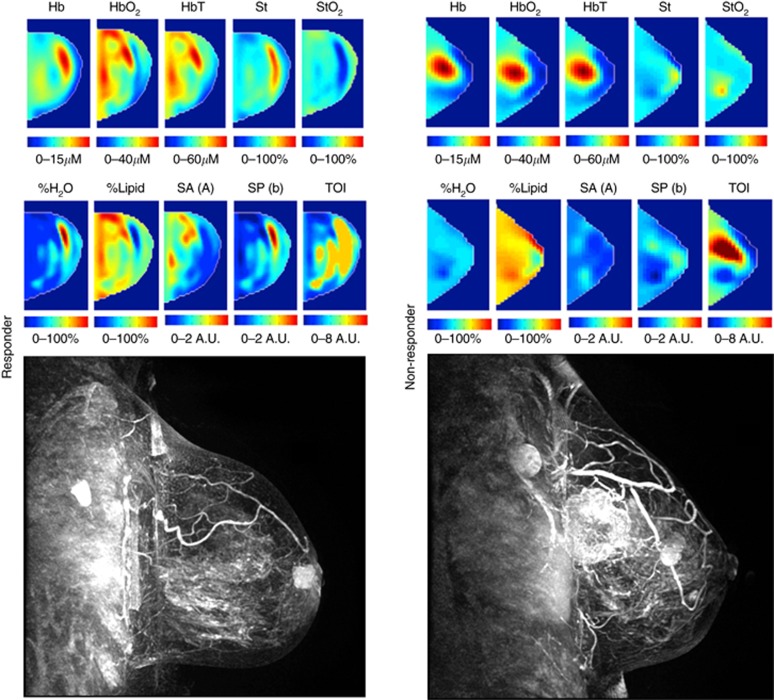
Diffuse optical spectroscopy (DOS) has been demonstrated capable of monitoring response to neoadjuvant chemotherapy (NAC) in locally advanced breast cancer (LABC) patients. In this study, we evaluate texture features of pretreatment DOS functional maps for predicting LABC response to NAC.
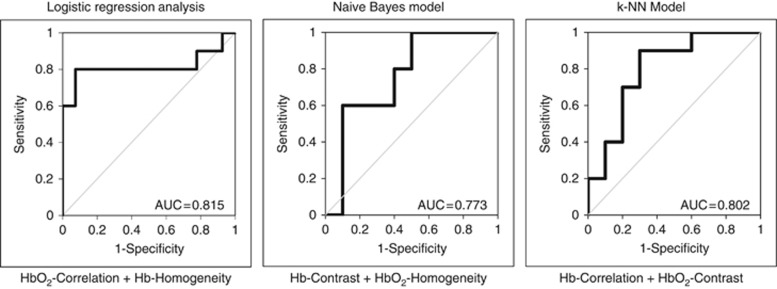
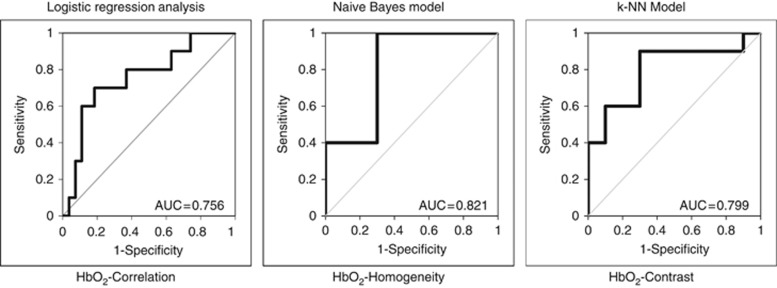
Locally advanced breast cancer patients (n=37) underwent DOS breast imaging before starting NAC. Breast tissue parametric maps were constructed and texture analyses were performed based on grey-level co-occurrence matrices for feature extraction. Ground truth labels as responders (R) or non-responders (NR) were assigned to patients based on Miller-Payne pathological response criteria. The capability of DOS textural features computed on volumetric tumour data before the start of treatment (i.e., 'pretreatment') to predict patient responses to NAC was evaluated using a leave-one-out validation scheme at subject level. Data were analysed using a logistic regression, naive Bayes, and k-nearest neighbour classifiers.
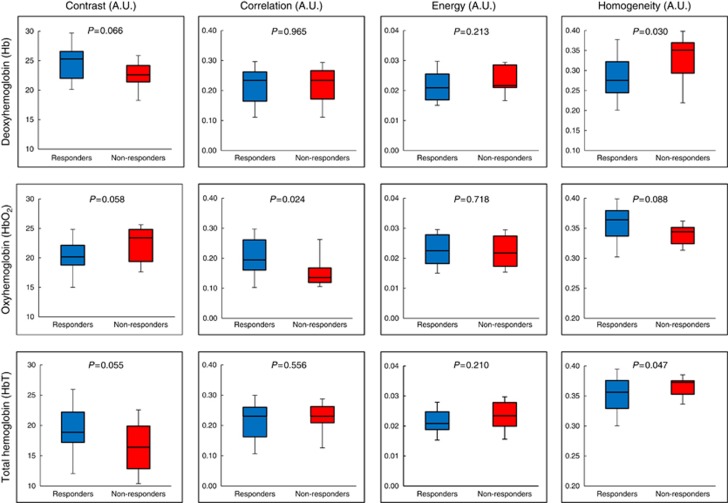
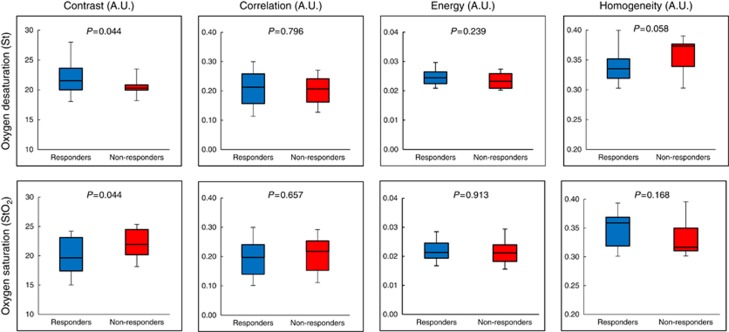
Data indicated that textural characteristics of pretreatment DOS parametric maps can differentiate between treatment response outcomes. The HbO homogeneity resulted in the highest accuracy among univariate parameters in predicting response to chemotherapy: sensitivity (%Sn) and specificity (%Sp) were 86.5% and 89.0%, respectively, and accuracy was 87.8%. The highest predictors using multivariate (binary) combination features were the Hb-contrast+HbO-homogeneity, which resulted in a %Sn/%Sp=78.0/81.0% and an accuracy of 79.5%.
This study demonstrated that the pretreatment DOS texture features can predict breast cancer response to NAC and potentially guide treatments.
扩散光学光谱(DOS)已被证明能够监测局部晚期乳腺癌(LABC)患者对新辅助化疗(NAC)的反应。在本研究中,我们评估治疗前DOS功能图的纹理特征,以预测LABC患者对NAC的反应。
37例局部晚期乳腺癌患者在开始NAC前接受了DOS乳腺成像。构建乳腺组织参数图,并基于灰度共生矩阵进行纹理分析以提取特征。根据Miller-Payne病理反应标准,将患者标记为反应者(R)或无反应者(NR)。在个体水平上,使用留一法验证方案评估治疗开始前(即“治疗前”)在体积肿瘤数据上计算的DOS纹理特征预测患者对NAC反应的能力。使用逻辑回归、朴素贝叶斯和k近邻分类器对数据进行分析。
数据表明,治疗前DOS参数图的纹理特征可以区分治疗反应结果。在预测化疗反应的单变量参数中,HbO均匀性的准确率最高:敏感性(%Sn)和特异性(%Sp)分别为86.5%和89.0%,准确率为87.8%。使用多变量(二元)组合特征的最高预测因子是Hb对比度+HbO均匀性,其%Sn/%Sp = 78.0/81.0%,准确率为79.5%。
本研究表明,治疗前DOS纹理特征可以预测乳腺癌对NAC的反应,并可能指导治疗。