Moslemi Amir, Osapoetra Laurentius Oscar, Dasgupta Archya, Halstead Schontal, Alberico David, Trudeau Maureen, Gandhi Sonal, Eisen Andrea, Wright Frances, Look-Hong Nicole, Curpen Belinda, Kolios Michael, Czarnota Gregory J
Physical Sciences, Sunnybrook Research Institute, Toronto, ON M4N 3M5, Canada.
Department of Medical Oncology, Department of Medicine, Sunnybrook Health Sciences Centre, Toronto, ON M4N 3M5, Canada.
Tomography. 2025 Mar 13;11(3):33. doi: 10.3390/tomography11030033.
Neoadjuvant chemotherapy (NAC) is a key element of treatment for locally advanced breast cancer (LABC). Predicting the response of NAC for patients with LABC before initiating treatment would be valuable to customize therapies and ensure the delivery of effective care.
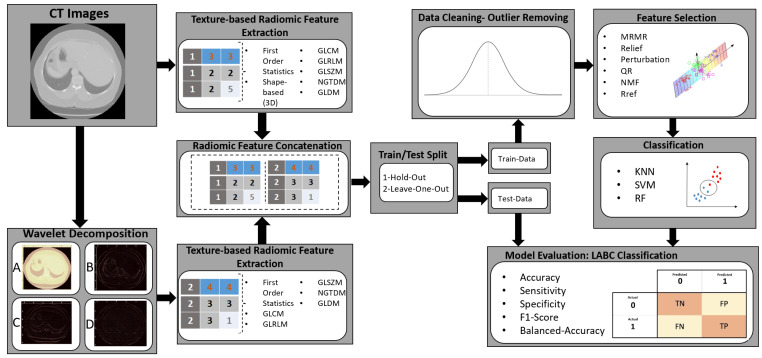
Our objective was to develop predictive measures of tumor response to NAC prior to starting for LABC using machine learning and textural computed tomography (CT) features in different level of frequencies.
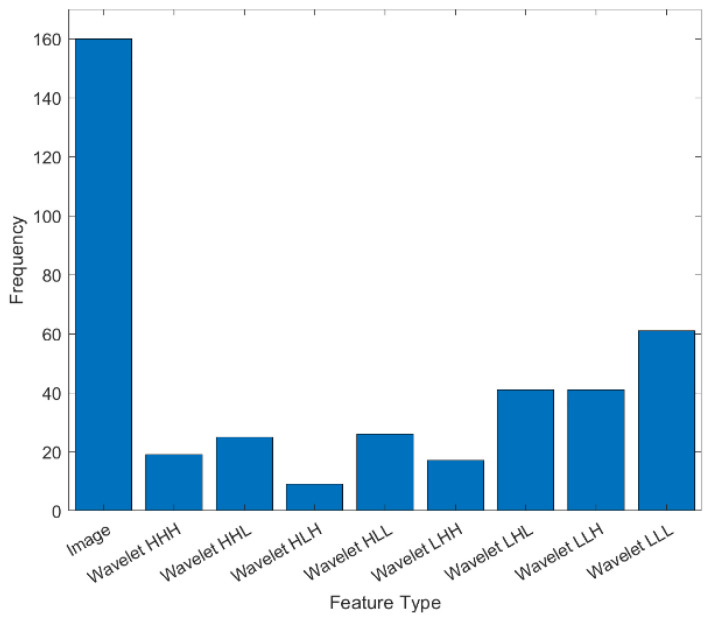
A total of 851 textural biomarkers were determined from CT images and their wavelet coefficients for 117 patients with LABC to evaluate the response to NAC. A machine learning pipeline was designed to classify response to NAC treatment for patients with LABC. For training predictive models, three models including all features (wavelet and original image features), only wavelet and only original-image features were considered. We determined features from CT images in different level of frequencies using wavelet transform. Additionally, we conducted a comparison of feature selection methods including mRMR, Relief, Rref QR decomposition, nonnegative matrix factorization and perturbation theory feature selection techniques.
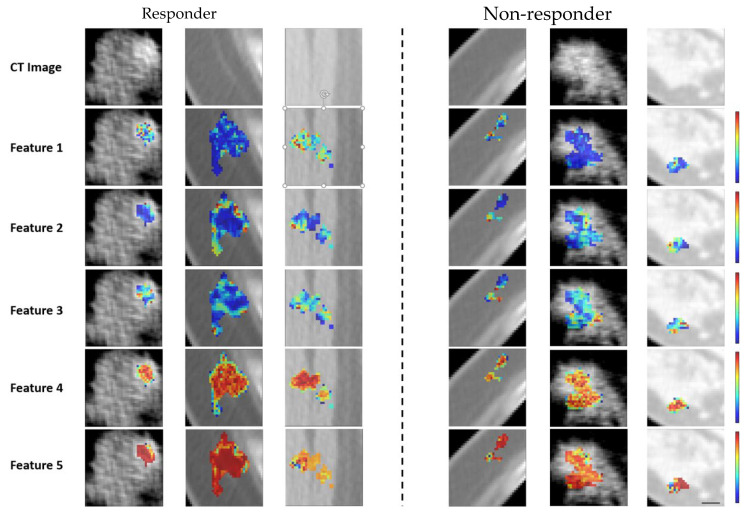
Of the 117 patients with LABC evaluated, 82 (70%) had clinical-pathological response to chemotherapy and 35 (30%) had no response to chemotherapy. The best performance for hold-out data splitting was obtained using the KNN classifier using the Top-5 features, which were obtained by mRMR, for all features (accuracy = 77%, specificity = 80%, sensitivity = 56%, and balanced-accuracy = 68%). Likewise, the best performance for leave-one-out data splitting could be obtained by the KNN classifier using the Top-5 features, which was obtained by mRMR, for all features (accuracy = 75%, specificity = 76%, sensitivity = 62%, and balanced-accuracy = 72%).
The combination of original textural features and wavelet features results in a greater predictive accuracy of NAC response for LABC patients. This predictive model can be utilized to predict treatment outcomes prior to starting, and clinicians can use it as a recommender system to modify treatment.
新辅助化疗(NAC)是局部晚期乳腺癌(LABC)治疗的关键要素。在开始治疗前预测LABC患者对NAC的反应,对于定制个性化治疗方案并确保提供有效的治疗具有重要价值。
我们的目的是利用机器学习和不同频率水平的纹理计算机断层扫描(CT)特征,在开始治疗前开发预测LABC患者对NAC肿瘤反应的指标。
从117例LABC患者的CT图像及其小波系数中确定了总共851个纹理生物标志物,以评估对NAC的反应。设计了一个机器学习流程来对LABC患者对NAC治疗的反应进行分类。为了训练预测模型,考虑了三种模型,包括所有特征(小波和原始图像特征)、仅小波特征和仅原始图像特征。我们使用小波变换从不同频率水平的CT图像中确定特征。此外,我们对包括最小冗余最大相关(mRMR)、Relief、Rref QR分解、非负矩阵分解和微扰理论特征选择技术在内的特征选择方法进行了比较。
在评估的117例LABC患者中,82例(70%)对化疗有临床病理反应,35例(30%)对化疗无反应。使用KNN分类器对所有特征采用通过mRMR获得的前5个特征进行留出法数据分割时,表现最佳(准确率 = 77%,特异性 = 80%,敏感性 = 56%,平衡准确率 = 68%)。同样,使用KNN分类器对所有特征采用通过mRMR获得的前5个特征进行留一法数据分割时,也能获得最佳表现(准确率 = 75%,特异性 = 76%,敏感性 = 62%,平衡准确率 = 72%)。
原始纹理特征和小波特征的结合可提高LABC患者对NAC反应的预测准确性。该预测模型可用于在开始治疗前预测治疗结果,临床医生可将其用作推荐系统来调整治疗方案。