Gorelova Vera, Ambach Lars, Rébeillé Fabrice, Stove Christophe, Van Der Straeten Dominique
Laboratory of Functional Plant Biology, Department of Biology, Ghent UniversityGhent, Belgium.
Laboratory of Toxicology, Department of Bioanalysis, Ghent UniversityGhent, Belgium.
Front Chem. 2017 Mar 29;5:21. doi: 10.3389/fchem.2017.00021. eCollection 2017.
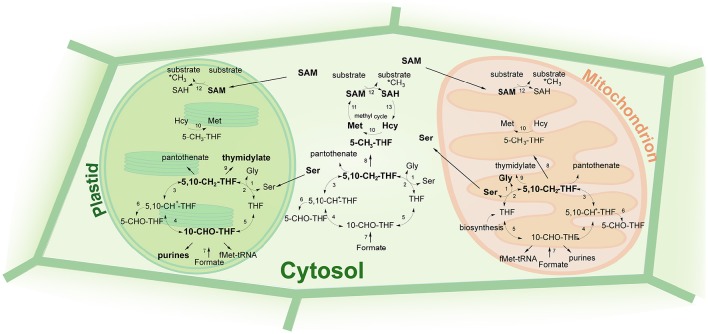
Folates, also known as B9 vitamins, serve as donors and acceptors in one-carbon (C1) transfer reactions. The latter are involved in synthesis of many important biomolecules, such as amino acids, nucleic acids and vitamin B5. Folates also play a central role in the methyl cycle that provides one-carbon groups for methylation reactions. The important functions fulfilled by folates make them essential in all living organisms. Plants, being able to synthesize folates , serve as an excellent dietary source of folates for animals that lack the respective biosynthetic pathway. Unfortunately, the most important staple crops such as rice, potato and maize are rather poor sources of folates. Insufficient folate consumption is known to cause severe developmental disorders in humans. Two approaches are employed to fight folate deficiency: pharmacological supplementation in the form of folate pills and biofortification of staple crops. As the former approach is considered rather costly for the major part of the world population, biofortification of staple crops is viewed as a decent alternative in the struggle against folate deficiency. Therefore, strategies, challenges and recent progress of folate enhancement in plants will be addressed in this review. Apart from the ever-growing need for the enhancement of nutritional quality of crops, the world population faces climate change catastrophes or environmental stresses, such as elevated temperatures, drought, salinity that severely affect growth and productivity of crops. Due to immense diversity of their biochemical functions, folates take part in virtually every aspect of plant physiology. Any disturbance to the plant folate metabolism leads to severe growth inhibition and, as a consequence, to a lower productivity. Whereas today's knowledge of folate biochemistry can be considered very profound, evidence on the physiological roles of folates in plants only starts to emerge. In the current review we will discuss the implication of folates in various aspects of plant physiology and development.
叶酸,也被称为维生素B9,在一碳(C1)转移反应中充当供体和受体。后者参与许多重要生物分子的合成,如氨基酸、核酸和维生素B5。叶酸在为甲基化反应提供一碳基团的甲基循环中也起着核心作用。叶酸所具有的重要功能使其在所有生物中都必不可少。植物能够合成叶酸,对于缺乏相应生物合成途径的动物而言,植物是叶酸的优质膳食来源。不幸的是,水稻、土豆和玉米等最重要的主食作物中叶酸含量相当低。已知叶酸摄入不足会导致人类出现严重的发育障碍。对抗叶酸缺乏有两种方法:以叶酸片形式进行药物补充和对主食作物进行生物强化。由于前一种方法对世界上大部分人口来说成本较高,主食作物的生物强化被视为对抗叶酸缺乏的一种不错选择。因此,本文将探讨植物中叶酸强化的策略、挑战和最新进展。除了对提高作物营养品质的需求不断增长外,世界人口还面临气候变化灾难或环境压力,如气温升高、干旱、盐碱化等,这些都会严重影响作物的生长和生产力。由于叶酸具有极其多样的生化功能,它几乎参与了植物生理学的各个方面。对植物叶酸代谢的任何干扰都会导致严重的生长抑制,进而导致生产力降低。虽然如今对叶酸生物化学的了解可以说是非常深入,但关于叶酸在植物中的生理作用的证据才刚刚开始出现。在本综述中,我们将讨论叶酸在植物生理学和发育的各个方面的影响。