Department of Botany, University of British Columbia, Vancouver, Canada.
Department of Zoology, University of British Columbia, Vancouver, Canada.
Sci Adv. 2017 Mar 31;3(3):e1602552. doi: 10.1126/sciadv.1602552. eCollection 2017 Mar.
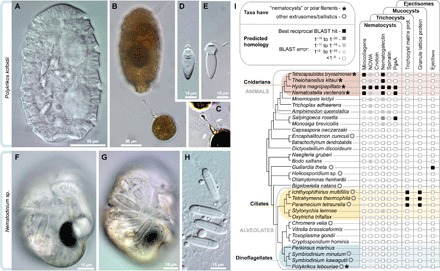
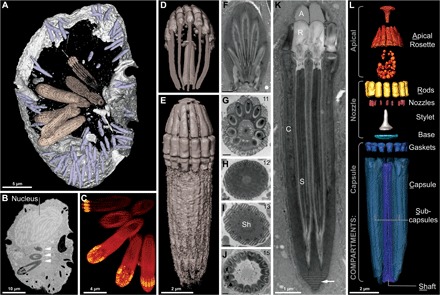
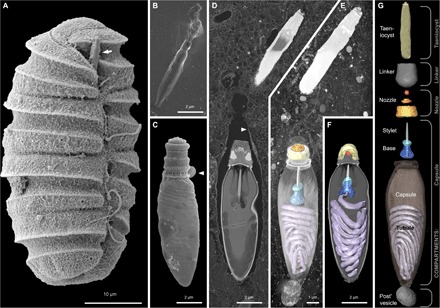
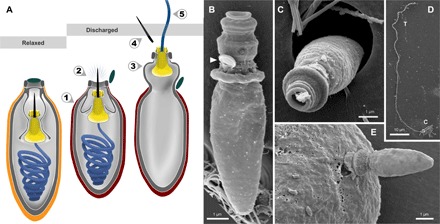
We examine the origin of harpoon-like secretory organelles (nematocysts) in dinoflagellate protists. These ballistic organelles have been hypothesized to be homologous to similarly complex structures in animals (cnidarians); but we show, using structural, functional, and phylogenomic data, that nematocysts evolved independently in both lineages. We also recorded the first high-resolution videos of nematocyst discharge in dinoflagellates. Unexpectedly, our data suggest that different types of dinoflagellate nematocysts use two fundamentally different types of ballistic mechanisms: one type relies on a single pressurized capsule for propulsion, whereas the other type launches 11 to 15 projectiles from an arrangement similar to a Gatling gun. Despite their radical structural differences, these nematocysts share a single origin within dinoflagellates and both potentially use a contraction-based mechanism to generate ballistic force. The diversity of traits in dinoflagellate nematocysts demonstrates a stepwise route by which simple secretory structures diversified to yield elaborate subcellular weaponry.
我们研究了甲藻原生生物中类似鱼叉的分泌细胞器(刺丝囊)的起源。这些弹道细胞器被假设与动物(刺胞动物门)中类似的复杂结构同源;但我们使用结构、功能和系统基因组学数据表明,刺丝囊在这两个谱系中是独立进化的。我们还记录了甲藻刺丝囊排放的第一个高分辨率视频。出乎意料的是,我们的数据表明,不同类型的甲藻刺丝囊使用两种截然不同的弹道机制:一种类型依赖于单个加压囊来推进,而另一种类型则从类似于加特林枪的排列中发射 11 到 15 个弹丸。尽管它们的结构差异很大,但这些刺丝囊在甲藻中具有单一的起源,并且都可能使用基于收缩的机制来产生弹道力。甲藻刺丝囊的多样性特征表明,简单的分泌结构通过逐步多样化产生了精细的亚细胞武器。