Department of Child and Adolescent Psychiatry,Institute of Psychiatry, Psychology and Neuroscience, King's College,London,UK.
Centre for Integrative Neuroscience and Neurodynamics, School of Psychology and Clinical Language Sciences, University of Reading,Reading,UK.
Psychol Med. 2017 Oct;47(14):2513-2527. doi: 10.1017/S0033291717001088. Epub 2017 Apr 24.
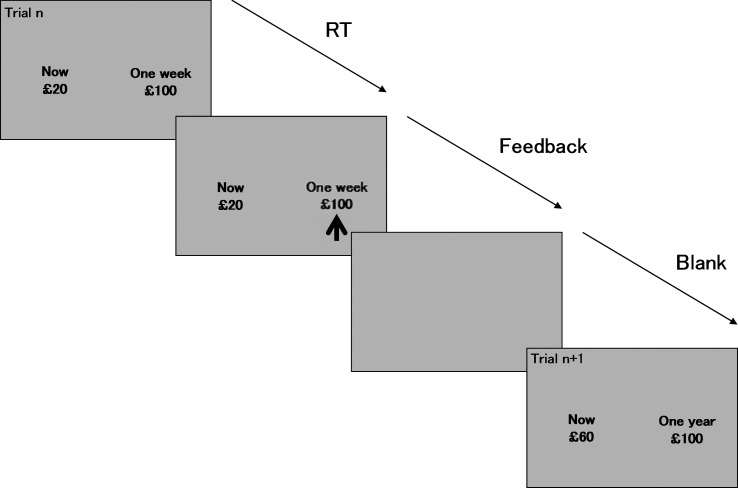
Autism spectrum disorder (ASD) and obsessive-compulsive disorder (OCD) share abnormalities in hot executive functions such as reward-based decision-making, as measured in the temporal discounting task (TD). No studies, however, have directly compared these disorders to investigate common/distinct neural profiles underlying such abnormalities. We wanted to test whether reward-based decision-making is a shared transdiagnostic feature of both disorders with similar neurofunctional substrates or whether it is a shared phenotype with disorder-differential neurofunctional underpinnings.
Age and IQ-matched boys with ASD (N = 20), with OCD (N = 20) and 20 healthy controls, performed an individually-adjusted functional magnetic resonance imaging (fMRI) TD task. Brain activation and performance were compared between groups.
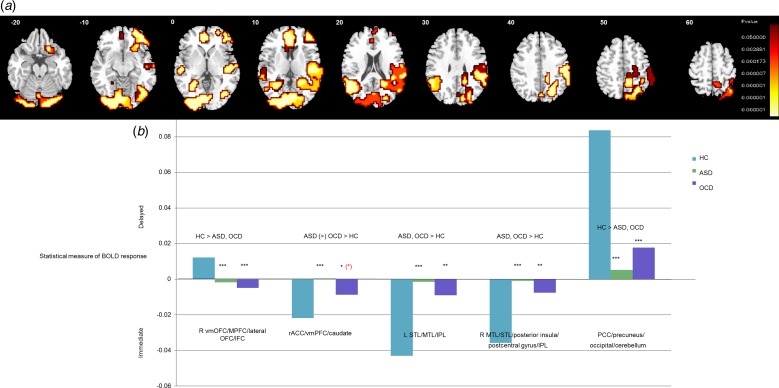
Boys with ASD showed greater choice-impulsivity than OCD and control boys. Whole-brain between-group comparison revealed shared reductions in ASD and OCD relative to control boys for delayed-immediate choices in right ventromedial/lateral orbitofrontal cortex extending into medial/inferior prefrontal cortex, and in cerebellum, posterior cingulate and precuneus. For immediate-delayed choices, patients relative to controls showed reduced activation in anterior cingulate/ventromedial prefrontal cortex reaching into left caudate, which, at a trend level, was more decreased in ASD than OCD patients, and in bilateral temporal and inferior parietal regions.
This first fMRI comparison between youth with ASD and with OCD, using a reward-based decision-making task, shows predominantly shared neurofunctional abnormalities during TD in key ventromedial, orbital- and inferior fronto-striatal, temporo-parietal and cerebellar regions of temporal foresight and reward processing, suggesting trans-diagnostic neurofunctional deficits.
自闭症谱系障碍(ASD)和强迫症(OCD)在基于奖励的决策等热执行功能方面存在异常,如在时间折扣任务(TD)中测量。然而,没有研究直接比较这些疾病以调查这些异常背后的共同/不同的神经特征。我们想测试基于奖励的决策是否是这两种疾病的共同跨诊断特征,具有相似的神经功能基础,或者它是否是一种具有疾病差异神经功能基础的共同表型。
年龄和智商匹配的 ASD(N=20)、OCD(N=20)和 20 名健康对照的男孩进行了个体调整的功能磁共振成像(fMRI)TD 任务。比较了组间的大脑激活和表现。
与 OCD 和对照组男孩相比,ASD 男孩的选择冲动性更大。全脑组间比较显示,ASD 和 OCD 患者相对于对照组男孩,在右侧腹内侧/外侧眶额皮层和内侧/下前额叶皮层以及小脑、后扣带回和楔前叶中,延迟即时选择的冲动性降低。对于即时延迟选择,与对照组相比,患者的前扣带/腹内侧前额叶皮层的激活减少,延伸到左侧尾状核,这在 ASD 患者中比 OCD 患者更为明显,并且在双侧颞叶和下顶叶区域也有减少。
这是首次使用基于奖励的决策任务对 ASD 和 OCD 青少年进行的 fMRI 比较,结果表明,在时间预测和奖励处理的关键腹内侧、眶额和下额纹状体、颞顶叶和小脑区域中,TD 期间存在主要的共享神经功能异常,表明存在跨诊断的神经功能缺陷。