Muñoz-Sanz Juan Vicente, Zuriaga Elena, López Inmaculada, Badenes María L, Romero Carlos
Fruit Tree Breeding Department, Instituto Valenciano de Investigaciones Agrarias (IVIA), CV-315, Km. 10,7., 46113, Moncada, Valencia, Spain.
Department of Biochemistry, University of Missouri, 117 Schweitzer Hall, 65211, Columbia , MO, USA.
BMC Plant Biol. 2017 Apr 26;17(1):82. doi: 10.1186/s12870-017-1027-1.
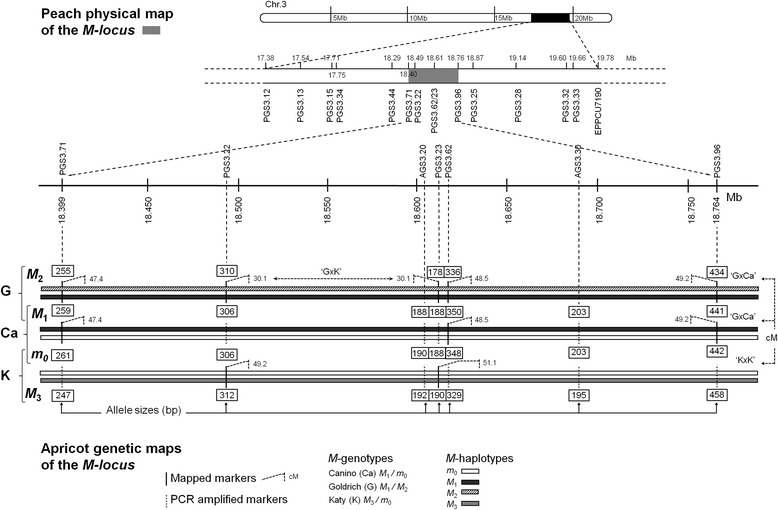
Apricot (Prunus armeniaca L.) exhibits a gametophytic self-incompatibility (GSI) system and it is mostly considered as a self-incompatible species though numerous self-compatible exceptions occur. These are mainly linked to the mutated S -haplotype carrying an insertion in the S-locus F-box gene that leads to a truncated protein. However, two S-locus unlinked pollen-part mutations (PPMs) termed m and m' have also been reported to confer self-compatibility (SC) in the apricot cultivars 'Canino' and 'Katy', respectively. This work was aimed to explore whether other additional mutations might explain SC in apricot as well.
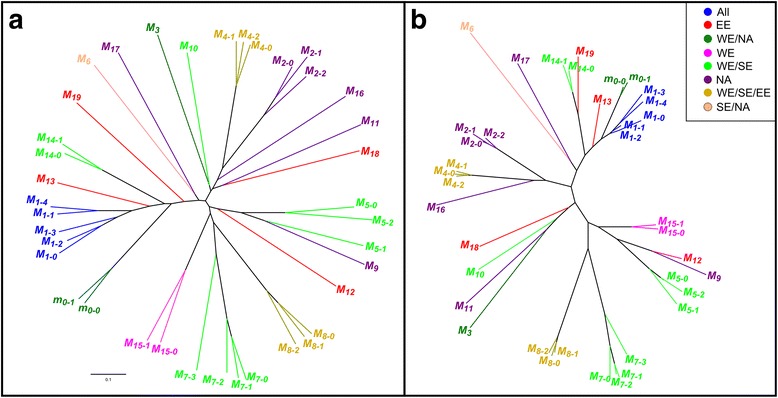
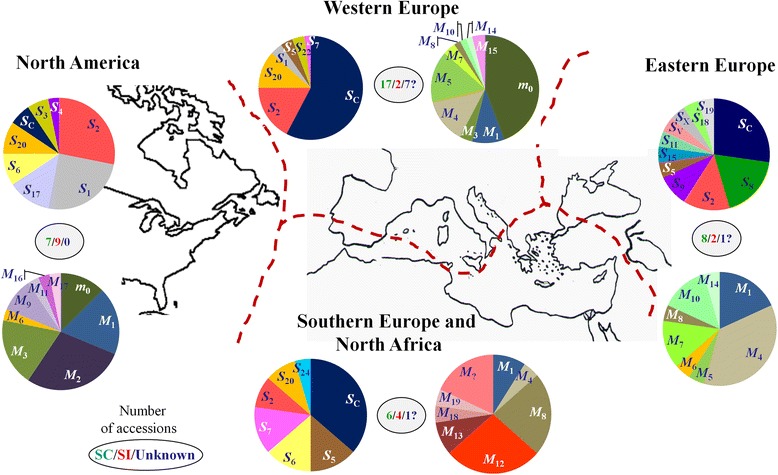
A set of 67 cultivars/accessions with different geographic origins were analyzed by PCR-screening of the S- and M-loci genotypes, contrasting results with the available phenotype data. Up to 20 S-alleles, including 3 new ones, were detected and sequence analysis revealed interesting synonymies and homonymies in particular with S-alleles found in Chinese cultivars. Haplotype analysis performed by genotyping and determining linkage-phases of 7 SSR markers, showed that the m and m' PPMs are linked to the same m haplotype. Results indicate that m -haplotype is tightly associated with SC in apricot germplasm being quite frequent in Europe and North-America. However, its prevalence is lower than that for S in terms of frequency and geographic distribution. Structures of 34 additional M-haplotypes were inferred and analyzed to depict phylogenetic relationships and M was found to be the closest haplotype to m Genotyping results showed that four cultivars classified as self-compatible do not have neither the S - nor the m -haplotype.
According to apricot germplasm S-genotyping, a loss of genetic diversity affecting the S-locus has been produced probably due to crop dissemination. Genotyping and phenotyping data support that self-(in)compatibility in apricot relies mainly on the S- but also on the M-locus. Regarding this latter, we have shown that the m -haplotype associated with SC is shared by 'Canino', 'Katy' and many other cultivars. Its origin is still unknown but phylogenetic analysis supports that m arose later in time than S from a widely distributed M-haplotype. Lastly, other mutants putatively carrying new mutations conferring SC have also been identified deserving future research.
杏(Prunus armeniaca L.)表现出配子体自交不亲和(GSI)系统,尽管存在许多自交亲和的例外情况,但它大多被认为是自交不亲和物种。这些例外主要与携带S位点F-box基因插入的突变S单倍型有关,该插入导致蛋白质截短。然而,也有报道称两个与S位点不连锁的花粉部分突变(PPMs),分别称为m和m',可使杏品种‘Canino’和‘Katy’具有自交亲和性(SC)。这项工作旨在探索是否还有其他额外的突变也能解释杏的自交亲和性。
通过对S和M位点基因型进行PCR筛选,分析了一组67个具有不同地理来源的品种/种质,并将结果与现有的表型数据进行对比。共检测到多达20个S等位基因,包括3个新的等位基因,序列分析揭示了有趣的同义性和同音性,特别是与中国品种中发现的S等位基因。通过对7个SSR标记进行基因分型并确定连锁阶段进行单倍型分析,结果表明m和m' PPMs与同一个m单倍型连锁。结果表明,m单倍型与杏种质中的自交亲和性紧密相关,在欧洲和北美相当常见。然而,就频率和地理分布而言,其普遍性低于S单倍型。推断并分析了另外34个M单倍型的结构,以描绘系统发育关系,发现M是与m最接近的单倍型。基因分型结果表明,四个被归类为自交亲和的品种既没有S单倍型也没有m单倍型。
根据杏种质的S基因分型,可能由于作物传播导致影响S位点的遗传多样性丧失。基因分型和表型数据支持,杏的自交(不)亲和性主要依赖于S位点,但也依赖于M位点。关于后者,我们已经表明,与自交亲和性相关的m单倍型在‘Canino’、‘Katy’和许多其他品种中都有。其起源仍然未知,但系统发育分析支持m比S从一个广泛分布的M单倍型中出现的时间更晚。最后,还鉴定出了其他可能携带赋予自交亲和性新突变的突变体,值得未来进一步研究。