Bao Li, Chen Mingzhi, Lei Yong, Zhou Zemin, Shen Huiping, Le Feng
Department of Pediatrics Department of Thoracic Surgery Department of Protection, Affiliated Yixing People Hospital, Jiangsu University, Yixing, China.
Medicine (Baltimore). 2017 Apr;96(17):e6718. doi: 10.1097/MD.0000000000006718.
Vitamin D and the vitamin D receptor (VDR) are important in the metabolic processes that affect bone mineral density (BMD). However, the effect of VDR BsmI polymorphism on BMD in pediatric patients is still unclear.
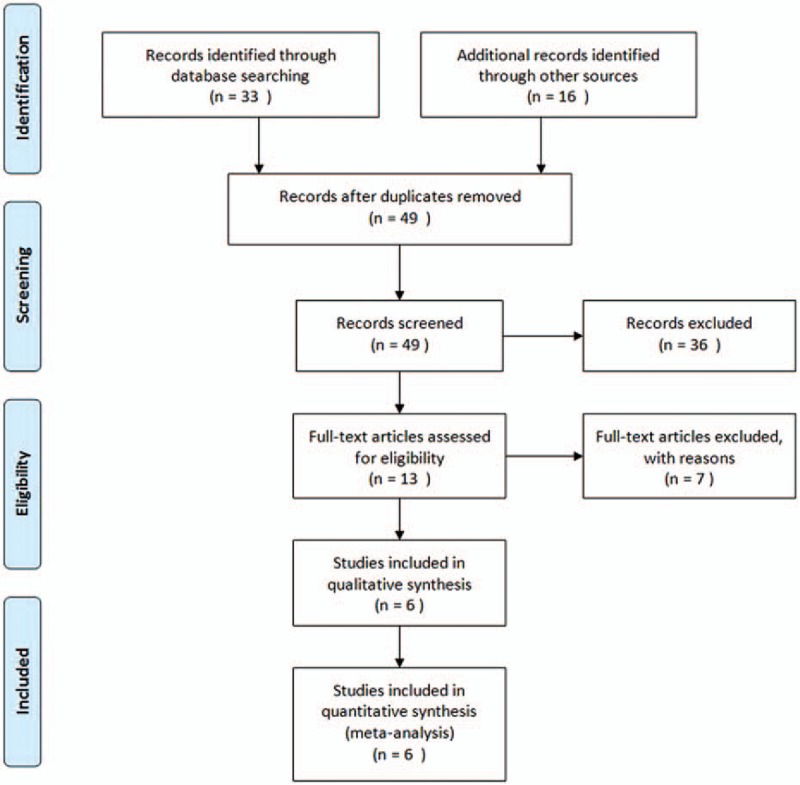
Eligible studies were identified from the following electronic databases: PubMed, Embase, the Cochrane Library, and the Chinese CNKI and Wanfang databases before October 1, 2016. Data were extracted from the eligible studies, and associations between VDR BsmI polymorphism and BMD in pediatric patients were estimated with weighted mean differences (WMDs) and 95% confidence intervals (CIs). Subgroup analysis of ethnicity and sensitivity analyses were used to identify sources of heterogeneity.
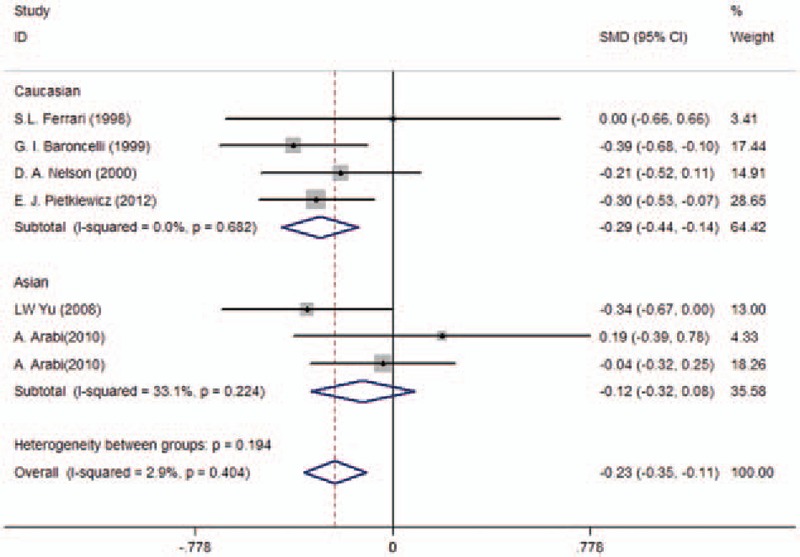
A significant difference was observed between VDR BsmI polymorphism and pediatric BMD levels of the lumbar spine (LS) in the corecessive model (bb vs BB + Bb: WMD = -0.23, 95% CI [-0.35, -0.11], P < 0.01). No significant relationship was found in the dominant, recessive, or codominant models for LS BMD (BB vs Bb: WMD = -0.56, 95% CI [-1.58, 0.46], P = 0.29; BB vs bb: WMD = -0.54, 95% CI [-1.49, 0.41], P = 0.27; and BB vs Bb + bb: WMD = -0.45, 95% CI [-1.71, 0.26], P = 0.22). In addition, we found no remarkable association between the BsmI polymorphism and BMD levels of the femoral neck (FN) in children (BB vs Bb: WMD = -1.08, 95% CI [-3.13, 0.96], P = 0.30; BB vs bb: WMD = 0.98, 95% CI [-0.89, 2.85], P = 0.31; BB vs Bb + bb: WMD = -0.061, 95% CI [-0.30, 0.17], P = 0.61; and bb vs BB + Bb: WMD = 0.82, 95% CI [-0.59, 2.32], P = 0.25).
Our meta-analysis found that the VDR BsmI genetic polymorphism was correlated with LS BMD level in pediatric patients: compared with those with the B allele, children with the bb genotype were less likely to have lower BMD levels. No significant difference was identified in the pediatric FN BMD levels.
维生素D和维生素D受体(VDR)在影响骨密度(BMD)的代谢过程中起重要作用。然而,VDR BsmI基因多态性对儿科患者骨密度的影响仍不清楚。
于2016年10月1日前从以下电子数据库中检索符合条件的研究:PubMed、Embase、Cochrane图书馆以及中国知网和万方数据库。从符合条件的研究中提取数据,并采用加权平均差(WMD)和95%置信区间(CI)评估儿科患者VDR BsmI基因多态性与骨密度之间的关联。采用种族亚组分析和敏感性分析来确定异质性来源。
在共隐性模型中,观察到VDR BsmI基因多态性与儿科腰椎(LS)骨密度水平之间存在显著差异(bb与BB + Bb相比:WMD = -0.23,95% CI [-0.35, -0.11],P < 0.01)。在LS骨密度的显性、隐性或共显性模型中未发现显著相关性(BB与Bb相比:WMD = -0.56,95% CI [-1.58, 0.46],P = 0.29;BB与bb相比:WMD = -0.54,95% CI [-1.49, 0.41],P = 0.27;BB与Bb + bb相比:WMD = -0.45,95% CI [-1.71, 0.26],P = 0.22)。此外,我们发现BsmI基因多态性与儿童股骨颈(FN)骨密度水平之间无显著关联(BB与Bb相比:WMD = -1.08,95% CI [-3.13, 0.96],P = 0.30;BB与bb相比:WMD = 0.98,9% CI [-0.89, 2.85],P = 0.31;BB与Bb + bb相比:WMD = -0.061,95% CI [-0.30, 0.17],P = 0.61;bb与BB + Bb相比:WMD = 0.82,95% CI [-0.59, 2.32],P = 0.25)。
我们的荟萃分析发现,VDR BsmI基因多态性与儿科患者LS骨密度水平相关:与携带B等位基因的患者相比,bb基因型的儿童骨密度水平较低的可能性较小。儿科FN骨密度水平未发现显著差异。