Kuzmanovska Irena, Milias-Argeitis Andreas, Mikelson Jan, Zechner Christoph, Khammash Mustafa
Department of Biosystems Science and Engineering, ETH Zurich, Mattenstrasse 26, Basel, 4058, Switzerland.
Groningen Biomolecular Sciences and Biotechnology, University of Groningen, Nijenborgh 4, Groningen, 9747, AG, Netherlands.
BMC Syst Biol. 2017 Apr 26;11(1):52. doi: 10.1186/s12918-017-0425-1.
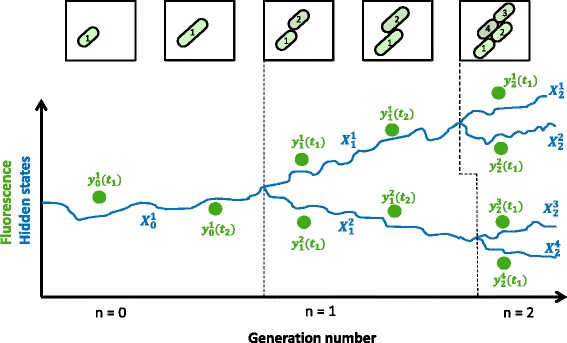
With the advance of experimental techniques such as time-lapse fluorescence microscopy, the availability of single-cell trajectory data has vastly increased, and so has the demand for computational methods suitable for parameter inference with this type of data. Most of currently available methods treat single-cell trajectories independently, ignoring the mother-daughter relationships and the information provided by the population structure. However, this information is essential if a process of interest happens at cell division, or if it evolves slowly compared to the duration of the cell cycle.
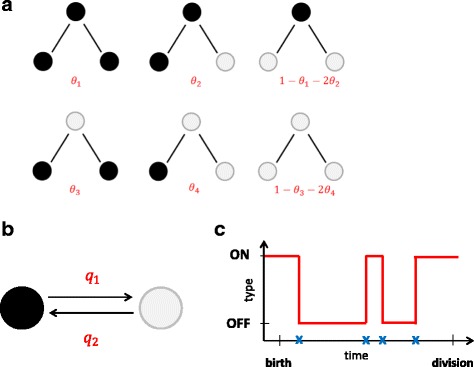
In this work, we propose a Bayesian framework for parameter inference on single-cell time-lapse data from lineage trees. Our method relies on a combination of Sequential Monte Carlo for approximating the parameter likelihood function and Markov Chain Monte Carlo for parameter exploration. We demonstrate our inference framework on two simple examples in which the lineage tree information is crucial: one in which the cell phenotype can only switch at cell division and another where the cell state fluctuates slowly over timescales that extend well beyond the cell-cycle duration.
There exist several examples of biological processes, such as stem cell fate decisions or epigenetically controlled phase variation in bacteria, where the cell ancestry is expected to contain important information about the underlying system dynamics. Parameter inference methods that discard this information are expected to perform poorly for such type of processes. Our method provides a simple and computationally efficient way to take into account single-cell lineage tree data for the purpose of parameter inference and serves as a starting point for the development of more sophisticated and powerful approaches in the future.
随着诸如延时荧光显微镜等实验技术的进步,单细胞轨迹数据的可用性大幅增加,对适用于此类数据参数推断的计算方法的需求也随之增加。目前大多数可用方法独立处理单细胞轨迹,忽略了母女关系以及群体结构提供的信息。然而,如果感兴趣的过程发生在细胞分裂时,或者与细胞周期持续时间相比其演化缓慢,那么这些信息至关重要。
在这项工作中,我们提出了一个用于从谱系树进行单细胞延时数据参数推断的贝叶斯框架。我们的方法依赖于用于近似参数似然函数的序贯蒙特卡罗方法和用于参数探索的马尔可夫链蒙特卡罗方法的组合。我们在两个谱系树信息至关重要的简单示例上展示了我们的推断框架:一个示例中细胞表型仅在细胞分裂时切换,另一个示例中细胞状态在远远超出细胞周期持续时间的时间尺度上缓慢波动。
存在一些生物过程的例子,如干细胞命运决定或细菌中表观遗传控制的相变,其中细胞谱系预计包含有关潜在系统动力学的重要信息期望。丢弃此信息的参数推断方法对于此类过程的表现预计会很差。我们的方法提供了一种简单且计算高效的方式,用于在参数推断时考虑单细胞谱系树数据,并为未来开发更复杂、更强大的方法奠定了基础。