Varricchi Gilda, Galdiero Maria Rosaria, Loffredo Stefania, Marone Giancarlo, Iannone Raffaella, Marone Gianni, Granata Francescopaolo
Department of Translational Medical Sciences (DiSMeT), Center for Basic and Clinical Immunology Research (CISI), University of Naples Federico II, Naples, Italy.
Department of Public Health, University of Naples Federico II, Monaldi Hospital Pharmacy, Naples, Italy.
Front Immunol. 2017 Apr 12;8:424. doi: 10.3389/fimmu.2017.00424. eCollection 2017.
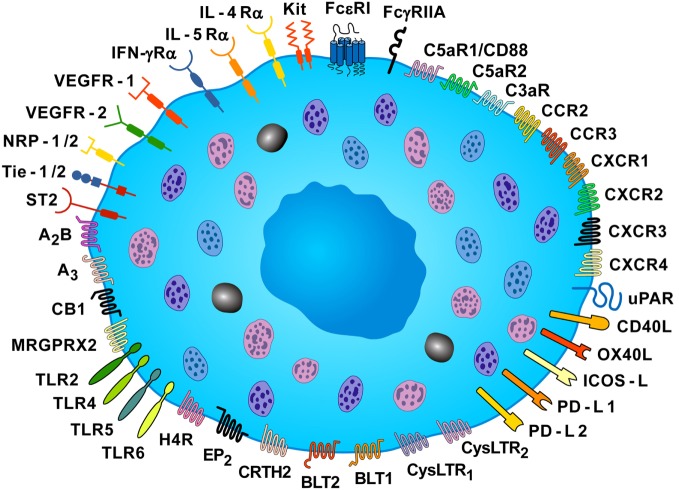
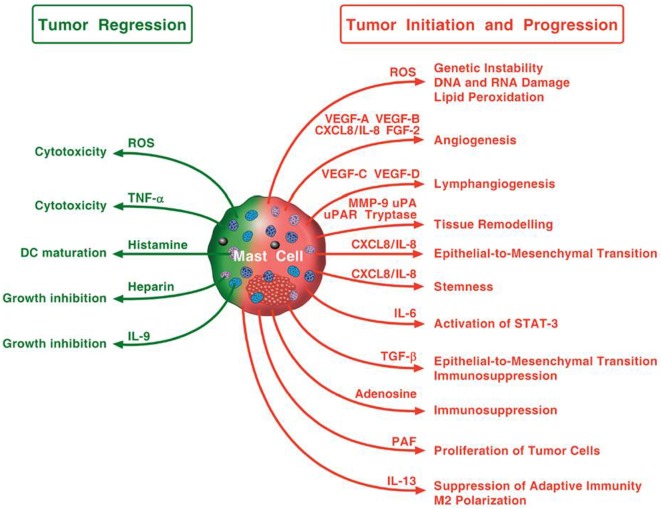
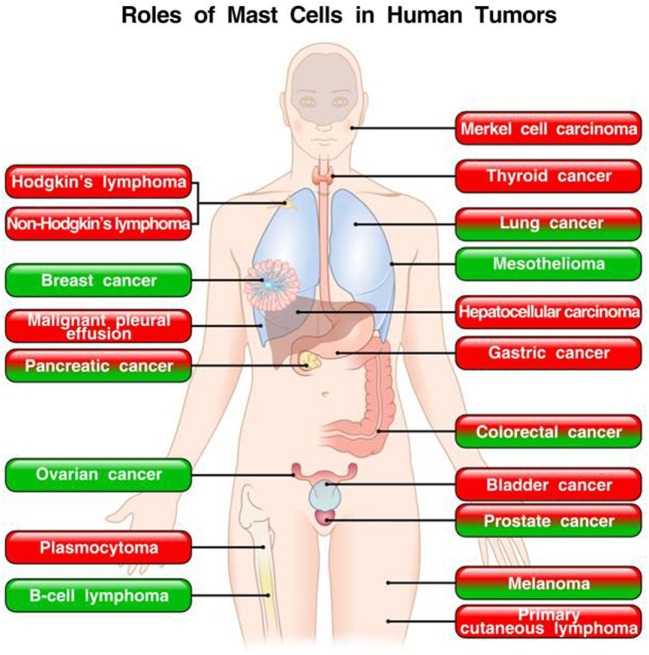
Prolonged low-grade inflammation or smoldering inflammation is a hallmark of cancer. Mast cells form a heterogeneous population of immune cells with differences in their ultra-structure, morphology, mediator content, and surface receptors. Mast cells are widely distributed throughout all tissues and are stromal components of the inflammatory microenvironment that modulates tumor initiation and development. Although canonically associated with allergic disorders, mast cells are a major source of pro-tumorigenic (e.g., angiogenic and lymphangiogenic factors) and antitumorigenic molecules (e.g., TNF-α and IL-9), depending on the milieu. In certain neoplasias (e.g., gastric, thyroid and Hodgkin's lymphoma) mast cells play a pro-tumorigenic role, in others (e.g., breast cancer) a protective role, whereas in yet others they are apparently innocent bystanders. These seemingly conflicting results suggest that the role of mast cells and their mediators could be cancer specific. The microlocalization (e.g., peritumoral vs intratumoral) of mast cells is another important aspect in the initiation/progression of solid and hematologic tumors. Increasing evidence in certain experimental models indicates that targeting mast cells and/or their mediators represent a potential therapeutic target in cancer. Thus, mast cells deserve focused consideration also as therapeutic targets in different types of tumors. There are many unanswered questions that should be addressed before we understand whether mast cells are an ally, adversary, or innocent bystanders in human cancers.
持续性低度炎症或隐匿性炎症是癌症的一个标志。肥大细胞构成了一类异质性免疫细胞群体,它们在超微结构、形态、介质含量和表面受体方面存在差异。肥大细胞广泛分布于所有组织中,是炎症微环境的基质成分,可调节肿瘤的发生和发展。尽管传统上认为肥大细胞与过敏性疾病有关,但根据环境的不同,肥大细胞是促肿瘤(如血管生成和淋巴管生成因子)和抗肿瘤分子(如TNF-α和IL-9)的主要来源。在某些肿瘤(如胃癌、甲状腺癌和霍奇金淋巴瘤)中,肥大细胞发挥促肿瘤作用;在其他肿瘤(如乳腺癌)中,肥大细胞发挥保护作用;而在另外一些肿瘤中,它们显然是无辜的旁观者。这些看似相互矛盾的结果表明,肥大细胞及其介质的作用可能具有癌症特异性。肥大细胞的微定位(如肿瘤周围与肿瘤内)是实体瘤和血液系统肿瘤发生/进展中的另一个重要方面。某些实验模型中越来越多的证据表明,靶向肥大细胞和/或其介质是癌症潜在的治疗靶点。因此,肥大细胞作为不同类型肿瘤的治疗靶点也值得重点关注。在我们了解肥大细胞在人类癌症中是盟友、对手还是无辜旁观者之前,有许多未解决的问题需要解决。