Department of Social and Preventive Medicine, University of Montreal, Canada.
Bordeaux Population Health Research Centre, INSERM U1219 and University of Bordeaux, Bordeaux, France.
Int J Methods Psychiatr Res. 2017 Dec;26(4). doi: 10.1002/mpr.1566. Epub 2017 Apr 27.
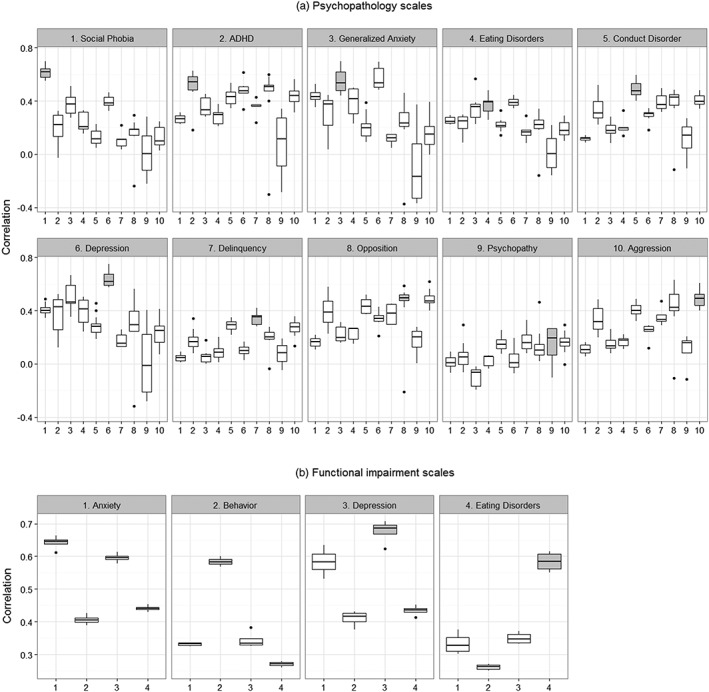
We report on the psychometric properties of the Mental Health and Social Inadaptation Assessment for Adolescents (MIA), a self-report instrument for quantifying the frequency of mental health and psychosocial adaptation problems using a dimensional approach and based on the DSM-5. The instrument includes 113 questions, takes 20-25 minutes to answer, and covers the past 12 months. A population-based cohort of adolescents (n = 1443, age = 15 years; 48% males) rated the frequency at which they experienced symptoms of Attention Deficit Hyperactivity Disorder (ADHD), Conduct Disorder, Oppositional Defiant Disorder, Depression, Generalized Anxiety, Social Phobia, Eating Disorders (i.e. DSM disorders), Self-harm, Delinquency, Psychopathy as well as social adaptation problems (e.g. aggression). They also rated interference with functioning in four contexts (family, friends, school, daily life). Reliability analyses indicated good to excellent internal consistency for most scales (alpha = 0.70-0.97) except Psychopathy (alpha = 0.46). The hypothesized structure of the instrument showed acceptable fit according to confirmatory factor analysis (CFA) [Chi-square (4155) = 9776.2, p = 0.000; Chi-square/DF = 2.35; root mean square error of approximation (RMSEA) = 0.031; Comparative Fit Index (CFI) = 0.864], and good convergent and discriminant validity according to multitrait-multimethods analysis. This initial study showed adequate internal validity and reliability of the MIA. Our findings open the way for further studies investigating other validity aspects, which are necessary before recommending the wide use of the MIA in research and clinical settings.
我们报告了青少年心理健康和社会适应评估量表(MIA)的心理测量学特性,这是一种自我报告工具,采用维度方法和基于 DSM-5 来量化心理健康和心理社会适应问题的频率。该工具包括 113 个问题,回答时间为 20-25 分钟,涵盖过去 12 个月。我们对一个基于人群的青少年队列(n=1443,年龄=15 岁;48%为男性)进行了调查,让他们评估自己在过去 12 个月中经历注意力缺陷多动障碍(ADHD)、品行障碍、对立违抗性障碍、抑郁、广泛性焦虑、社交恐惧症、饮食障碍(即 DSM 障碍)、自残、犯罪行为以及社会适应问题(如攻击性)的频率。他们还评估了这些症状在四个情境(家庭、朋友、学校、日常生活)中对功能的干扰程度。可靠性分析表明,大多数量表的内部一致性良好到优秀(alpha=0.70-0.97),除了精神病态(alpha=0.46)。根据验证性因素分析(CFA),该工具的假设结构显示出可接受的拟合度[卡方(4155)=9776.2,p=0.000;卡方/DF=2.35;近似均方根误差(RMSEA)=0.031;比较拟合指数(CFI)=0.864],根据多特质-多方法分析,具有良好的收敛和区分效度。这项初步研究表明,MIA 具有足够的内部有效性和可靠性。我们的研究结果为进一步研究其他有效性方面开辟了道路,这是在研究和临床环境中广泛推荐使用 MIA 之前所必需的。