Fernandez Fabian, Nyhuis Casandra C, Anand Payal, Demara Bianca I, Ruby Norman F, Spanò Goffredina, Clark Caron, Edgin Jamie O
Departments of Psychology and Neurology, BIO5 Institute, University of Arizona, Tucson, USA; Evelyn F. McKnight Brain Institute, University of Arizona, Tucson, USA.
Department of Psychology, University of Arizona, Tucson, USA; Sonoran University Center for Excellence in Developmental Disabilities, University of Arizona, Tucson, USA.
Sleep Med. 2017 May;33:134-144. doi: 10.1016/j.sleep.2016.12.026. Epub 2017 Feb 10.
To evaluate sleep consolidation and circadian activity rhythms in infants and toddlers with Down syndrome (DS) under light and socially entrained conditions within a familiar setting. Given previous human and animal data suggesting intact circadian regulation of melatonin across the day and night, it was hypothesized that behavioral indices of circadian rhythmicity would likewise be intact in the sample with DS.
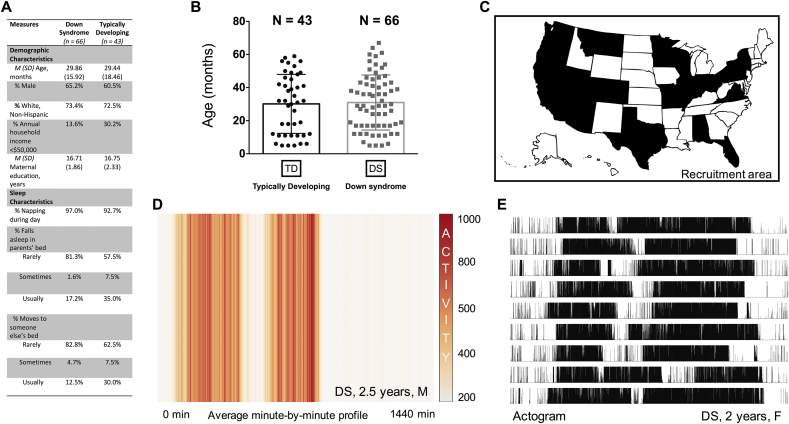
A cross-sectional study of 66 infants and young children with DS, aged 5-67 months, and 43 typically developing age-matched controls. Sleep and measures of circadian robustness or timing were quantified using continuous in-home actigraphy recordings performed over seven days. Circadian robustness was quantified via time series analysis of rest-activity patterns. Phase markers of circadian timing were calculated alongside these values. Sleep efficiency was also estimated based on the actigraphy recordings.
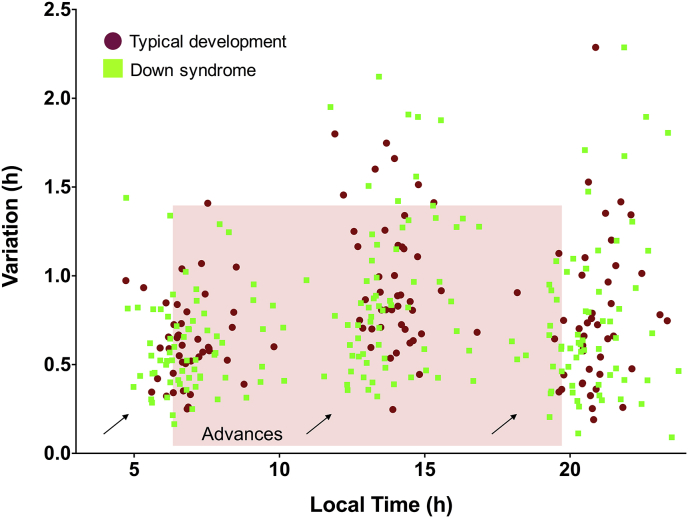
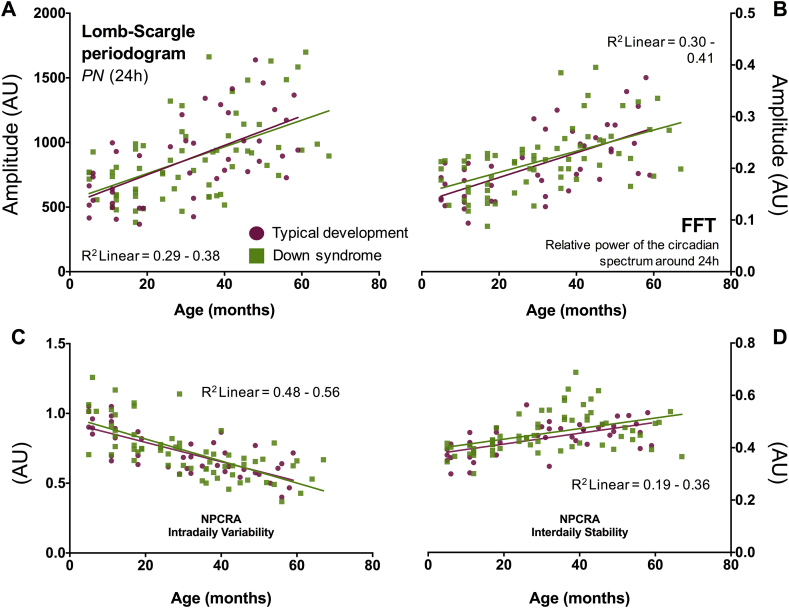
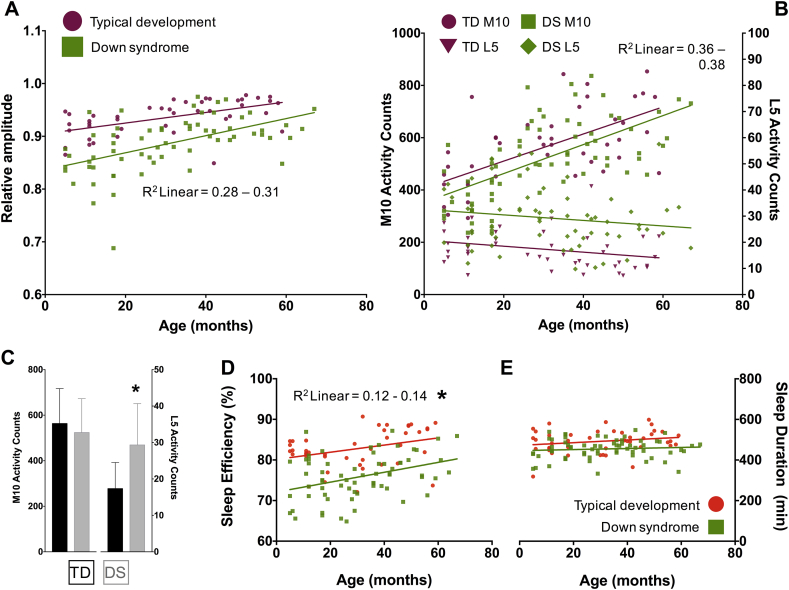
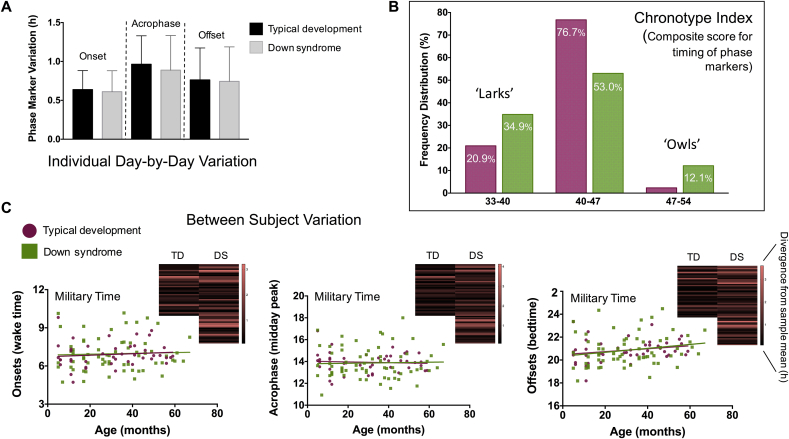
This study provided further evidence that general sleep quality is poor in infants and toddlers with DS, a population that has sleep apnea prevalence as high as 50% during the preschool years. Despite poor sleep quality, circadian rhythm and phase were preserved in children with DS and displayed similar developmental trajectories in cross-sectional comparisons with a typically developing (TD) cohort. In line with past work, lower sleep efficiency scores were quantified in the group with DS relative to TD children. Infants born with DS exhibited the worst sleep fragmentation; however, in both groups, sleep efficiency and consolidation increased across age. Three circadian phase markers showed that 35% of the recruitment sample with DS was phase-advanced to an earlier morning schedule, suggesting significant within-group variability in the timing of their daily activity rhythms.
Circadian rhythms of wake and sleep are robust in children born with DS. The present results suggest that sleep fragmentation and any resultant cognitive deficits are likely not confounded by corresponding deficits in circadian rhythms.
在熟悉的环境中,评估唐氏综合征(DS)婴幼儿在光照和社交诱导条件下的睡眠巩固及昼夜活动节律。鉴于之前的人类和动物数据表明褪黑素的昼夜节律调节完整,因此推测DS样本中昼夜节律的行为指标同样完整。
对66名年龄在5 - 67个月的DS婴幼儿和43名年龄匹配的发育正常的对照儿童进行横断面研究。使用连续7天的家庭活动记录仪记录来量化睡眠以及昼夜节律稳定性或时间安排的指标。通过对休息 - 活动模式的时间序列分析来量化昼夜节律稳定性。同时计算昼夜时间安排的相位标记。还根据活动记录仪记录估计睡眠效率。
本研究进一步证明,DS婴幼儿的总体睡眠质量较差,该群体在学龄前睡眠呼吸暂停患病率高达50%。尽管睡眠质量差,但DS患儿的昼夜节律和相位得以保留,并且在与发育正常(TD)队列的横断面比较中显示出相似的发育轨迹。与以往研究一致,相对于TD儿童,DS组的睡眠效率得分较低。患有DS的婴儿睡眠碎片化最严重;然而,在两组中,睡眠效率和巩固程度均随年龄增长而提高。三个昼夜相位标记显示,35%的DS招募样本相位提前至更早的早晨时间表,表明其日常活动节律时间存在显著的组内变异性。
患有DS的儿童清醒和睡眠的昼夜节律较强。目前的结果表明,睡眠碎片化以及由此产生的任何认知缺陷可能不会因昼夜节律的相应缺陷而混淆。