EMBL Australia Node in Single Molecule Science, School of Medical Sciences, University of New South Wales, Sydney, New South Wales 2052, Australia.
ARC Centre of Excellence in Advanced Molecular Imaging, University of New South Wales, Sydney, New South Wales 2052, Australia.
Nat Commun. 2017 Apr 28;8:15100. doi: 10.1038/ncomms15100.
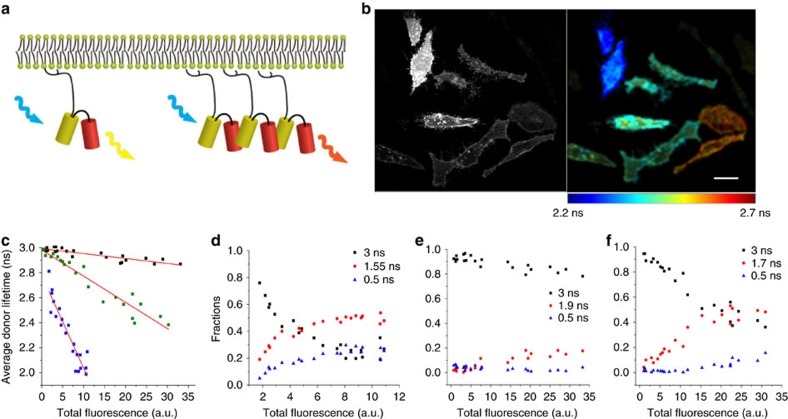
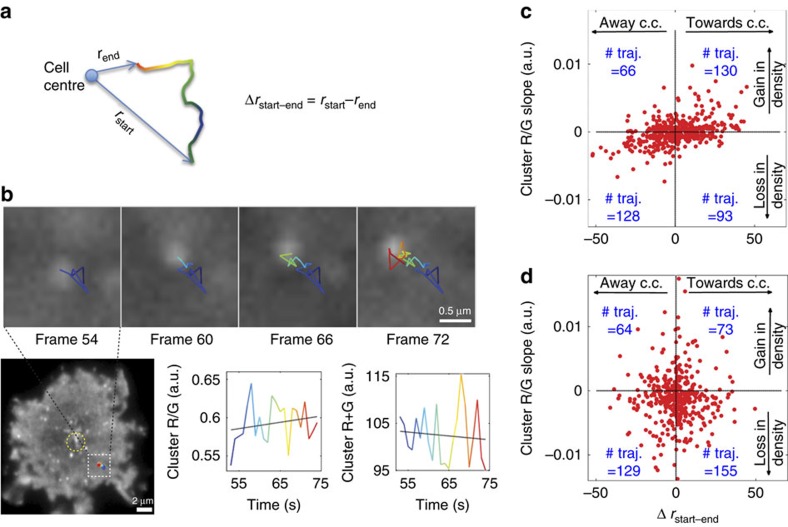
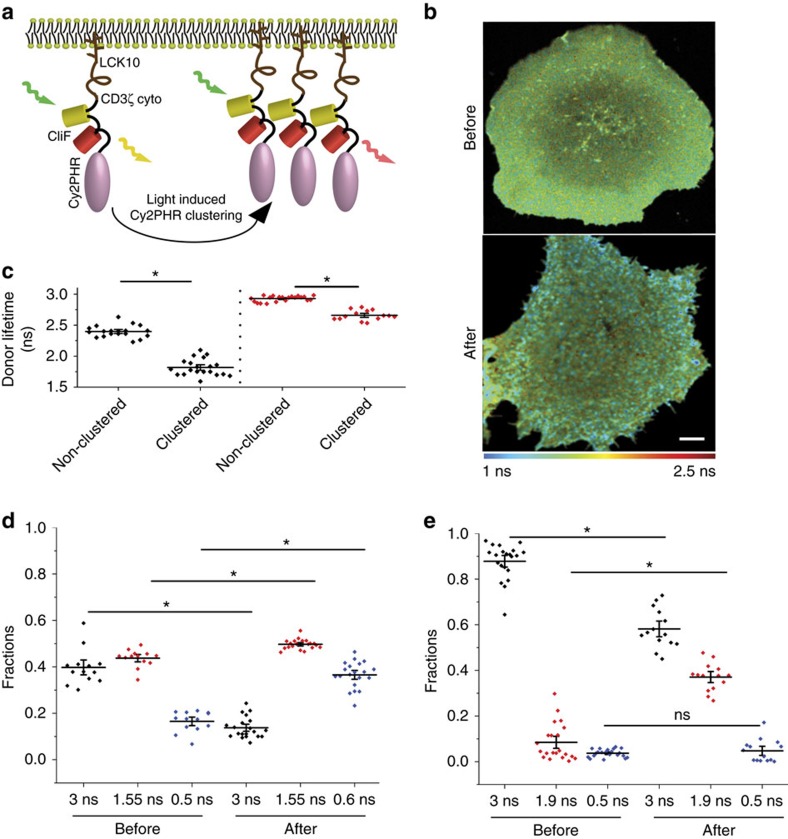
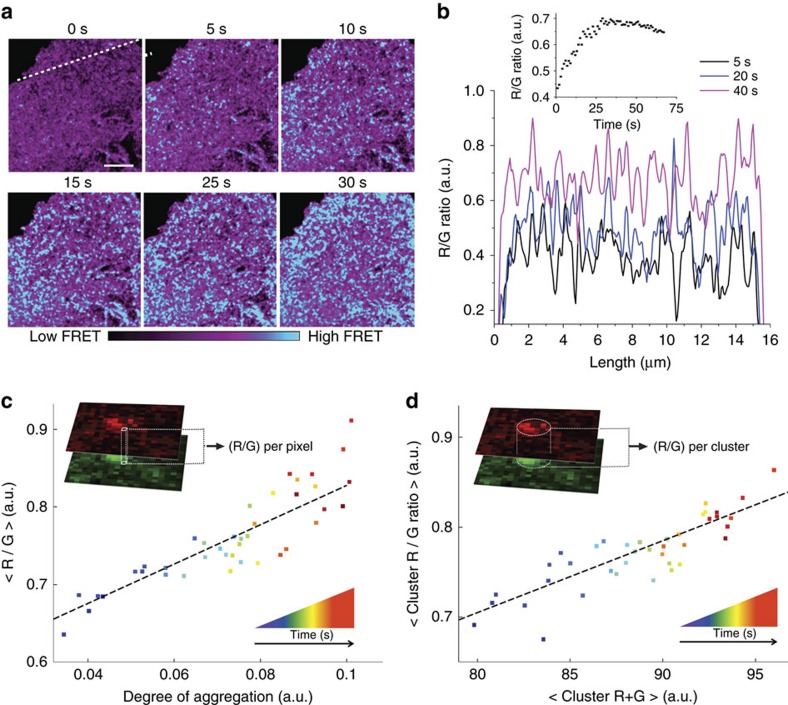
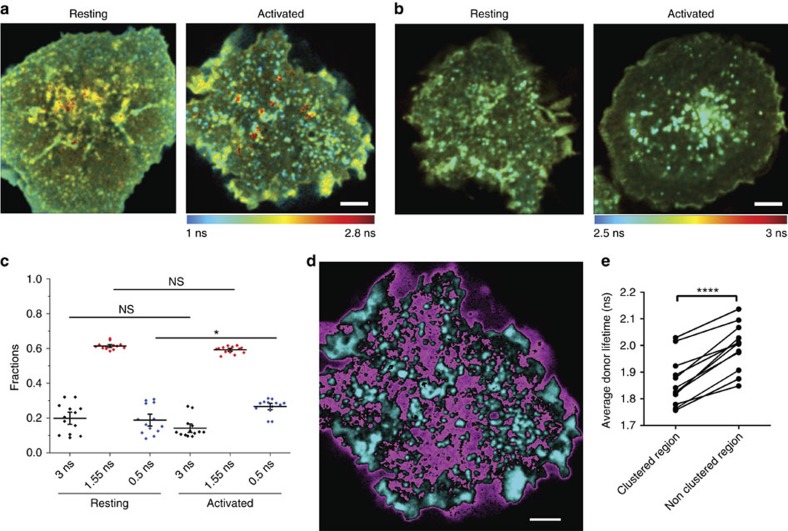
Clustering of the T-cell receptor (TCR) is thought to initiate downstream signalling. However, the detection of protein clustering with high spatial and temporal resolution remains challenging. Here we establish a Förster resonance energy transfer (FRET) sensor, named CliF, which reports intermolecular associations of neighbouring proteins in live cells. A key advantage of the single-chain FRET sensor is that it can be combined with image correlation spectroscopy (ICS), single-particle tracking (SPT) and fluorescence lifetime imaging microscopy (FLIM). We test the sensor with a light-sensitive actuator that induces protein aggregation upon radiation with blue light. When applied to T cells, the sensor reveals that TCR triggering increases the number of dense TCR-CD3 clusters. Further, we find a correlation between cluster movement within the immunological synapse and cluster density. In conclusion, we develop a sensor that allows us to map the dynamics of protein clustering in live T cells.
T 细胞受体 (TCR) 的聚类被认为可以启动下游信号转导。然而,高时空分辨率下蛋白质聚类的检测仍然具有挑战性。在这里,我们建立了一种Förster 共振能量转移 (FRET) 传感器,命名为 CliF,它可以在活细胞中报告相邻蛋白质的分子间相互作用。这种单链 FRET 传感器的一个关键优势是它可以与图像相关光谱 (ICS)、单粒子跟踪 (SPT) 和荧光寿命成像显微镜 (FLIM) 结合使用。我们用一种光敏激活物对传感器进行了测试,这种激活物在蓝光照射下会诱导蛋白质聚集。当应用于 T 细胞时,该传感器表明 TCR 触发会增加密集 TCR-CD3 簇的数量。此外,我们还发现免疫突触内的簇运动与簇密度之间存在相关性。总之,我们开发了一种传感器,可以在活 T 细胞中绘制蛋白质聚类的动力学图谱。