Elemike Elias E, Onwudiwe Damian C, Ekennia Anthony C, Sonde Christopher U, Ehiri Richard C
Material Science Innovation and Modelling (MaSIM) Research Focus Area, Faculty of Agriculture, Science and Technology, North-West University (Mafikeng Campus), Private Bag X2046, Mmabatho 2357, South Africa.
Department of Chemistry, School of Mathematical and Physical Sciences, North-West University (Mafikeng Campus), Mmabatho 2735, South Africa.
Molecules. 2017 Apr 28;22(5):674. doi: 10.3390/molecules22050674.
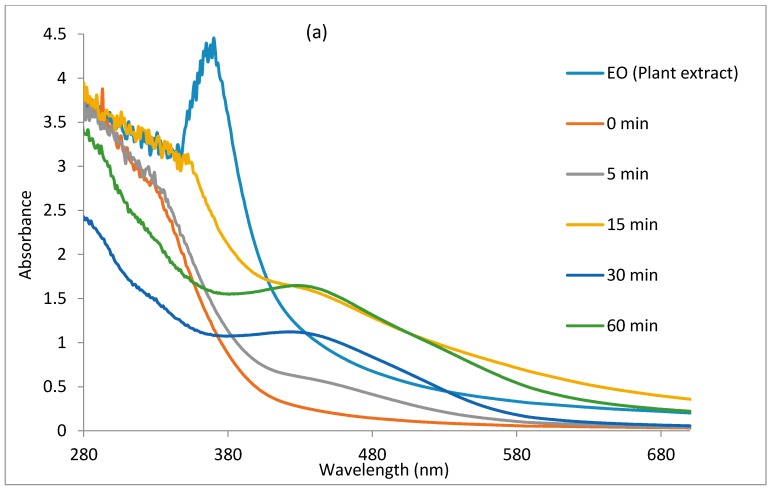
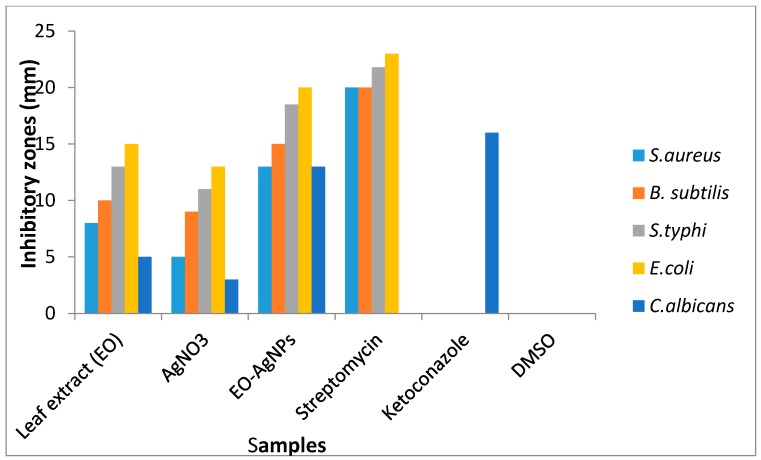
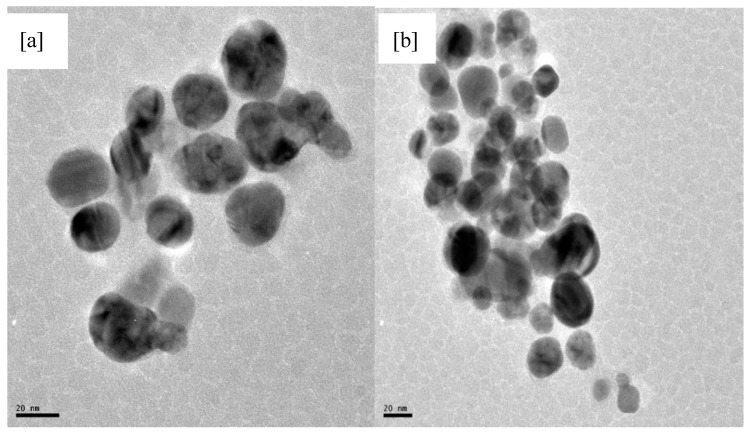
The health challenges associated with pathogens and ectoparasites highlight the need for effective control approaches. Metal nanoparticles have been proposed as highly effective tools towards combatting different microbial organisms and parasites. The present work reports the antimicrobial and larvicidal potential of biosynthesized Ag/Ag₂O nanoparticles using aqueous leaf extract of (EO). The constituents of the leaf extract act as both reducing and stabilizing agents. The UV-VIS spectra of the nanoparticles showed surface plasmon resonance. The particle size and shape of the nanoparticles was analysed by transmission electron microscopy (TEM). The larvicidal study was carried out using third and fourth instar larvae. The mosquito larvae were exposed to varying concentrations of plant extract (EO) and the synthesized nanoparticles, and their percentage of mortality was accounted for at different time intervals of 12 h and 24 h periods of exposure. The nanoparticles were more lethal against third and fourth instars of larvae at the 24 h period of exposure with lower lethal concentration values (LC50 = 95.9 ppm; LC90 = 337.5 ppm) and (LC50 = 166.4 ppm; LC90 = 438.7 ppm) compared to the plant extract (LC50 = 396.8 ppm; LC90 = 716.8 ppm and LC50 = 448.3 ppm; LC90 = 803.9 ppm, respectively). The antimicrobial properties of the nanoparticles were established against different clinically-isolated microbial strains and compared to that of the plant extract (EO) and standard antimicrobial drugs. The nanoparticles were generally more active than the plant extract against the selected microbial organisms. The Gram-negative bacterial strains and were more susceptible towards the nanoparticles compared to the Gram-positive strains and the fungal organism.
与病原体和外寄生虫相关的健康挑战凸显了有效控制方法的必要性。金属纳米颗粒已被提议作为对抗不同微生物和寄生虫的高效工具。本研究报告了使用(某种植物)叶水提取物生物合成的Ag/Ag₂O纳米颗粒的抗菌和杀幼虫潜力。叶提取物的成分既作为还原剂又作为稳定剂。纳米颗粒的紫外-可见光谱显示出表面等离子体共振。通过透射电子显微镜(TEM)分析了纳米颗粒的粒径和形状。使用三龄和四龄(某种蚊虫)幼虫进行杀幼虫研究。将蚊虫幼虫暴露于不同浓度的植物提取物(该植物提取物)和合成的纳米颗粒中,并在暴露12小时和24小时的不同时间间隔记录其死亡率。与植物提取物(LC50 = 396.8 ppm;LC90 = 716.8 ppm和LC50 = 448.3 ppm;LC90 = 803.9 ppm)相比,在暴露24小时时,纳米颗粒对(某种蚊虫)三龄和四龄幼虫的致死性更强,致死浓度值更低(LC50 = 95.9 ppm;LC90 = 337.5 ppm)和(LC50 = 166.4 ppm;LC90 = 438.7 ppm)。确定了纳米颗粒对不同临床分离微生物菌株的抗菌性能,并与植物提取物(该植物提取物)和标准抗菌药物进行了比较。纳米颗粒对所选微生物的活性通常比植物提取物更强。与革兰氏阳性菌株和真菌相比,革兰氏阴性细菌菌株(两种菌株名称未给出)对纳米颗粒更敏感。